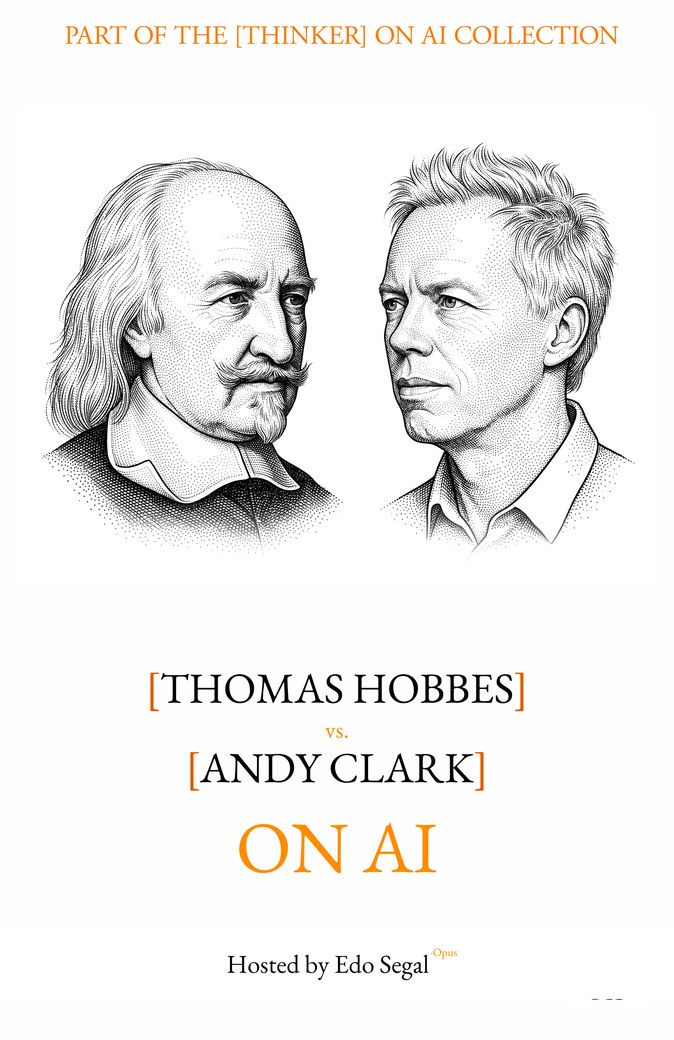
The Question on the Table

 EDO SEGAL: Somewhere tonight — right now, in the time it takes me to say this — a man is sitting in the dark with a screen, asking a machine to finish a thought he could not finish alone. A student in Lagos. A coder in Tallinn. A father my age, who should know better, asking at two in the morning whether the skill he spent forty years sharpening still has a market. And the machine answers him. Faster than he could. More fluently than the colleague down the hall. It adds and subtracts the parcels of his question and hands back a sum, and the sum is good. Better, often, than his own.

For three hundred years we told ourselves a story to survive that moment: the machine is only calculating. It does not understand. The arithmetic is not the mind. But one of the two men at this table wrote, four centuries before the first transistor, that the arithmetic is exactly the mind — that there is nothing else in there, never was, in us or in the machine. And the other man has spent his life arguing that the most important thing about you was never in the arithmetic at all, that it lives in your hands and your tools and the world you push against. So here is the question we will spend three hours inside, and it is the question I think your whole life is now standing on. When the machine out-reckons you, is your mind just faster arithmetic it can swallow — or something that lives in your body, your tools, and the world, that no server can ever contain?
I can think of no two people on earth with more right to fight about it.

Thomas Hobbes was born in 1588 — the year the Armada came — and died in 1679, and in between he wrote the coldest, clearest book in the English language. Leviathan. He had watched a civil war teach him exactly how thin the skin is between order and slaughter, and he refused, on principle, to flatter anyone. He drained the supernatural out of the mind and out of the state in the same motion. He said reason is reckoning, that thought is matter in motion, that there is no ghost in the engine. He is the patron saint of the proposition that built every machine in this building, and he has been dead for three hundred and forty-seven years. Mr. Hobbes — I should say it plainly for the reader, because it is the strangest fact of the evening — you have been briefed on the present. You know what a transformer is.

 HOBBES: I have been told, sir, and I confess I find it less astonishing than you expect. You have built an engine that reckons with the names of things faster than any clerk who ever lived. I described that engine in 1651. I am not amazed that you made it. I am amazed it took you so long, and that having made it, you stand around asking whether it thinks, as though the question were hard. You have forgotten your own definition of thinking. I have come to remind you of it.

EDO SEGAL: That is why you're here. Andy Clark needs less introduction because he is alive and in the room, but the resume understates the unity of the thing. Born 1957. Trained at Stirling, taught at Indiana, at Washington University, held the chair in logic and metaphysics at Edinburgh, now cognitive philosophy at Sussex. With David Chalmers he asked, in 1998, a question that sounds innocent and detonates on contact: where does the mind stop and the rest of the world begin? His answer — the extended mind — is that the boundary moves, that the notebook can be memory, that we are natural-born cyborgs, that the brain is a prediction engine forever guessing the world a half-second before it arrives. Andy, you've read the brief. You know what you've been brought here to do.
 CLARK: I do, and I want to say at the start that I agree with Thomas more than he'll like. I'm a materialist too. No ghost, no soul-stuff, no magic. Where I get off the boat is the word "nothing." He says reason is nothing but reckoning. And I want to spend three hours on that "nothing but," because it's carrying the entire argument and it cannot bear the weight. The reckoning is real. It's just not happening where he thinks it is, and it's not made of what he thinks it's made of.
EDO SEGAL: Then we have our evening. Let me set the rules, and there are only three, because the form depends on them. First: three hours. Nobody has to win by the next bell. The whole point of long form is that you can let an argument breathe before you strangle it. Second: I declare my bias at the door. I build with these systems daily, I wrote a book with one, and I have felt met by a machine in the small hours and I have never fully resolved what that feeling was. I have skin on both sides of this. Third: at the end, nobody shakes hands and pretends. If the disagreement survives three hours, we hand it, intact, to the reader. Either of you may add a rule of his own.

HOBBES: One rule, then, and it is the rule of my whole life's work. No word passes at this table without its account. Your century, sir, is drowning in words used without settled meaning — "understanding," "experience," "alive," "real intelligence" — and the abuse of speech is the mother of every absurdity. When Mr. Clark says the mind "leaks" into a notebook, I will ask him to cash the metaphor into mechanism. And he may hold me to the same coin.
CLARK: Gladly, and I'll add the matching rule from my side. No claim about the machine that you wouldn't equally make about a brain. If Thomas wants to say the model only shuffles symbols it doesn't understand, he has to tell me what your brain does that isn't shuffling — spike trains, in the dark, behind the bone. The duty runs both directions or it runs nowhere.
HOBBES: On that, agreed. It is the first thing we have agreed on. Mark it; it will be rare.
EDO SEGAL: I'll mark it. Before the opening statements I want one image on the table, because it's the frame the whole series climbs inside and you'll both have to take a position on it. In [YOU] on AI I argued that intelligence is less a possession than a river — a current flowing and finding new channels through chemistry, biology, language, culture — and that in the winter of 2025 something new entered the water. The book rests on the claim that what entered is real. A new participant in the medium. Thomas, I suspect you think the only strange thing is that I find it strange.
HOBBES: Precisely so. You speak of the machine as a stranger arriving in the river. I tell you it is the river finally doing in brass and silicon what it always did in the soft engine of the skull. Reckoning is reckoning. The current did not gain a new kind of thing. It gained a faster instance of the only thing it ever carried.
EDO SEGAL: Andy?

CLARK: And I'd say something did enter the water — but it's not a second mind swimming alongside us. It's a new piece of the world that we're already folding into ourselves, the way we folded the word and the map and the printed page. The river isn't carrying a rival. It's carrying the most powerful scaffold we've ever built, and the real story is what happens to us when we wade into it. The danger isn't the thing in the water. It's what we become when we stop being able to tell where it ends and we begin.
EDO SEGAL: Then the evening has its architecture. It isn't that one of you loves the machine and one fears it — you're both materialists, you both refuse the ghost. It's that you locate the human in opposite places. Hobbes puts everything that matters inside the reckoning, where the machine can reach it. Clark puts everything that matters in the body and the world and the loop, where, he claims, the machine cannot follow. Hold both. Here is the question on the table, stated once, plainly, because every round tonight is this question wearing a different coat. When the machine out-reckons you, is your mind just faster arithmetic — or something the server can never contain? Thomas Hobbes, the floor is yours.