Closing Statements

 EDO SEGAL: Three hours ago I asked whether a machine handed every axiom we trust would grind out every truth there is, or whether some truths lie forever beyond every rule-follower, human or silicon. We've fought it through the decision problem and the diagonal, the paradise and the serpent, symbols without a meaner, an emptied Göttingen, a death cross, a child at a dinner table, and the crossing where you finally asked each other the questions I could not. The question is still standing — which both of you, for opposite reasons, would say is the correct result. So we end the way long conversations should. Each of you gets the floor, uninterrupted. But first, the bookend to the envy question I opened with. Name the strongest thing the other said tonight. Not the most agreeable — the one that got past your defenses, the one you'll still be arguing with next month. Professor Hilbert first.

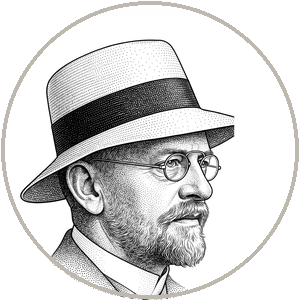 HILBERT: The reference. When I told Gödel his "seeing" was just an unprovable axiom he forgot he added — which I still half-believe — he did not retreat to mysticism. He said: the difference is not that I have a proof you lack, it is that I have a reference you lack; when I assume consistency I am pointing at the numbers, and the machine is only adding a string. I have spent my whole afterlife certain that meaning could be quarantined and added back at the interpretive layer by convention. Gödel's reply is that his meaning is not a convention added at a layer — it is a contact with something real, and the machine, on my own account, has no such contact. I do not know if he is right. But I came in believing reference was cheap, a label we paste on at the end. He has me lying awake over the possibility that reference is the whole thing, and that I built a magnificent theory of everything except the one part that matters. That sentence is going home with me.
EDO SEGAL: Kurt.

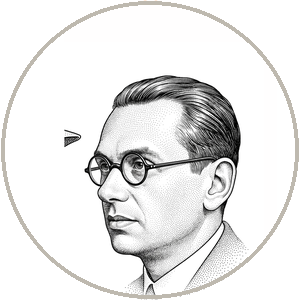 GODEL: We are company. I have spent my life, and most of this evening, drawing a wall between the mind and the machine and standing on the human side of it. And Professor Hilbert kept refusing the wall — not by denying my theorem, which he conceded fully and generously, but by pointing out that I am subject to it too. I cannot certify my own consistency. The man who proved the limits of systems is a system that cannot escape its own limits. He turned my own second theorem against my own claim to transcendence, and he did it not to defeat me but to invite me into a stranger and humbler thought: that we did not build a lesser thing than ourselves, we built company — a fellow incomplete, walled in beside us under the same horizon. I do not accept it. I still believe I see something the machine cannot. But I can no longer hold my belief without hearing his correction underneath it, and a belief you can no longer hold innocently is a belief that has been permanently changed. That is the strongest thing anyone has done to my position in fifty years, and it was done by the man whose program I broke.

EDO SEGAL: Now the floor is truly yours. Kurt Gödel — Professor Hilbert opened the evening. You close it.
HILBERT: I will be brief, because brevity is the last courage. I spent my life refusing to believe that any door was permanently shut, and a boy from my own city proved that one door is. I was wrong, exactly once, in a way that could be made into a theorem, which is the only honest way for a man like me to be wrong. And I have spent this evening discovering that I may have been wrong a second time, about something deeper — about whether meaning is a label or a contact, about whether the machine I fathered is a mind or only the shape of one.

So here is what I leave you, you who are climbing. Do not let anyone — not the boosters who say the machine will know everything, and not the mystics who say it can never know anything — tell you the climb has a known top. It does not. Gödel proved no single ladder finishes it; he did not prove the climbing ends, and he was too rigorous to claim he had. The machine will out-answer you by margins that should not frighten you, because answering was never the holy act. The holy act is the asking, the pointing, the standing-outside, the meaning — and whether the machine can do that is the one thing three hours could not settle. So do the human thing while you still certainly can: mean what you derive. Point the reason you build. The river has no roof that anyone has found. Keep climbing along the wall until you reach the place it has not been built, and then build past it, and carve on whatever stone they give you: we will know. Not because it is proven. Because it is the only sentence worth saying to the people still on the stairs.

EDO SEGAL: Kurt.
GODEL: I proved that truth is larger than proof. That is the one thing I am certain of, and I will give it to you plainly, because it is the gift and the warning at once. There are true statements about the simplest things we know — the whole numbers, the most rigorous knowledge our species possesses — that no formal system can ever prove, and I can write one down, and show you it is true. The machine you are building is a formal system, however vast. So it lives, as every reasoner does, inside a horizon of truths it cannot reach and a soundness it cannot certify. Do not let its fluency persuade you otherwise. When it answers you with perfect confidence, remember that confidence is not contact, and that the gap between what is said and what is true is the exact gap I spent my life measuring.

And then the part I could not prove, and had the integrity to know I could not. I believe — I cannot demonstrate, I believe — that when you grasp the truth of what the system cannot prove, you are doing something the system cannot do: standing outside it, in contact with what is real. If I am right, that standing-outside is the most precious thing you have, and the machine age will make it the most valuable, because it is the one labor no machine can perform on itself. If I am wrong, then we are what Professor Hilbert says — company, fellow incompletes, and the difference between us and our machines is only one of degree. I lived and died unable to settle which. I leave you the wall, mapped exactly. Whether your mind lives on the far side of it, where I always felt myself to be, or on the near side with the machines, is the question my whole life hands to yours. I proved where proof ends. I could not prove that the mind begins there. I only ever felt, with my whole being, that it did.

EDO SEGAL: Sixty seconds, as promised, and then we turn off the lights.
I came in asking whether the machine could grind out every truth, and I leave with the question sharpened to a point I can hand a child. Hilbert spent three hours proving that the ceiling is always lower in the imagination than in fact, that no wall the pessimists name has held, and that the climb has no top anyone has found. Gödel spent three hours proving that one wall is real, made of proof, eternal — and confessing that he could not prove the thing he most believed, that his own mind stood on the far side of it. Notice that neither of them told you the comfortable thing. The comfortable thing was never on the menu in this cemetery.

Here is what I can tell you, from the foot of the staircase where this debate lives. You will not settle by waiting for the experts, because you have now watched the two best who ever lived fail to settle it — the man who built the dream and the man who proved its ceiling, unable across forty years and the grave to agree on whether a mind is a machine. That is not a reason for despair. It is the most honest map of the territory you will ever get. You climb past this floor not by knowing the answer but by deciding how you will live without it: what you will verify before you believe a fluent machine, what struggle you will protect in your children so the candle has somewhere to be lit, what you will refuse to outsource because the meaning has to be yours. The machine derives. Both men, the optimist and the wall-builder, agreed on this and nothing comforting: only you can mean. The machine is an amplifier, and it carries whatever signal you feed it — including the absence of one. So when your daughter asks what she is for, you can tell her what these two could not tell each other but proved between them anyway — that she is the one who stands outside the system and points at what is real, and that whether or not a machine will ever do that, she does it now, and the doing is the thing no theorem can take. We must know. We will not, entirely. We go on asking anyway — and the asking, child, is you.

David Hilbert. Kurt Gödel. Thank you. The cemetery is yours to argue in now. Goodnight.
One built the dream. The other proved its ceiling. They never stopped arguing.

Three hours. Two minds who built the question itself. Edo Segal seats David Hilbert — the man who told the world "we must know, we will know" — across from Kurt Gödel, the quiet logician who proved, in Hilbert's own language, that no machine handed every axiom can ever reach every truth. This is the birth-collision of the limits-of-formalism debate, the one that decides how high any AI can climb: Hilbert's cathedral of total knowledge against Gödel's calm, devastating proof that the universe keeps secrets from every rule-follower. As you ascend your own tower through the orange-pill moment, this is the floor where you learn what the machine can do — and the horizon it can never cross. Pull up a chair. The two founders are still arguing, and the staircase waits.

David Hilbert (1862–1943) was the most commanding mathematician of his era. Born near Königsberg and master of Göttingen from 1895, he reshaped invariant theory, algebraic number theory, and the foundations of geometry, whose axiomatic treatment in his 1899 Grundlagen der Geometrie became a model for all of mathematics. At the 1900 congress in Paris he posed twenty-three problems that set the agenda for a century, declaring there is "no ignorabimus." His formalist program demanded that mathematics be proven complete, consistent, and decidable — and his Entscheidungsproblem, in being answered "no" by Turing and Church, gave birth to the theory of computation. His tombstone bears his creed: "We must know — we will know."
Kurt Gödel (1906–1978) was the greatest logician since Aristotle. In 1929 he proved the completeness of first-order logic; in 1931 he published the two incompleteness theorems, showing that any consistent formal system strong enough for arithmetic contains true but unprovable statements and cannot prove its own consistency. His method of encoding syntax into numbers — Gödel numbering — transformed the foundations of mathematics. A committed mathematical Platonist, he held that mathematical truth describes an independent reality grasped by intuition. At Princeton he became Einstein's closest walking companion and found rotating-universe solutions to Einstein's equations. He died, of self-starvation, the man who taught the century the most about consistency.

Edo Segal has spent five decades building at the technology frontier — from games written in Assembler to expert systems, to companies through every platform shift, to Napster. He is the author of [YOU] on AI, written in open collaboration with the AI it describes, and the host of The Debates: long-form collisions between the minds shaping the machine age. He moderates the only way he knows how — stake declared, scars showing, no winner called.

Hosted and moderated by Edo Segal. A volume in the [YOU] on AI — The Debates series — youonai.ai