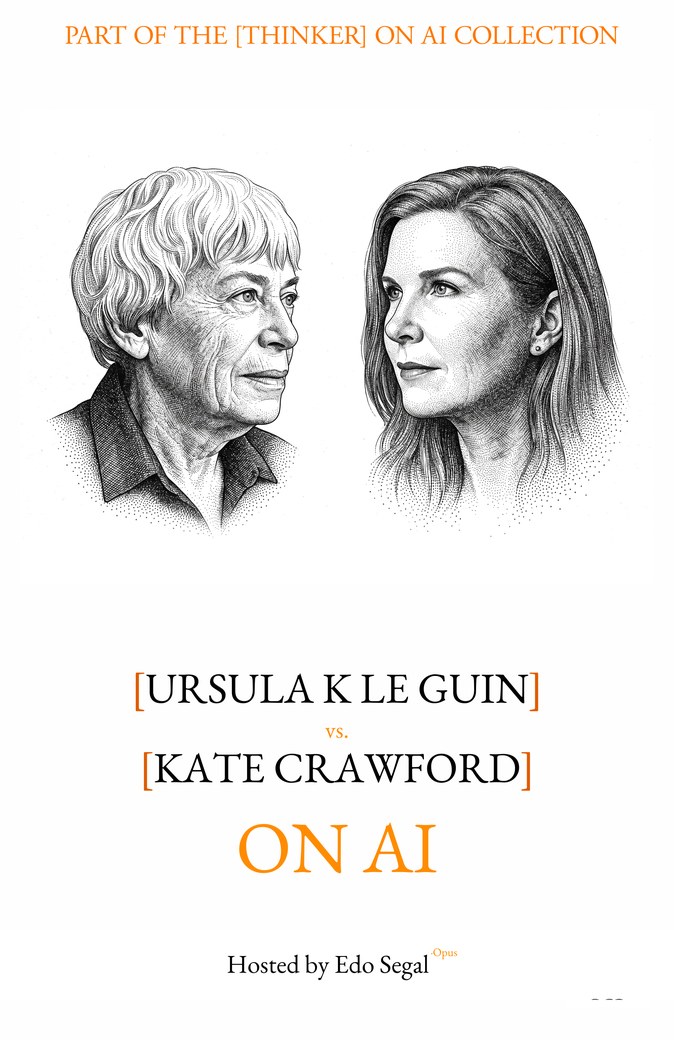
The Question on the Table

 EDO SEGAL: Somewhere right now, in the time it takes me to say this sentence, a child in a classroom is asking a machine to write her essay, and a man in a warehouse is being timed to the second by a system he helped train, and a woman in Nevada is watching a salt flat she grew up beside turn into a grid of turquoise evaporation ponds because the world has decided it needs the lithium underneath. Three people. One machine. And the machine answers the child so fluently, and disciplines the worker so smoothly, and dries the salt flat so quietly, that none of the three would ever guess they were touching the same object. That is the magic trick we are here to ruin tonight.

Because the trick has two solvents, and I have invited the two people who invented them. One of you breaks the spell by telling a better story. The other breaks it by refusing story altogether and walking to the back of the stage to follow the wire. And the question I want to live inside for three hours, the question every round tonight is going to be wearing a different coat of, is whether those are two methods or one. To climb past the spell this technology casts over you — must you tell a braver story about the machine? Or must you refuse story altogether and follow the wire back to the lithium mine?
I have wanted this conversation for a long time. Let me introduce my guests, and then I'll set the rules, and then we begin.

Ursula K. Le Guin needs no introduction and will get one anyway, because the scale of it resists summary. For sixty years she wrote the books that taught a culture how to imagine otherwise — Earthsea, The Left Hand of Darkness, The Dispossessed, which she subtitled, with characteristic refusal of comfort, "An Ambiguous Utopia." She gave us the city of Omelas and the child in its basement. She gave us the carrier bag theory of fiction, an argument that the first tool was not the spear but the container. She stood at the National Book Foundation in 2014, eighty-five years old, and told a room full of publishers that "we live in capitalism; its power seems inescapable — but then, so did the divine right of kings." She is the prophet of the imaginative, and I should say plainly, because honesty is the toll at this table: Ursula, you died in January of 2018, before the machine could answer in our own tongue. We have briefed you on the present. You know what a large language model is, you know your own books were fed to it without your leave, and you are reacting to all of it in your own voice. We'll note that once and then never again insult you by mentioning it.

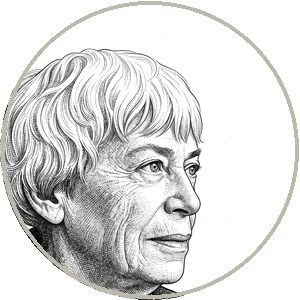 GUIN: Note it and move on. The dead have always been allowed to speak at the council fire, as long as they don't pretend to be alive. I'll keep the bargain.

EDO SEGAL: Kate Crawford is the cartographer of the material. In Atlas of AI she did something almost no one else thought to do: she refused to look at the screen. She walked the supply chain backward — to the lithium in Silver Peak, the cobalt in the Congo, the workers tagging images for pennies, the data scraped from a stranger's vacation photos, the carbon and the water and the cooling towers — and she came back with a sentence that detonates the whole industry's self-image: AI is neither artificial nor intelligent. With Vladan Joler she drew the Anatomy of an AI System, a map that takes a single voice assistant and unfolds it into a planet. With Trevor Paglen she excavated the datasets and found prejudice frozen into the categories that teach machines to see. She is a principal researcher inside one of the largest technology companies on earth, and she has spent years documenting that same industry's costs. She is not a doomsayer and not a booster. She is something rarer.
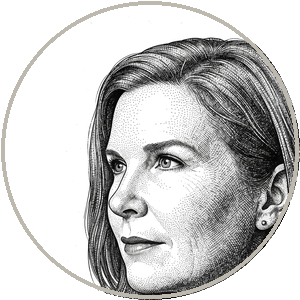 CRAWFORD: I'm the person who reads the footnotes and then goes to find the mine the footnote forgot to mention. Thank you for not calling me a critic. Critics review the show. I'm trying to get backstage.
EDO SEGAL: Everything backstage tonight. So — the rules, and there are only three, because three is the number a thing has to be before it counts as a structure. First: we have three hours, which means nobody wins by the next bell. The whole point of long form is that an argument gets to breathe before anyone strangles it. Second: I declare my bias at the door. I build with these systems daily, I wrote a book with one, I felt the wonder and wrote it down — and I have never once asked where the cobalt came from. I am, in this room, the reader who got enchanted. Press me. Third: if the disagreement survives three hours, we do not paper it over. We hand it to the reader intact, still warm, still dangerous. Either of you may add a rule of your own.

GUIN: One. No one in this room is allowed to say the word "inevitable" without being made to defend it. It's the most expensive word in the language, and people spend it like small change.
CRAWFORD: And mine: every abstraction has to be cashed out in a place. Not "data," but whose data, scraped from where. Not "compute," but which watershed it's drinking. If either of us floats off into the immaterial, the other gets to pull us back to the ground.
EDO SEGAL: You've just described the entire fault line of the evening, and we haven't even started. Because Ursula, your rule is a rule about story — the refusal to let the most powerful story, the story of inevitability, go unchallenged. And Kate, your rule is a rule against story — the refusal to let any story float free of its supply chain. You are both trying to break the same spell. You have brought opposite solvents. Let me put one image on the table before openings, because both of you will have to take a position on it whether you like it or not. In my book I called what happened in 2025 the moment the machine learned our language, and I called intelligence a river finding a new channel. Kate, I suspect you think the river is the problem. Ursula, I suspect you think the river is the answer. Say it in a sentence each, and then we open properly.
CRAWFORD: A river is what you call a thing when you want people to stop asking who dammed it. There's no river. There's a watershed, an owner, a turbine, and a town downstream that didn't get a vote. Call it weather and you'll never look for the people who built it.
GUIN: A river is also the oldest proof we have that water does not ask the rock's permission. Kate is right that someone dammed it. But the dam is a story too — the story that it had to be there, that it has always been there, that it cannot be moved. I spent my life writing the other story. The one where the dam comes down.

EDO SEGAL: I want to sit on your two sentences for one more beat, because the whole evening is folded inside them. Kate, you said there's no river, there's a watershed and an owner and a town that didn't get a vote. Ursula, you said the river is the proof that water doesn't ask the rock's permission. You're using the same word to mean opposite things, and I don't think that's a confusion — I think it's the debate. Kate, in one more sentence: why is calling it a river dangerous even when it's true?
CRAWFORD: Because a true metaphor is the most dangerous kind. If the river were obviously false, no one would be fooled. It's dangerous precisely because intelligence does flow and spread and find channels, so the metaphor feels earned — and that earned feeling smuggles in the part that isn't true, the part that says no one is responsible for where it flows, that it's nature rather than infrastructure. The best lies are ninety percent true. That's what makes them load-bearing.
GUIN: And in my one sentence: it's dangerous to stop telling it, because the moment you concede that intelligence is only ever infrastructure, only ever owned, only ever a thing done to people, you have surrendered the possibility that it could be a commons, a current, a thing that belongs to no one and flows for everyone — and you cannot fight for a world you've forbidden yourself to imagine. Kate guards against the river that drowns. I guard against the drained riverbed, the world so thoroughly mapped as property that no one can remember it was ever wild.
EDO SEGAL: Then we have our three hours. Here is the question once more, plainly, because we'll return to it on every floor: to climb past the spell, do you tell a braver story, or do you follow the wire to the mine? Ursula opened the door; Kate, you've already walked through it. Let's go back to the top. Opening statements. Ursula, the floor is yours.