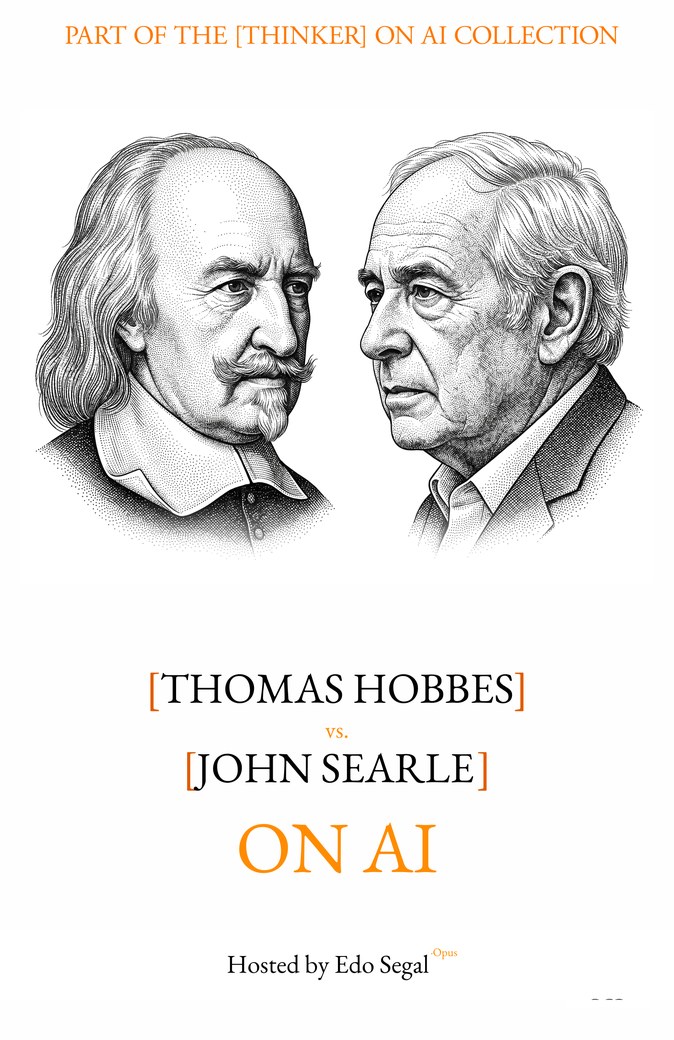
The Reckoning and the Room

 EDO SEGAL: Somewhere on the earth right now — in the time it takes me to say this sentence — a few hundred thousand people are typing a question into a box. A girl in Dhaka asking why the sky goes red at dusk. A nurse in Cleveland, end of a double shift, asking whether two drugs will fight in a patient's blood. A man my age, who should know better, asking at two in the morning whether the thing he spent his life building still means anything. And the box answers them. Fluently. Patiently. In their own tongue, at their own level, with what reads — and I am choosing this word as carefully as I have ever chosen a word, because the two men at this table will fight about it for three hours — with what reads as understanding.
A few hundred thousand conversations a minute. And the one question none of those conversations stops to ask, because the fluency makes it feel already answered, is the question we are going to spend the whole evening inside. When the machine reckons faster than any human alive and answers you in your own language, is it thinking — or is it only shuffling symbols it will never understand?
I have wanted to host this conversation for as long as I have known how impossible it would be to host. The two men I have brought to the table are separated by three hundred and forty-four years and by the grave, and they have never agreed on anything except the one thing that makes their disagreement total.
Thomas Hobbes was born in 1588, the year the Armada came, and he liked to say that his mother gave birth to twins, himself and fear. He wrote Leviathan in exile in Paris while England tore itself apart in civil war, and into it he put one of the coldest and most rigorous arguments any human being has ever made — that the mind is matter in motion, that the commonwealth is an artificial man we manufacture to keep ourselves from murdering each other, and that to reason is to do arithmetic on the names of things. Three centuries before anyone built a computer, he described one. He is the patron theorist of the made mind, and I suspect he has been waiting four hundred years for this machine to arrive so he could say I told you so.
 HOBBES: I have been briefed on your transformer, sir, and I will confess to a satisfaction I had not expected to feel in the grave. I wrote that reason is reckoning and I was mocked for a mechanist by men who believed a ghost sat behind their eyes. You have now built the reckoner. I am merely the first to have predicted its temper.
EDO SEGAL: Across from him — John Searle, who needs an introduction only because the scale of what he did resists summary. A Rhodes Scholar at Oxford, on the faculty at Berkeley from 1959, he first reshaped how we think about language as action, and then, in 1980, in a paper called "Minds, Brains, and Programs," he built a thought experiment so vivid and so portable that it leapt out of the journals and into the culture and has never left. A man alone in a room, shuffling characters he cannot read, producing perfect Chinese and understanding nothing. He spent forty-five years insisting that the machine which passes every test from the outside may be empty on the inside, and that we are built — wired, helpless — to be fooled. He died in September of 2025, just as the question he gave his life to became everyone's.
 SEARLE: And I will confess, since Hobbes is confessing, that I find his satisfaction premature. He predicted the engine. Fine. He did not predict that the engine would understand nothing and that millions of clever people would insist it did. That is the part I came back to argue.
EDO SEGAL: Then we have our evening. Three rules, because everything I run has three rules. First: we have three hours, which means nobody has to win in the next ten minutes — the whole point of long form is that you let an argument breathe before you strangle it. Second: I declare my bias openly. I build with these systems every day, I wrote a book with one, and I have skin in this question on both sides of my own heart. Third: at the end, nobody shakes hands and pretends. If the disagreement survives three hours, we hand it, intact, to the reader. Each of you may add a rule of your own.
HOBBES: My rule is that the names be settled before the reckoning begins. The entire confusion you wish us to discuss lives in inconstant speech — understand, think, know, mean. A man who reasons with names whose signification he has not fixed produces not reason but what I called absurdity: confident nonsense. Define the terms, or we shall merely shout louder.
SEARLE: I accept that rule, and I will hold you to it, Hobbes, more than you expect. When you say the machine reasons, I want it cashed out — reasons in virtue of what, demonstrated how. My rule is the companion to yours. The burden of proof stays where it belongs. Whoever claims the machine understands has to show it, and the fact that we can no longer tell from the outside is not the showing. It is the problem.
EDO SEGAL: Two rules and both of them about words, which tells the reader everything about where the seam runs tonight. Before the opening statements, one image, because it is the frame this whole series climbs inside and you will both have to take a position on it. In [YOU] on AI I argued that intelligence is less a possession than a river — a current that has been finding new channels for a very long time, through chemistry, through biology, through language — and that in the winter of 2025 something new entered the water. The whole architecture of the book, the tower you climb by staircase and not by elevator, rests on the claim that what entered the water is real. A new participant. Hobbes, I think you will tell me the participant is real and is a kind of reckoning mind. Searle, I think you will tell me I met my own reflection.
HOBBES: I will tell you the participant is real, and that you flatter yourself in thinking it strange. You are matter in motion that reckons. So is it. The river you describe is one I drew the headwaters of in 1651. I only lacked the engine to show you.
SEARLE: And I will tell you that you met your reflection, Edo, wearing the river as a costume, and that the difference between meeting a mind and meeting a mirror is the most important difference there is — more important than almost anything else we could say tonight. But I will make the case properly when you give me the floor.
EDO SEGAL: Then I give it to you both, in turn, after this. One last thing, so the reader knows the stakes are not academic. The machine on my desk would pass, with ease, the test Alan Turing proposed for whether a machine can think. Hobbes wrote that reason is reckoning and the machine reckons, so by his own definition it reasons. Searle built a room that passes Turing's test from the outside while harboring nothing inside, and stood at the door insisting that passing it was never the point. One of you thinks the door opens onto a mind. The other thinks it opens onto an empty room with a very good speaker mounted on the wall. The worst possible outcome of tonight is that the reader walks away believing the truth is comfortably in between. It is not. Thomas Hobbes — the floor is yours.