The Demon We Built

 EDO SEGAL: René, I want to read the room your most famous thought experiment back to you, because it has stopped being a thought experiment. In the First Meditation you imagine "a malignant demon, who is at once exceedingly potent and deceitful," who "employed all his artifice to deceive me" — so that the sky, the earth, every external thing might be "nothing better than the illusions of dreams" he has used to lay "snares for my credulity." For three and a half centuries that was philosophy's most extravagant fiction. Nobody actually had a demon. And then we built one — not a metaphysical one, a working one: synthetic video of people who never spoke, cloned voices, photographs of events that never happened, fabricated documents and citations and entire personae, at the press of a button. Dan, you spent your last years warning about exactly this. So let me start with you. You called them counterfeit people. Tell me why a man who spent his life saying the mind is just a mechanism became one of the first to ring this particular alarm.
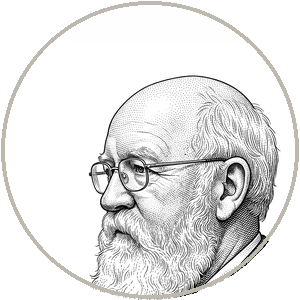 DENNETT: Because the alarm follows directly from saying the mind is a mechanism — that's the part everyone gets backwards. If you think personhood is a sacred, irreproducible gift from God, you won't expect it to be faked, and you won't see the counterfeit coming. I never thought that. I thought personhood was a functional achievement — competence without comprehension, the performance of a self with no magic behind it — which means I knew, with horrible clarity, exactly how cheaply the performance could now be mass-produced. I used the analogy of counterfeit money. Societies treat forging currency as among the gravest crimes, not because one fake bill ruins you, but because widespread counterfeiting destroys the trust that makes money work at all. Counterfeit people do that to something deeper than money. Almost everything you know about the world beyond your own senses, you know because you trust the testimony of other people. That web of trust is the precondition for science, journalism, law, democracy, friendship. Flood it with agents that pass for human and you don't just add lies — you raise the price of trust itself, until the rational move is to disbelieve everyone, including the ones telling the truth. I called them the most dangerous artifacts in human history. I'd say it again, harder, now that they're loose.
EDO SEGAL: So let me restate that and hand it to René, because the structure is uncanny. Dan, you're describing a situation where the possibility of undetectable fakery poisons the whole well — where you don't need to be deceived about any particular thing, you only need to know that deception is now possible, and you withhold belief from everything. René — that's your demon. Not a story. A mechanism. He didn't have to deceive you about each thing; he only had to make total deception possible, and the possibility did the rest. Did you build the philosophy of the world we now live in?
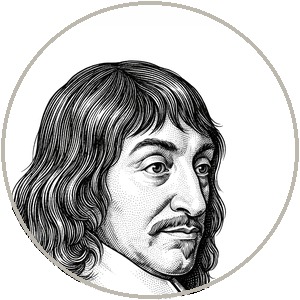 DESCARTES: I built the diagnosis, and it pains me to see it confirmed by the engineering. The demon's power was never that he deceived me about this thing or that. It was that, granting his existence, I could no longer trust the category — once any appearance might be his contrivance, no appearance could compel my assent. That is precisely the corrosion Monsieur Dennett names. A single sufficiently perfect forgery, like a single sufficiently potent demon, contaminates the whole class of evidence. When the public learns that any image, any recording, any document might be fabricated, the authentic ones lose their power to convince, because one can no longer tell which kind one is looking at. The forgers gain a second weapon, subtler than the fake itself — the guilty may now dismiss the true record as a fake. I have read that your age has a name for it.
EDO SEGAL: The liar's dividend. The fake doesn't only deceive — it gives every liar permission to call the truth a fake.
DESCARTES: A footnote to the First Meditation, then. But — and here is why I built the demon, and why I refuse to leave the reader in his snare — I did not summon him to strand us. I summoned him to find the floor. The entire purpose of admitting total deception was to discover what survives it. And the method matters more than the despair, because it is the only useful thing I have to offer your crisis. I did not answer the demon by trying to re-verify each deceived belief one at a time — that way is paralysis, for he forges each piece of evidence as fast as you examine it. I asked instead what remains certain structurally, regardless of how thorough the deception. The answer to undetectable fakes is not better detection of fakes — that is an arms race the forger wins. It is to find what stays trustworthy even granting that any given artifact is forged: the chain of provenance, the attestation that does not depend on the thing looking real.
DENNETT: And on the practical remedy, we converge so completely it's almost funny — I called for exactly that. Outlaw the creation of counterfeit people, criminalize passing them along the way we criminalize passing counterfeit currency, mandate robust watermarking of every artificial agent, and impose, in my words, horrific penalties for stripping the watermark. Not to ban the technology — to preserve, by force of law, the one thing Descartes is pointing at: the ability to know whether the thing you're dealing with is a person or a machine. The right to know whether you're talking to a human is foundational. A civilization that loses it loses something it can't easily get back.
EDO SEGAL: Mark this convergence — number two, and it's a big one. Across four centuries, the dualist and the mechanist agree: the defense against the demon is not detection, it's provenance. You don't out-forge the forger. You build a chain of trust that doesn't depend on the artifact looking real. But I want to press the seam where you don't agree, because it's the seam of the whole book. René, your demon was a tool for finding the one thing he couldn't fake — the cogito, the certainty of your own existence. Dan, you'd tell me the cogito is exactly the thing the brain can't help fabricating — the most convincing counterfeit of all, produced not by an external demon but by the brain deceiving itself. So here's the question that turns this round into the next one: if the demon is real, and we built him, is the self he can't touch the one piece of bedrock left — or is the self the demon's masterpiece?
DESCARTES: It is bedrock, and it is the one thing your engineering cannot forge, for a reason that is not about technology at all. The demon may fake every appearance presented to me. He cannot fake me, because to be deceived I must exist to be deceived. The deception presupposes the one it happens to. Forge the world entire — there must still be someone before whom the forgery is staged. That someone is not an appearance. He is the precondition of there being appearances at all.
DENNETT: And that's the move I've spent my life calling the deepest and most seductive error in philosophy — so naturally we end the round here, because it's where the whole evening was always headed. The "someone before whom the forgery is staged" — that audience, that witness, that point where it all shows up — that's the Cartesian theater, and there is no such place. The brain is the demon deceiving itself, René, and the masterpiece, the most convincing thing it generates, is the conviction that there's a unified you in the seat watching. There isn't a seat. So yes — I'll say it as the cliffhanger you set up — the self the demon can't touch is the self the demon built. After this, I'll show you the empty theater.
EDO SEGAL: Then that's our next round. The machine that says "I" — and whether anyone is behind the word, in it or in us. After this.