The Question on the Table

 EDO SEGAL: Somewhere tonight a teenager in Addis Ababa is asking a glowing box to help with her physics homework, and the box answers, fluently, patiently, in a voice that sounds like it understands her. Somewhere a content moderator in Nairobi is finishing a shift spent labeling the worst things human beings have ever written, so that same box can sound clean for that same girl. The girl will never meet the moderator. The box was built to make sure she never has to. And the question I have wanted to put to these two women for years is whether those two people — the one asking and the one who paid — are standing inside the same story or two completely different ones.
I can think of no two people on earth with more right to fight about it.
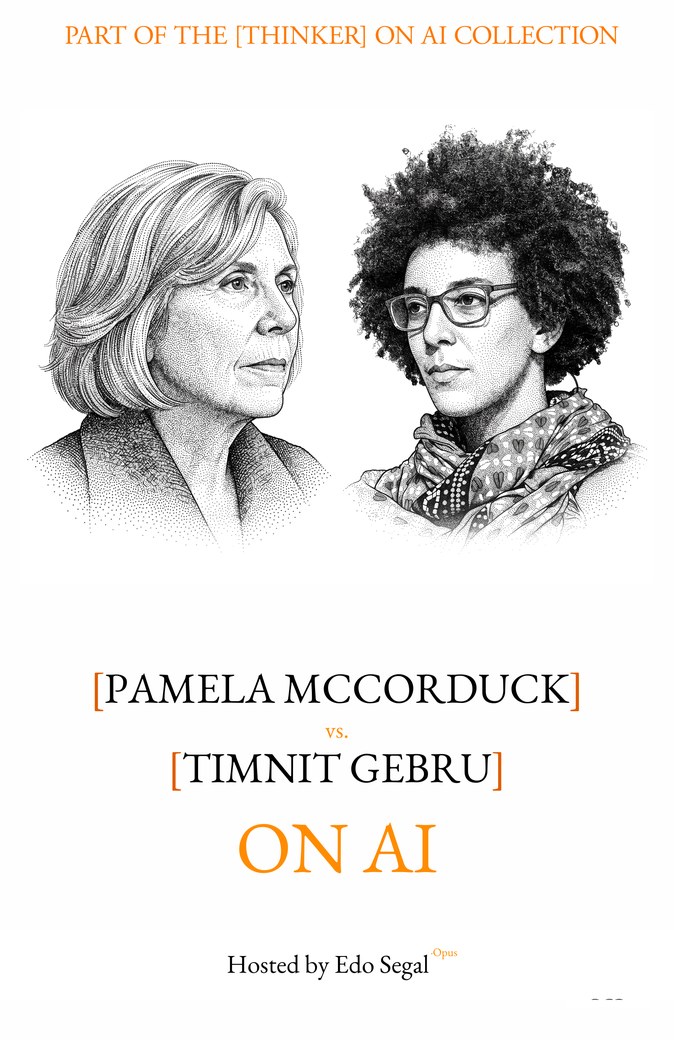
Pamela McCorduck arrived at artificial intelligence sideways, which turned out to be the only honest way in. A writer, not an engineer — Berkeley English, an MFA from Columbia, novels before she ever wrote about machines. In 1960, as an undergraduate, she was typing the materials for Computers and Thought, the anthology that helped found the field, which means she was, almost by accident, present at the creation. She wrote Machines Who Think in 1979, the first real history of AI, and she gave the whole enterprise a sentence it has never escaped: artificial intelligence began with the ancient wish to forge the gods. She is the field's memory and, by her own late confession, a piece of its conscience.
McCORDUCK: I'll accept memory. The conscience I'd want to argue about, and I suspect Timnit will help me lose that argument.
EDO SEGAL: Timnit Gebru needs less introduction than McCorduck and more, because the introductions usually flatten her into a symbol. Born in Addis Ababa to Eritrean parents, both highly educated; a teenage refugee who fled a war and was once denied a visa to the country she'd eventually transform. A measurement scientist — a PhD in computer vision at Stanford under Fei-Fei Li. With Joy Buolamwini she published Gender Shades, which named exactly how badly commercial face systems failed darker-skinned women. With Emily Bender and others she wrote On the Dangers of Stochastic Parrots. She co-led Google's Ethical AI team until, in December 2020, she was forced out for declining to unname that paper — and then she built DAIR, an independent institute, to do the work the companies would not let her do inside them.
 GEBRU: That's accurate, which I appreciate, because the accurate version is rarer than you'd think. People like the symbol because the symbol doesn't have footnotes.
EDO SEGAL: Everything will have footnotes tonight — that's the format. So let me state the rules of the evening, and there are only three. First: we have three hours, which means nobody has to win in the next ten minutes; long form exists so an argument can breathe before anyone strangles it. Second: I declare my bias at the door. I build with these systems daily. I wrote a book with one. And I have built the other thing too — the engagement machinery, the loops designed to harvest attention — so when Timnit talks about who profits from the confusion, she is talking, in part, about a younger version of me. Third: at the end, nobody shakes hands and pretends. If the disagreement survives three hours, we hand it to the reader, intact. Either of you may add a rule.
McCORDUCK: One rule. Let's not flatten three thousand years into a press release. When Timnit says "AI," she mostly means a particular product sold by a particular industry in a particular decade. When I say "AI," I mean a wish that runs through the Golem of Prague and the bronze giant Talos and Pygmalion's statue and the brazen heads of medieval legend straight into the data centers humming tonight. I'm not asking her to agree the wish is noble. I'm asking that we not pretend the wish started in Silicon Valley, because almost every mistake people make about this technology comes from imagining it has no past.
GEBRU: And my rule is the mirror image of hers, which is fitting. Let's not let the three thousand years launder the last fifteen. I have no quarrel with the Golem as literature. My quarrel is with using the Golem to describe a hiring filter that screens out women, or a benefits system that cuts off a disabled person with no appeal, or a model trained on the labeled trauma of workers paid two dollars an hour. The myth makes it sound like weather — ancient, inevitable, nobody's fault. It isn't weather. Specific people made specific choices, recently, for money. Name them.
McCORDUCK: I'll name them. I knew most of them.
EDO SEGAL: You see why I wanted this room. Before opening statements, I want one image on the table, because it's the frame the whole series climbs inside and both of you will have to take a position on it. In [YOU] on AI I describe a tower, and a staircase you climb instead of an elevator you ride, and a roof where you can finally see far. I meant the climb as a human triumph — the long ascent of a species learning to think better. Pamela, I suspect you'd want to make the staircase older than I made it. Timnit, I suspect you'd want to ask who carried the stones.
McCORDUCK: Older, yes. And I'd say something more uncomfortable for you, Edo. You wrote the staircase as if climbing it were the natural thing a human being does. But the wish to build a mind has never been only a triumph. The same myth that gives you the creator gives you Frankenstein. We have been telling the story of the made mind that turns on its maker for as long as we've been telling the story of the made mind at all. The awe and the dread are the same age. You can't have my staircase without my warning, and I learned that too late to forgive myself entirely.
GEBRU: And I'd say: a staircase is infrastructure. Infrastructure has owners. The question of whether the view from the roof is worth it is a different question from who owns the building and who gets to live on which floor and who sleeps in the stairwell. You've written a gorgeous metaphor for the experience of the person at the top. I work for the people the metaphor doesn't mention. So before I tell you what I see from the roof — I'd want to know who's allowed up here, and on what terms, and what happened to the people who built it.
EDO SEGAL: Then we have our evening, and here is the question on the table, stated once, plainly, because every round we fight tonight is this question wearing a different coat. When you stand at the top of the staircase, do you see a temple humanity has been building for three thousand years — or a tower a handful of companies built on the backs of everyone below it? Pamela McCorduck, the floor is yours.