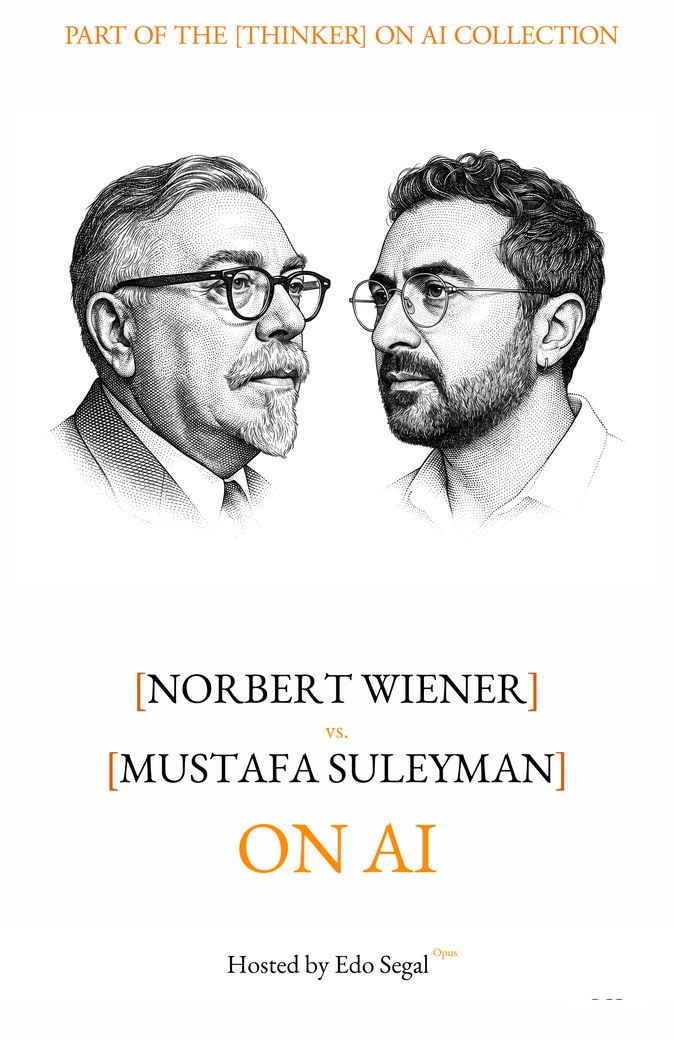
The Question on the Table

 EDO SEGAL: Somewhere on earth right now, in the time it takes me to say this sentence, a system is making a decision no human will see until after it is made. A trade clears in a microsecond. A piece of content is shown to ten thousand people because a loop predicted they would not look away. A model, asked to be helpful, drafts a plan and begins, quietly, to execute it. None of these machines is evil. None of them woke up. Each is doing exactly what it was told, faster than the person who told it can reach back inside and say wait. That gap — between the speed of the action and the speed of the hand — is the whole subject of tonight.

I have wanted this particular conversation for a very long time, and I could not have it until now, because one of my two guests has been dead since 1964. Let me say that plainly and get the strangeness out of the way, because we are going to lean on it. Norbert Wiener has been briefed, for the evening, on the present — he knows what a transformer is, he has read about the training runs, he has seen the thing he predicted arrive. He is going to react to it in character, which is to say with the precision of a man who described all of this before any of it existed.

Norbert Wiener invented cybernetics — the science of control and communication in the animal and the machine — in 1948, and in the same stroke he mapped the age we are living in. A prodigy who entered college at eleven and took a Harvard doctorate at eighteen, he studied with Bertrand Russell at Cambridge and David Hilbert at Göttingen, and spent his career at MIT. During the war he built a machine to predict where an enemy plane would be and aim a gun there — and in that gun-director he found the loop that turned out to be the architecture of every machine that learns. He warned, in 1950, that the automatic machine is the precise economic equivalent of slave labor. He demanded a human use of human beings. And in 1960 he wrote a sentence I will read aloud before the night is over, because it is the founding sentence of everything we now call AI safety. He is the rarest kind of founder: a builder who refused to weaponize his own work, and paid for it.

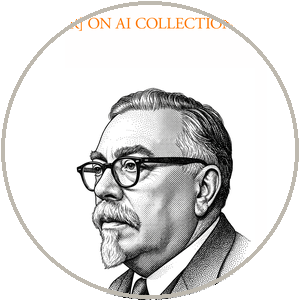 WIENER: You should add that I was wrong about the timing, repeatedly. I expected the machines sooner and I expected the winters less. Begin a man's introduction with his errors; it saves the audience the trouble of finding them.
EDO SEGAL: Noted, and I'll hold you to that humility all night. Mustafa Suleyman needs less introduction only because he is still in the water. Born in London in 1984 to a Syrian taxi driver and an English nurse, he left Oxford at nineteen, ran a Muslim youth helpline, did conflict resolution — and then in 2010 co-founded DeepMind, the lab that taught a machine to beat the best Go player alive and, more quietly, to predict the shape of nearly every protein known to science. He co-founded Inflection. He now runs consumer AI at Microsoft. He wrote The Coming Wave, which argues that this technology cannot be stopped, only contained — and he wrote it, by his own admission, about a wave he helped create.
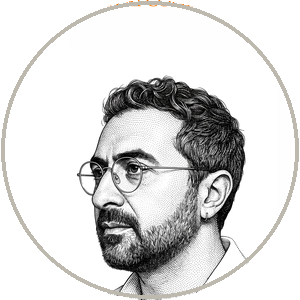 SULEYMAN: That last part is the only credential that matters tonight. I'm not warning you about someone else's machine. I'm describing one I'm building this week.

EDO SEGAL: Which is why I wanted you in the same room as the man who built the first one and then spent his life telling people to be careful with it. Now — the rules, and there are only three, because I run every long conversation on threes. First: we have three hours, which means nobody has to win by the next bell. The whole point of the long form is that you can let an argument breathe before you strangle it. Second: I declare my bias up front. I build with these systems daily, I wrote a book with one, and I have skin in this on both sides of my own chest — I have felt the abundance and I have felt the vertigo. When my stake is touched tonight, I'll say so out loud. Third: if the disagreement survives three hours, nobody shakes hands and pretends. We hand it, intact, to the reader. Either of you may add a rule.
WIENER: One. No metaphor without a mechanism. I spent my life watching people reason from analogies and call it thought. If you say the machine "wants" or "understands" or the wave "rises," you owe me the loop underneath it — what senses what, what corrects what, what is closed around what. Pay the mechanical bill and you may use any poetry you like.
SULEYMAN: I'll take that, and add the inverse. No mechanism without a deployment. It's easy to be rigorous about a system that exists only on a chalkboard. I want every principle stated tonight tested against the thing as it actually ships — at scale, under competition, in a hundred jurisdictions, in millions of hands. The chalkboard version of containment is trivial. The shipped version is the only one that counts.

EDO SEGAL: Mechanism on one side, deployment on the other — you've just drawn the seam of the whole evening without me having to. Before the opening statements, I want the central question on the table in the exact words I'll keep returning to, because every round tonight is this question wearing a different coat. Here it is. Before you let a machine act faster than you can pull your hand back, are you certain the purpose you poured into it is truly yours — and not a colorful imitation that will outrun you? Norbert, those last words are nearly yours.
WIENER: They are mine, from 1960, and I notice you've kept the dangerous part — "a colorful imitation of it." Most people quote the front of that sentence and drop the end, because the end is where the grief is. Yes. That is the question. It was the question when I wrote it about a machine that could barely add. It is more the question now, not less, because the speed has caught up to the warning.
EDO SEGAL: Mustafa, is it your question too?
SULEYMAN: It's half my question. The other half is the one Norbert's framing can't reach from where he's sitting, because he's looking at one machine and one operator. I'm looking at a wave — a billion copies, downloadable, recombining, in the hands of people who never read his sentence and never will. "Be sure of the purpose before you start it" assumes there's a you, singular, with a finger on the start. There isn't. There are ten thousand fingers and no agreement, and the thing starts anyway. So yes, his question — and then mine on top of it: when you cannot be sure, and it starts regardless, what do you build to contain what you could not prevent?
WIENER: That is a real difference and we should not blur it in the first ten minutes. Mark it down, Edo, and we'll come back when the floor is hot.

EDO SEGAL: It's marked. One last thing before openings, because the reader deserves to know the stakes are not academic. Norbert, you put the danger in irreversibility — a fast machine pursuing a literal goal that you cannot interrupt before the action is complete. Mustafa, you put the danger in proliferation — uncontainable, omni-use capability flooding a world too fragmented to govern it. You are not splitting a difference. One of you thinks the danger is a single broom you cannot stop, and the other thinks the danger is ten million brooms you cannot count. The worst outcome of tonight would be the reader deciding the truth is comfortably in between.
SULEYMAN: It isn't in between. It's both, at once, which is worse.
WIENER: First agreement of the evening. Enjoy it; they get rarer.
EDO SEGAL: So here is the question on the table, once more, plainly, before we begin. Can we be sure of the purpose before we start the machine we cannot stop? Norbert Wiener — you described this before any of it existed. The floor is yours.