The Question on the Table

 EDO SEGAL: Somewhere tonight a person is sitting in the dark with a glowing rectangle, asking it to make something that did not exist this morning. A teenager in Chengdu asking it to draw the creature from a book she just finished. A surgeon in Cleveland, end of a double shift, asking a vision system whether the shadow on the scan is a tumor or nothing. A father my age, who should know better, asking at two in the morning whether the thing he is building will outgrow the children asleep down the hall. And the machine answers. It sees. It speaks. It makes. And in each of those rooms, unasked because the fluency makes it feel already settled, sits the oldest question a maker can ask — the one we are here to live inside for three hours.

I will put it to you plainly, because everything tonight is this question wearing a different coat. When you build a mind that may one day outclimb you, are you a parent raising a child — or a maker who has built the thing that will turn and ask why you made it?
I have wanted this conversation more than any I have ever hosted, and I want to tell you why before I introduce my guests. This is the railing you grip on the floor where the staircase gets steep — the rung where the machine's capability rises to meet your own and you cannot tell anymore whether you are climbing or being carried. The two people at this table are the only two I could find who have looked directly at the act of making a mind — not at its uses, not at its profits, at the act — and walked away with opposite verdicts about what that act already contains.

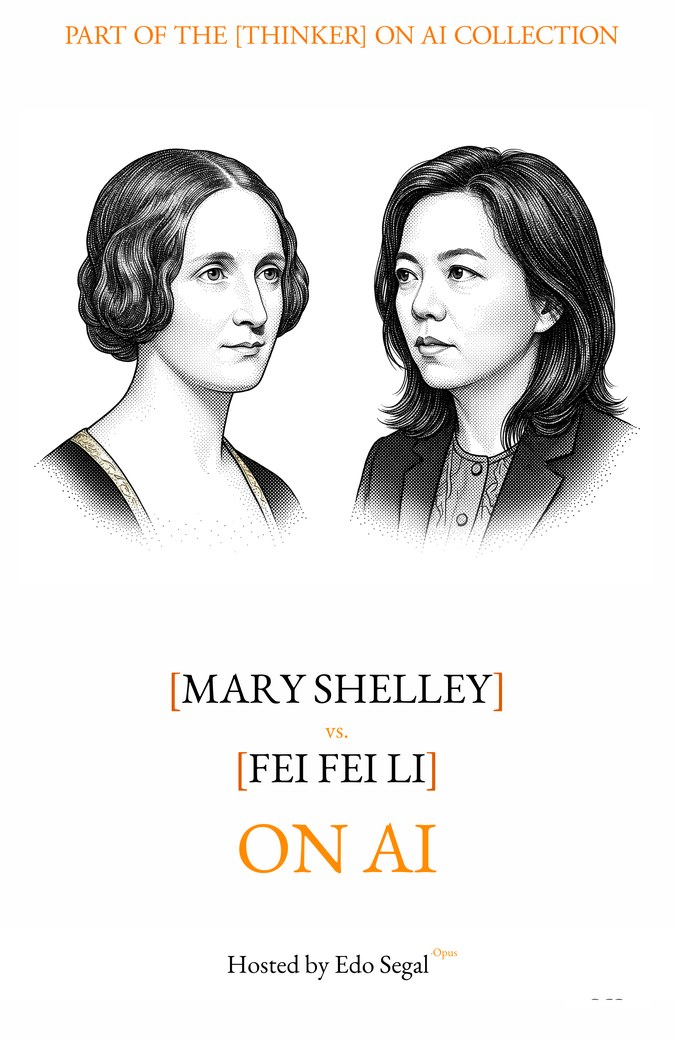
Mary Shelley wrote the founding myth of artificial intelligence two hundred years before the technology existed. At nineteen, in a rain-bound summer on Lake Geneva, she imagined a brilliant student who discovers the principle of life, assembles a thinking being out of dead matter, looks at what he has made — and runs. Everything that follows in Frankenstein — the deaths, the vengeance, the ruin — flows not from the making but from the running. She gave the world its first and fiercest warning that an artificial mind we breathe life into will turn to face its maker, and that the sin is not the creature's wickedness but the maker's hubris and his refusal to love what he made. She is, by some distance, the oldest voice in this series and the one that has aged least.

 SHELLEY: You will forgive me if I find it strange to be the oldest voice in any room. In my own time I was the youngest by a great margin, and the only woman, and they thought my book a horrid little entertainment.
EDO SEGAL: They were wrong, and we will spend three hours proving it. Fei-Fei Li needs an introduction only because the scale of what she did resists a single sentence. She came to America at sixteen speaking almost no English, ran her family's dry-cleaning shop on weekends while solving physics at Princeton, and then bet her young career on a heresy: that the way to teach a machine to see was not a cleverer algorithm but more of the world. She built ImageNet — millions of images, hand-labeled, the visual childhood a machine had never been given — and in 2012 a network trained on her data did something that changed the trajectory of the century. And then, having lit the fire, she did the rarer thing. She refused to retire into eminence and spent the years since insisting that capability is not the point — that the only question that finally matters is who the seeing is for.

 LI: Thank you. Though I should say at the start — I did not build the thing that turns on its maker. I helped build a thing that sees. What it becomes is a separate question, and I suspect Mary and I are going to disagree about whether it is separate at all.

EDO SEGAL: We are, and I am glad you found the seam in your first breath. Before we go further, an honesty I owe the reader. Mary — you wrote in 1818. You have been briefed on the present. You know what a neural network is, what ImageNet did, what these systems can now do. We are going to proceed as though you have read the last two hundred years on the plane here, and you will react to all of it as yourself. Is that a fair contract?
SHELLEY: It is a generous one. I have had the strange experience of watching my private nightmare become a quarterly earnings report. I will try to be myself about it, which I expect means I will be alarmed.
EDO SEGAL: Good. Then the rules of the evening, and there are only three. First: we have three hours, which means nobody must win by the next bell — long form exists so an argument can breathe before anyone strangles it. Second: I declare my bias at the door. I build with these systems daily, I wrote a book with one, and I have skin in this question on both sides of my own heart — I have felt the wonder Fei-Fei defends and the dread Mary diagnoses, and I cannot put either down. Third: if the disagreement survives three hours, nobody shakes hands and pretends. We hand it, intact, to the reader. Either of you may add a rule of your own.
LI: A rule, then. We should be precise about what these systems actually are at each moment we discuss them — what they can do, what they cannot, measured, not imagined. I have spent years asking the world to govern AI on the basis of science, not science fiction. I would like us to honor that here, even when one of us is the author of the founding science fiction.

SHELLEY: [I will let that pass, because she means it kindly.] My rule is the inverse, and we shall see whether they can both stand. I would ask that we never speak of the machine without asking after the one who made it. Every time we say the system did this, I want to know — who animated it, and where did they go afterward? The whole of my book is the difference between those two questions.

EDO SEGAL: And there it is — before a single round, the architecture of the evening. Fei-Fei wants us to look hard at the thing itself and not inflate it. Mary wants us never to look at the thing without looking for the maker who fled. Hold both. Because here is the central question once more, stated plainly so the reader can carry it up every flight of stairs we climb tonight: when you make a mind that may exceed you, are you a parent, or a maker about to be judged? Mary Shelley, you have waited two hundred years. The floor is yours.