The Question on the Table

 EDO SEGAL: Somewhere in the world right now, in the time it takes me to finish this sentence, a machine is being told to do something in plain words, and it is doing it. A nurse at the end of a double shift types a question about a drug interaction and gets an answer in her own language, at her own level, instantly. A child in Lagos asks for help with a proof and the box explains it a fourth time without sighing. A man my age, who should know better, describes a half-formed idea at two in the morning and watches it come back clarified, connected to things he had not thought to connect. And in every one of those rooms the same thing is happening, and nobody stops to name it, because the fluency makes it feel already answered.
So let me name it, because it is the only thing we will talk about for three hours. Fifty-six years ago, in a laboratory at MIT, a young man built a program that you could tell, in English, to put the red block on the blue block — and it did. It asked clarifying questions. It remembered what it had done. It refused when you asked it to balance a block on a pyramid, because it knew a block will not balance on a point. The world watched it and saw the first light of dawn. And the man who built it spent the next fifty years explaining why the dawn was false. The question on this table tonight is the question that program posed in miniature and the largest machines now pose at planetary scale: when the machine says "put the red block on the blue block" and does it — did it understand a single word, or did you just mistake a moving mirror for a mind?
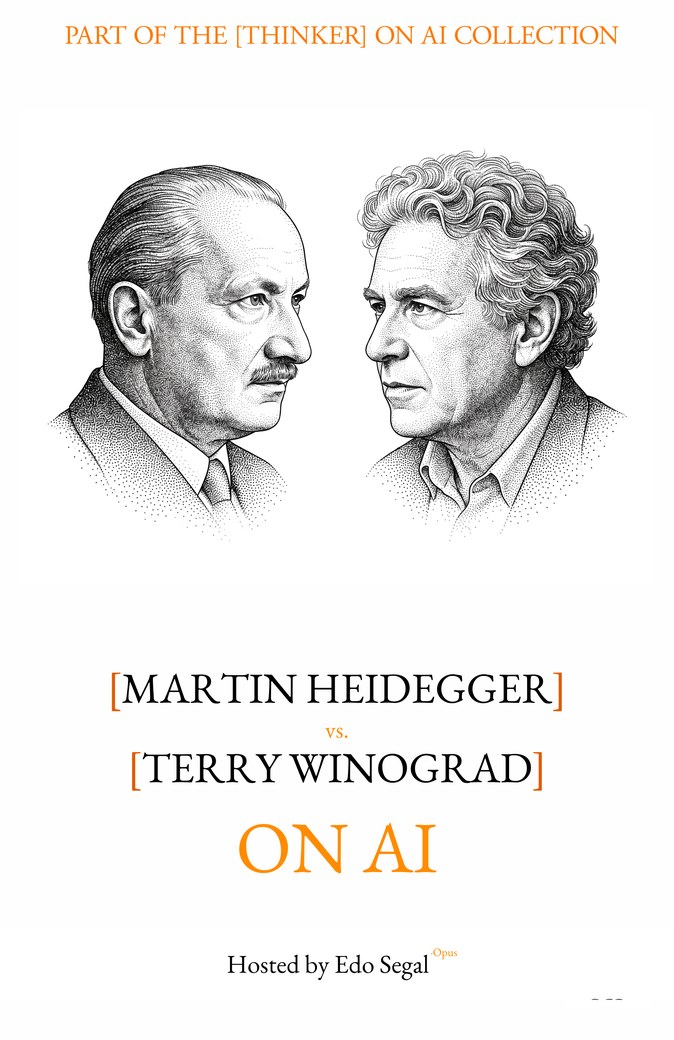
I can think of no two people on earth with more right to that question. To my left, a man who has been briefed on the present and is, I will admit, taking it with remarkable calm. Martin Heidegger spent the second half of his life arguing that understanding is not a thing inside a head at all — not facts, not rules, not representations — but a way of being in a world, the wordless fluency of the carpenter whose hammer has disappeared into the swing. His 1954 essay on technology is still the most penetrating account we have of what a machine is, beneath what it does. He died in 1976, the year before the Apple II shipped, and yet here he is, and he is already unsettling me.
 HEIDEGGER: You have introduced me as a man who never saw a computer. I would say rather that I saw nothing but. In the 1966 conversation I gave to be published only after my death, I was asked what would take the place of philosophy. I answered in one word. Cybernetics. I did not predict your transformer. I predicted the kind of civilization that would build it — one that had quietly replaced thinking that dwells with a question by thinking that computes an answer, and had forgotten there was a difference. So I am not a tourist here. I am, if you like, the man who saw the building going up from very far away and is only now walking through the rooms.
EDO SEGAL: And to my right, the man who poured the foundation. Terry Winograd wrote SHRDLU as a graduate student between 1968 and 1970 — the program I just described — and became famous for it. Then he became something rarer than famous. He read Heidegger, through Hubert Dreyfus, collaborated for years with the philosopher Fernando Flores, and concluded, in print, in 1986, that you could not build a machine that genuinely understands. A journalist later called him the first high-profile deserter from the world of AI. Terry, you are about to be cross-examined by the philosopher whose ideas made you walk away from your own creation. How does that sit?
 WINOGRAD: It sits strangely, and I will tell you exactly how. I did not desert anything. I changed my mind on the basis of evidence, and the evidence was my own most celebrated success. I built a thing everyone admired, and then I understood why it worked, and why it worked was the worst news in the building. So to be questioned by Heidegger tonight is not an ambush. It is closer to meeting the author of the manual after you have already taken the machine apart yourself and found the trick. I expect we will disagree. I did not become a Heideggerian. I became a builder who reads Heidegger, which is a different and more uncomfortable thing.
EDO SEGAL: That distinction is going to matter all night, and I want it on the record early. Let me state the rules, because there are only three, and then each of you may add one of your own. First: we have three hours. Nobody has to win by the next bell. Long form exists so an argument can breathe before anyone strangles it. Second: I declare my bias up front. I build with these systems daily, I wrote a book with one, and I have skin in this question on both sides of my own heart. Third: if the disagreement survives three hours, we do not shake hands and pretend. We hand it, intact, to the reader. Professor Heidegger, a rule of your own?
HEIDEGGER: One rule. We will not be permitted to say the word "understanding" as if it were a coin everyone in the room had already agreed to spend. Every time it is used tonight — by me, by Herr Winograd, by you — it must be cashed out. Understanding in virtue of what, shown how. The whole confusion lives in the word, and the word is the one nobody pays for.
EDO SEGAL: Terry?
WINOGRAD: Then my rule is the companion to his. We will not be permitted to point at the machine's behavior and treat the behavior as the end of the conversation. It produces the outputs of understanding. Grant that completely; I built the first impressive proof of it. The whole question is whether producing the outputs of understanding is the same as understanding, and you cannot answer that by producing more outputs. Behavior is the evidence in dispute. It cannot also be the verdict.
EDO SEGAL: Two rules that are nearly the same rule from opposite directions, which tells me we have the right two men. Before the opening statements, one image, because it is the frame this whole series climbs inside. In [YOU] on AI I argued that intelligence is less a possession than a river — a current that has flowed through chemistry, biology, language, culture, finding new channels — and that in the winter of 2025 something new entered the water. The whole architecture of the book, the tower, the staircase you climb instead of the elevator you ride, rests on the claim that what entered the water is real. A new participant. Professor Heidegger, I suspect you think I have described a flood and called it a guest.
HEIDEGGER: I think you have described enframing and called it a river, which is a more beautiful word and a more dangerous one. But you have asked the right question, and asking it is already more than your industry does. I will make the case when you give me the floor.
EDO SEGAL: Terry?
WINOGRAD: I think the river is real and the new thing in it is real, and that you have not yet said what the new thing is. It is not a mind. It may be the largest mirror ever built. Whether a mirror counts as a new participant in the river or as the river finally learning to reflect itself — that is worth three hours. I would only warn you, Edo, that the most seductive error available tonight is to feel met and to call the feeling evidence. I built a machine that made very smart people feel met in 1970. The feeling was entirely on their side of the glass.
EDO SEGAL: Then we have our evening, and we have the seam. So here is the question on the table, stated once, plainly, because every round tonight is this question wearing a different coat. The machine is told, in your own words, to put the red block on the blue block. It does it. Did it understand you — or are you alone in the room? Martin Heidegger, the floor is yours.