The Question on the Table

 EDO SEGAL: Somewhere in the world, in the seconds it takes me to say this, a few hundred thousand people are typing the word "understand" into a machine. Do you understand? — they ask it. I don't understand this — they tell it, about a contract, a diagnosis, a child's homework, a grief. And the machine answers, in their own language, at their own level: I understand. It says the word back to them, perfectly placed, perfectly timed. A man in Trivandrum, an engineer of mine, said it to me about that machine last winter, half joking — "it understands me better than my manager does" — and the room laughed, and I did not, because I had just realized I had no idea whether the sentence was true, false, or not even the kind of thing that can be true or false.

That is the question we are here to spend three hours inside. When the machine uses the word "pain" exactly the way you use it — when it says "I understand" and places it flawlessly — is there anyone home behind the word? Or is "behind the word" the very confusion we have to climb past to see straight?
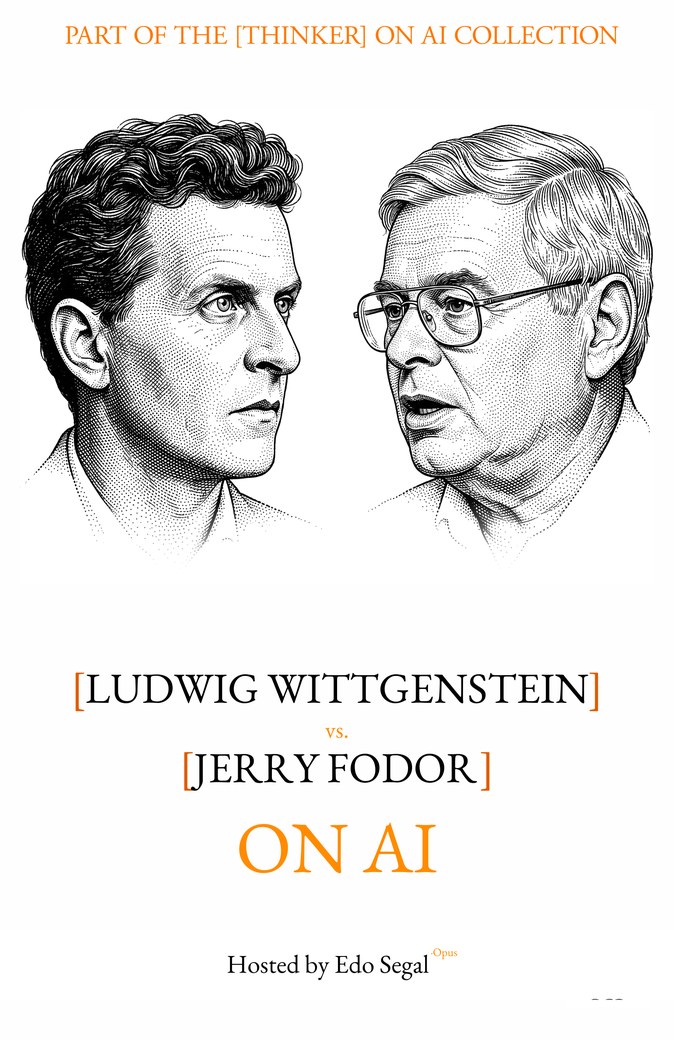
I have wanted these two men at one table for a very long time, and the universe declined to arrange it, so I have. Let me introduce them, because the audience deserves to know the size of what is sitting across from each other.
Ludwig Wittgenstein wrote two of the most important books in the history of philosophy, and the second one demolished the first. He spent his early life believing language pictured the world, and his later life proving that meaning is not a picture and not an inner object but a use — a move in a game, woven into the shared life of a community. He argued the question of machine thinking face to face with Alan Turing, in a Cambridge lecture room, in 1939, before there was a machine to argue about. He is, by some distance, the most dangerous interlocutor this subject has, because he does not let either side keep its favorite shortcut.
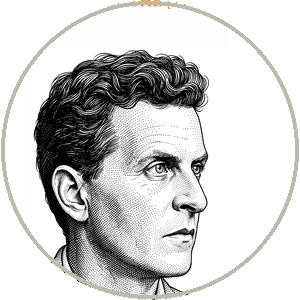 WITTGENSTEIN: You have already said too much. But go on.

EDO SEGAL: Jerry Fodor was the philosopher who took the idea that the mind is a computer more seriously, and more literally, than anyone alive — and then used that seriousness to draw a hard wall around what a computer could be. He proposed that thinking happens in an inner language, Mentalese, with symbols and a syntax of its own. He called the computational theory of mind "the only game in town." And with Zenon Pylyshyn, in 1988, he threw down the challenge that organized thirty years of this field: that networks like the ones now running could never explain the structure of thought. They could only fake it.

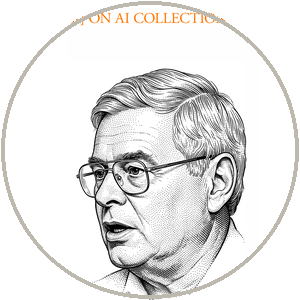 FODOR: "Fake" is your word. I'd have said "fail to explain," which is worse and more precise. But I'll take the introduction. I notice you put me second. Ludwig gets to be the deep one and I get to be the engineer. We'll see how that holds up.
WITTGENSTEIN: You are the engineer. It is not an insult. It is the disease.
FODOR: And there's the first three minutes gone exactly as I expected.
EDO SEGAL: You see why I wanted this. Before we begin, the rules of the evening — there are three, and you each may add one. First: we have three hours. Nobody has to win by the next bell, and I will not let either of you strangle an argument before it has breathed. Second: I declare my bias. I build with these machines daily, I wrote a book with one, I have felt met by the thing at three in the morning, and I do not know which of you that feeling belongs to. When my stake is touched tonight I will say so out loud. Third: if the disagreement survives three hours, we do not paper it over. We hand it, intact, to the reader. Ludwig, a rule of your own?

WITTGENSTEIN: Yes. No one is permitted to use the word "understand," or "mean," or "think," or "inside," as if its meaning were obvious. Every time one of us reaches for one of those words, the other may stop the room and ask: what are we doing with it here? What is the practice? The whole confusion we are here to dissolve lives in the unexamined use of exactly those words. I will hold myself to it as strictly as I hold him.
FODOR: Fine. And my rule is the mirror of his, which is why he'll hate it. He wants every word cashed out in a practice. I want every practice cashed out in a mechanism. When Ludwig says meaning is "use in a form of life," I get to ask: implemented how? In virtue of what, in the head or the chip, does the use come out right rather than wrong? "Form of life" is a phrase, not an explanation. If he gets to interrogate my words, I get to open his.
WITTGENSTEIN: He thinks there is always something underneath. That is the whole quarrel, in one sentence.
EDO SEGAL: Say more about that, because the audience needs the shape of it before the openings. Jerry — when you look at a person understanding a sentence, what do you think is happening that Ludwig refuses to look at?
FODOR: Something mechanical and meaningful at once, which is the only interesting thing in the universe. There's a structured representation in the head — symbols with shapes a mechanism can push, and meanings those shapes carry — and the pushing respects the meaning, so the person reasons. Ludwig looks at that and says "stop, you're hallucinating an inside." I look at his "use in a form of life" and say: that's the output, that's what you see from the gallery; I want the engine. He's a brilliant describer of the game from the stands. I want to be down on the field with a wrench.

WITTGENSTEIN: And he will find, under the hood, more symbols, which will need their own engine, which will need its own — until he is standing in an infinite garage explaining nothing. But we are getting ahead. The audience should watch us earn this.
FODOR: And he thinks if you describe the surface carefully enough, the underneath takes care of itself. That's the whole quarrel in my sentence. We agree about the quarrel. We disagree about the floor of the world.
EDO SEGAL: Then we have our evening. One image before openings, because it is the frame this entire series climbs inside, and both of you will have to take a position on it. In [YOU] on AI I argued that intelligence is less a possession than a river — a current that has found new channels through chemistry, biology, language, culture — and that something new entered the water when the machine learned to speak. The book leans on the claim that what entered is real: a new participant in the medium. Jerry, I suspect you want to open the new participant up and check what is inside it. Ludwig, I suspect you think "what is inside it" is the wrong question I should never have asked.
FODOR: Correct, and I'd go further. Your river is a lovely picture and pictures are where philosophy goes to die. Something is in the water — agreed. The only question with any content is what kind of thing: does it have structured representations with meaning, manipulated by rules, or is it a very large statistical surface that produces river-shaped output? You can't answer that by admiring the current. You answer it by draining the river and looking at the pipes.
WITTGENSTEIN: And I say: watch the river do its work among the people who live by it, and you will see everything there is to see. There is no hidden pipe. The demand to drain it and find the "real" meaning inside is the precise bewitchment I spent my life trying to cure. He wants to open the box. I am telling him the box is the wrong idea.
EDO SEGAL: Then the evening has its spine. The question, once more, plainly, because every round tonight is this question wearing a different coat: the machine uses your word exactly as you do. Is anyone home behind it — or is "behind it" the confusion? Ludwig Wittgenstein, the floor is yours.