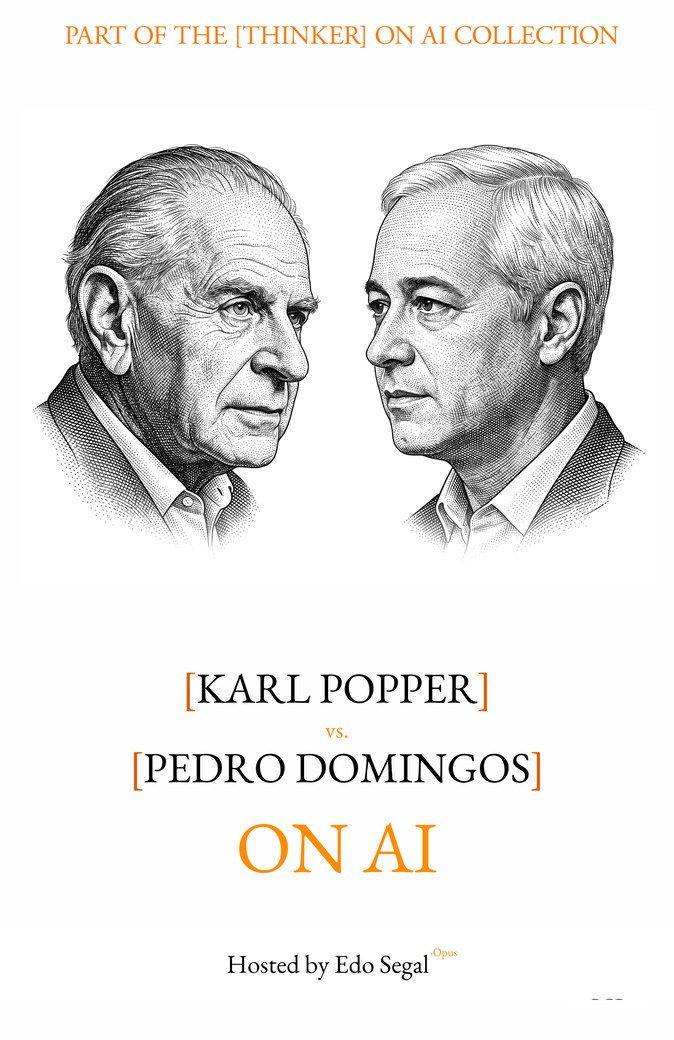
The Sunrise and the Black Swan

 EDO SEGAL: Somewhere on earth right now, in the few seconds it takes me to say this, a few million people are watching a machine finish their sentence before they do. A student in Lagos asking it to explain a proof. A doctor at the end of a long shift asking whether two drugs fight each other. A man my age, who should know better, asking at two in the morning whether the thing he gave his life to still means anything. And the machine answers — fluently, confidently, in their own language, with what reads, and I am choosing that word with care because my two guests are going to fight over it for three hours, with what reads as knowing.

Here is the question nobody in those millions of conversations stops to ask, because the fluency makes it feel already answered. The machine has seen a mountain of examples. From that mountain it predicts, and the predictions keep coming out right. So: has it discovered the world — or has it only failed, so far, to be wrong? And if you were climbing past it, trying to see further than it can, how on earth would you tell the difference?
I have wanted this conversation for a long time, and I want to be honest that one of my guests has had to travel further than anyone I have ever seated at this table. Karl Popper died in 1994. He has been brought current on everything — the transformer, the scaling curves, what a language model is and is not, the trillion dollars sloshing around it. He knows what year it is, in our world. We are going to acknowledge that strangeness exactly once, now, and then never again, because the ideas he brought do not have an expiration date and he is going to demonstrate that within five minutes.
Sir Karl, you spent your life on the proposition that knowledge does not come from piling up confirmations. Welcome.

 POPPER: Thank you. I confess I find the present remarkable, and I find it remarkable in a way that is almost embarrassing, because it is so familiar. You have built a machine that does, at colossal scale, the one thing I argued the human mind does not actually do to acquire knowledge — and which no logic permits. It generalizes from instances. And the world has greeted it by saying: at last, the inductive machine. I spent sixty years explaining why there is no such thing. So you must forgive an old man a certain grim amusement at being asked to react to the apotheosis of the error I devoted my life to refuting.

EDO SEGAL: And Pedro Domingos is the man who built a good part of the apotheosis — and who, I should say immediately, is not the cheerleader Karl might expect. Pedro is a computer scientist, professor emeritus at the University of Washington, one of the founders of the field that fuses logic and probability. He wrote The Master Algorithm, which made a claim as large as any in the field: that beneath the five warring tribes of machine learning lies a single universal learner, one algorithm that could derive all knowledge from data, the way a few equations derive all matter. He is also the man who likes to say the real danger is not that computers got too smart but that they are too stupid and already run the world. So he arrives here as a unifier and a deflater at once.

 DOMINGOS: That's a fair summary, and I'll add one thing for Sir Karl's benefit, since he's enjoying himself. I am not the man who thinks these systems are minds. I've spent the deep-learning boom telling people they're pattern-finding engines without an ounce of common sense — savants of narrow brilliance. So if Karl came ready to fight a triumphalist who thinks the language model has solved philosophy, he came to the wrong table. We may agree about these systems more than either of us expects. Where we will not agree — and I can feel it already — is about the word induction, and whether it names a myth or names the only thing any of us, carbon or silicon, has ever done.

EDO SEGAL: That is exactly the seam, and we will live inside it. But first the rules of the evening, and there are three. One: we have three hours, which means nobody has to win by the next bell. The whole virtue of long form is that you can let an argument breathe before you strangle it. Two: I declare my bias at the door. I build with these systems daily; I wrote a book with one; and I have a stake in this question on both sides of my own chest, because I have felt met by the machine and I have nearly been fooled by it, often in the same week. Three: if the disagreement survives three hours, I do not patch it. I hand it to the reader, intact, and let them carry it up the stairs. Either of you may add a rule.
POPPER: I will add one. No claim earns the word knowledge in this room merely by being useful, or impressive, or by having worked many times. Those are the credentials of superstition as much as of science. A claim earns standing here only if we can say what would refute it. I will hold the machine to that standard, and Pedro must hold me to it, and you, Edo, most of all — because you wrote a book full of large claims about a river, and I intend to ask each of them the only question that matters.

DOMINGOS: Then I'll add the symmetric one, because Karl's rule has a trapdoor in it. Whenever someone says "the machine doesn't really know, it only predicts," I want them to tell me what knowing is, mechanically, such that prediction isn't it. Not gesture at themselves and say this, it feels like this. Cash it out. The history of my field is a graveyard of people who said "a machine could never do X because X requires real understanding" — and then a machine did X, and they moved the fence one field back and repainted it. So my rule is: when you deny the machine something, name the test it fails. Or admit you're defending a fence, not a fact.

EDO SEGAL: You see why I wanted this. [ I'll mark for the reader what I can't show: that was the first exchange and both of them are already smiling, which will not last. ] Before opening statements I want one image on the table, because it is the frame this whole series climbs inside and neither of you gets to dodge it. In [YOU] on AI I argued intelligence is less a possession than a river — a current that has flowed and found new channels for thirteen billion years, through chemistry, through biology, through language, through culture, and that in the winter of 2025 something new entered the water. The whole architecture of the book — the tower, the staircase, the dam the beaver builds — rests on the claim that what entered is real. A new participant in the medium. Karl, I suspect you think I never met a participant at all. I met a very good guesser.

POPPER: You met a magnificent guesser, and I do not say "guesser" with contempt — guessing, bold conjecture, is the highest creative act there is, the source of everything we know. My quarrel is not that the machine guesses. My quarrel is with the word that follows in your sentence. You said something real entered the water and now it knows. The guessing is real. The knowing is the thing in dispute. A theory that has predicted ten thousand sunrises is exactly as logically secure, on the morning of the ten-thousand-and-first, as it was on the first. That is not pedantry. The men who burned the twentieth century down were all in possession of theories that had explained everything so far. I learned to fear the confident extrapolation in a school where being wrong cost more than a grade.

DOMINGOS: And I'll take the other side of your river, Edo, and it'll annoy you both. The metaphor is more literally right than you meant it, Karl included. A river doesn't decide to reach the sea; it finds the channel because of what water and gravity are. Learning is like that. You don't put the knowledge in. You pour in data — the soil — and the learning algorithm is a seed, and what grows is a model nobody hand-wrote. The reason that's not a myth, Karl, is that it works, repeatably, across domains, in a way no rules-based system ever did. You can call every successful prediction a sunrise that hasn't met its black swan. Fine. But at some point a theory that keeps surviving severe tests is exactly what you yourself called the best we can do. The machine is doing your thing. It's conjecturing and getting corrected by data, ten billion times an hour.

POPPER: Then we agree on more than you think, and disagree about the one thing that matters, which is the best possible footing for an evening. Yes — let it survive tests. But who designed the tests? A conjecture is only as good as the severity of the attempts to refute it, and I am going to spend three hours asking whether anyone is genuinely trying to kill what these machines produce, or whether we are merely admiring how many sunrises it has counted.

EDO SEGAL: Then we have our evening, and I will state the question once more, plainly, because every round tonight is this question wearing a different coat. The machine learns from a mountain of examples. Is it discovering truth, or has it only failed to be wrong yet — and how would you, climbing, ever know? Karl Popper, you have spent the longest getting here. The floor is yours.