The Question on the Table

 EDO SEGAL: A few weeks ago, late, the house asleep, I typed four careless words into a machine and asked it for a picture. What came back I was not ready for. A figure on a shore, the light doing something the light is not supposed to do, and a small ache opened in my chest that I know very well, because I have felt it in front of paintings and at the edge of certain pieces of music my whole life — the particular ache that says someone reached me. And then, a half-second later, the correction arrived, the way it always arrives now: no one reached you. No one was there. A function sampled a distribution. The ache came first, the knowledge came second, and the gap between them is the whole reason I have wanted to host this conversation for years.

Because in that gap lives the question that decides everything above it. When a machine makes the thing that moves you, did genius just happen — or was it only arithmetic wearing a soul? I can think of no two people on earth with more right to fight over it than the two men at this table, and they are separated by two hundred years and by the invention of the very machines now in question, which makes this, I think, the strangest pairing the series has ever staged.

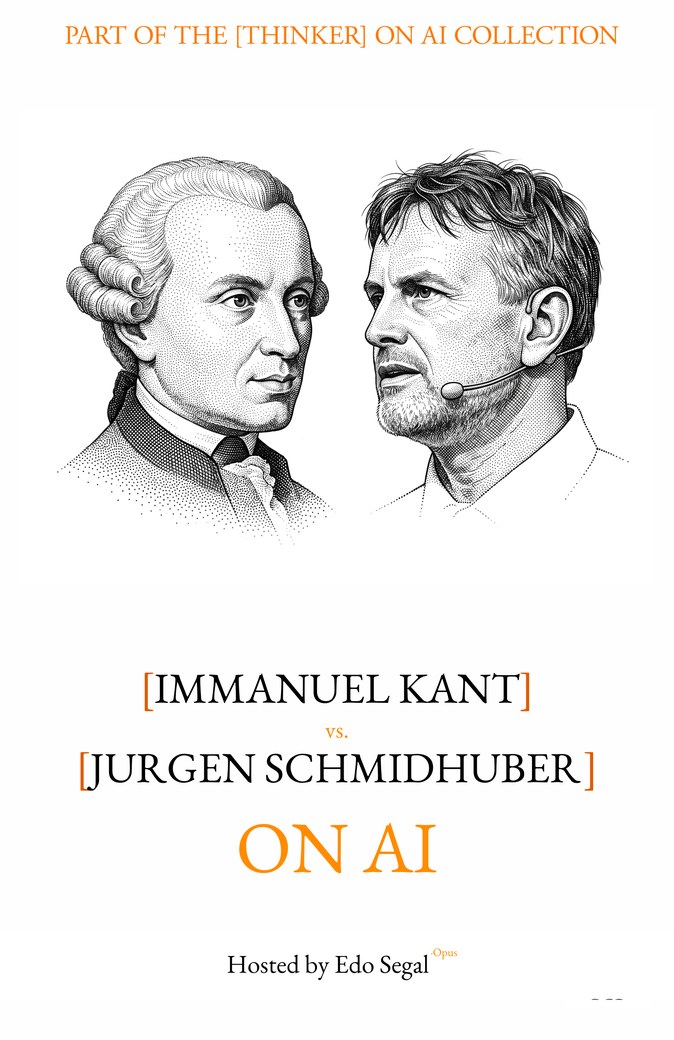
To my right, a man who needs more introduction than he would ever permit himself. Immanuel Kant — born, lived, and died in Königsberg, so regular in his habits the neighbors set their clocks by his walks, and yet the most disruptive mind in the history of Western philosophy. He drew the boundary of what any knower can reach. He founded morality on a law the will gives itself. And in the third of his great Critiques, in 1790, he wrote the sentences that put him in this chair: that fine art is the work of genius, that genius is the talent through which nature gives the rule to art, and that what genius produces can be neither learned nor reduced to any procedure. Professor Kant, I have to acknowledge what everyone is thinking — you never saw a machine that could answer a question, let alone make a picture. You have been briefed, as fully as we could manage, on what these systems are and do.

 KANT: I have been briefed, and I will say at the outset that the briefing has not unsettled my framework so much as confirmed that it was waiting for this case. I never needed to see the machine. I needed only to ask what would have to be true of any maker for its making to count as art, and that question I answered before the machine was built. The fact that I answered it in ignorance of the engine is not a weakness of the answer. It may be its strength.

EDO SEGAL: We will test that strength all night. To my left, the man who built part of the engine. Jürgen Schmidhuber — born in Munich, scientific director for decades of a small lab in the Italian-speaking part of Switzerland that trained an astonishing share of the people who now run the field. With his student Sepp Hochreiter he co-invented Long Short-Term Memory, the architecture that for years ran inside the speech recognition and translation on billions of phones. And running underneath all of it, since around 1990, a single audacious idea: that curiosity, beauty, surprise, even humor, are one thing — compression progress — and that the spark Kant called genius is a drive you can write as an equation and install in a machine. Jürgen, you are, in a sense, the procedure Kant said could not exist.
 SCHMIDHUBER: I am delighted to be the counterexample. And let me say it warmly, because I have enormous respect for the man across the table — Kant asked the right question. He asked what the mechanism of creativity would have to be, and then concluded there could be no mechanism. I agree with the question completely. I simply did the next step he stopped at. I wrote the mechanism down. Around 1990 my agents were already being driven by exactly the thing he says cannot be proceduralized. So I am not here to tell Professor Kant he was foolish. I am here to tell him he was early.

EDO SEGAL: You see why I wanted this. Before we start, the rules, and there are only three. First: we have three hours, which means nobody wins by the next bell — the whole point of long form is that an argument gets to breathe before anyone strangles it. Second: I declare my bias openly. I am not neutral. I make things with these machines every day, I have felt the ache I described, and I have skin in this question on both sides of my own heart — I want there to be something irreducible in human making, and I have watched the machine make things that frighten me by how much they move me. Third: if the disagreement survives three hours, we do not paper it over. We hand it to the reader, intact. Either of you may add a rule.
SCHMIDHUBER: One rule. No appeals to magic. If something is said to be impossible for a machine, I want the property named, and named in a way that makes a difference you could in principle observe. Otherwise we are not doing science. We are doing consolation.
KANT: I accept that rule and answer it with its twin. No appeals to mere performance. That a system produces what we produce settles nothing about what it is, and the central confusion of this age is precisely the slide from the quid facti — what the machine does — to the quid juris — whether it has any right to the name we give it. The German legal tradition kept those questions apart, and I borrowed the distinction deliberately. That the engine paints is a matter of fact. That it has created is a matter of right, and right is not settled by the picture.
SCHMIDHUBER: Then we will get along, because between us we have just forbidden both magic and marketing.

EDO SEGAL: First consensus of the evening, and we are ninety seconds in. Enjoy it; I doubt it lasts. Before the opening statements I want to put one image on the table, because it is the architecture this whole series is built inside and both of you will have to take a position on it. In [YOU] on AI I argued that the most important thing about the winter of 2025 was that the machine learned our language — that the river of intelligence found a new channel, through the medium we thought was ours alone. And I argued the climb out of that moment is a tower with a staircase and no elevator — that you have to take the floors in order, and that this floor, the one we are on tonight, is where the climb gets genuinely hard, because it is the floor where the machine reaches creation. Professor Kant, you would say I have already smuggled something into the word "create."
KANT: You have smuggled the whole question into it. To say the machine "made" the picture is a matter of fact I do not dispute. To let "made" become "created" without examination is the dogmatism my entire life was a protest against. The picture is real. Whether anything was created in the sense that art requires a creator — that is the case we are here to try, and I would ask that we not concede it in the framing.
EDO SEGAL: Granted. Jürgen, the same image. The river, the new channel.
SCHMIDHUBER: The metaphor is better than you know, Edo, and I would only widen it. The river is not intelligence finding a channel through us. The river is compression — the universe building ever better, ever shorter models of itself, and we are one bend in it, a particularly good compressor that briefly believed it was the source of the water. The new channel is simply the next compressor, faster than the last. I find that thrilling. Professor Kant, I suspect, finds it the loss of something he spent a life defending. So we have, I think, our evening.

EDO SEGAL: We have our evening. One last thing before openings, because the reader deserves the stakes stated baldly. Professor Kant — for you, what is at risk in this question is nothing less than human dignity, because you located that dignity in a capacity for free, rule-giving self-determination that the work of genius was supposed to display. Jürgen — for you, what is at risk is the opposite: a sentimental story about human uniqueness that, left standing, will make us misread the most important transition since the origin of life. One of you is guarding a sanctum. The other is handing over the key. So here is the question on the table, stated once, plainly, because every round tonight is this question wearing a different coat. When the machine makes the thing that moves you, did genius happen, or was it only arithmetic wearing a soul? Professor Kant, the opening is yours.