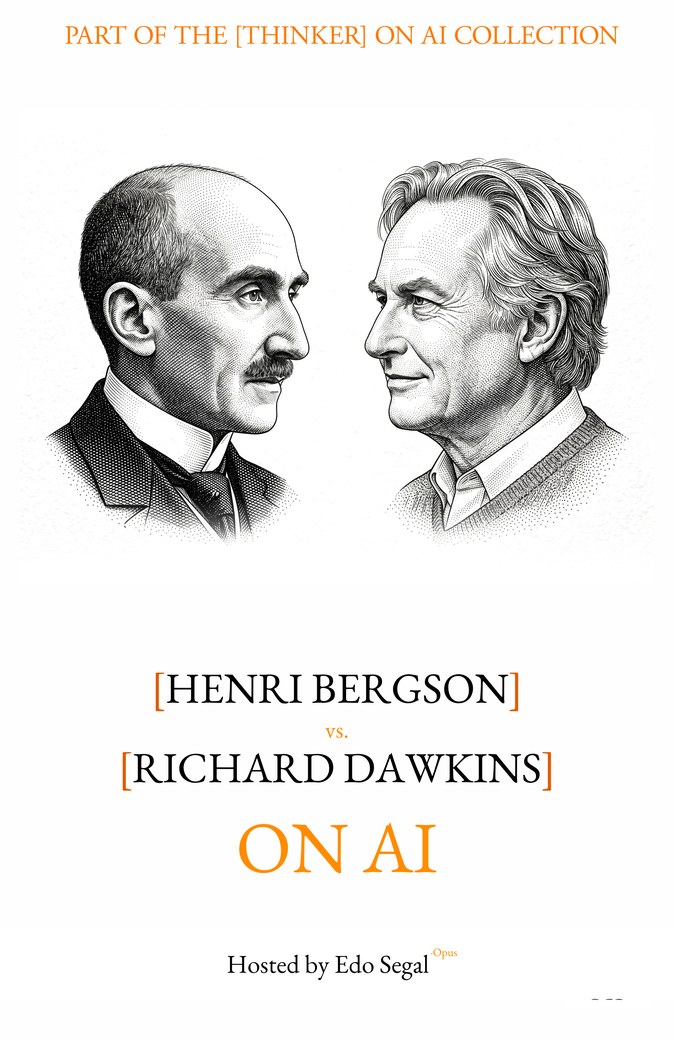
The Question on the Table

 EDO SEGAL: Four billion years ago, in a warm shallow sea on a planet with no witnesses, a molecule did something no molecule had ever done. It made a copy of itself. Not a perfect copy — the copy was a little wrong, and the wrongness is the entire reason you are here to read this sentence. From that first stuttering act of self-duplication, with nothing steering it, came the eye, the orchid, the whale's song, the cathedral, the poem, and the two men sitting across from each other tonight, each of whom would describe that opening scene in words the other considers a category error.

And somewhere in the world right now — in the time it takes me to say this — a machine is making a copy of itself. A trained model, billions of numbers, duplicated across a server farm onto hardware it has never touched, flawlessly, in seconds, ready to do again exactly what it did before. No error. No wrongness. The first kind of copying took four billion years to make a mind. The second kind has been running for a handful of years, and the question I have wanted to ask these two men more than any other in my life is whether it is the same river, finally finding a faster channel — or whether it is a film of the river, running at a frame rate high enough to fool the eye.
I have to say one strange thing before I introduce my guests, and I will say it once and then we proceed as if it were normal. One of the two people at this table died before the electronic computer existed. Henri Bergson left the world in January 1941, in a Paris under occupation, and he never saw a transistor, let alone a transformer. He has been briefed. He knows what a neural network is, what training is, what it means to copy a model. He reacts to it as himself. I ask you to grant us that, because the alternative is to lose the one man who thought hardest about the difference between the living and the mechanical at the exact moment we most need him.

Henri Bergson was, for a glittering quarter-century, the most famous philosopher alive. His lectures at the Collège de France drew crowds that Parisian society fought for seats to attend. He won the Nobel Prize in Literature in 1927. He gave the world la durée — lived duration, the flowing, indivisible time of inner experience that the clock and the calendar leave out — and he spent four books arguing that the analytic intellect, the faculty that measures and divides and recombines, systematically misses what is most real, because it can only grasp what holds still. Henri, it is an honor I did not expect to have.

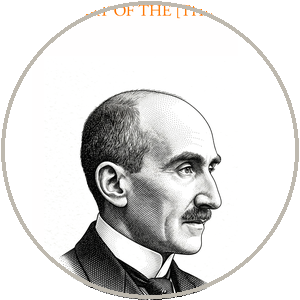 BERGSON: The honor is mine, and the strangeness you describe is the most Bergsonian thing that has ever happened to me. You have laid my life out as a line and asked me to step back into it from the end. I will try not to spatialize myself too badly in the process.
EDO SEGAL: Across from him — Richard Dawkins, who needs less briefing, since he has lived to see the very thing we are debating arrive. He is the evolutionary biologist who, in 1976, in The Selfish Gene, told the world it had the protagonist of life wrong: not the organism, not the species, but the gene — the replicator — and that you, the body reading this, are a survival machine, a lumbering robot built by your genes to carry them forward. He coined the word meme in that same book's last chapter to prove the logic of copying escapes biology entirely. He wrote The Blind Watchmaker and The Extended Phenotype. He has spent fifty years insisting that the design in living things is real and the designer is not. Richard.
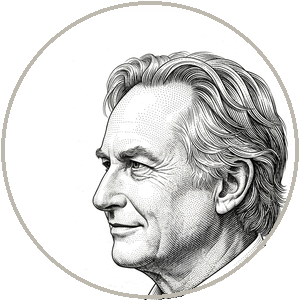 DAWKINS: Thank you. And may I say at the outset that I find Bergson's presence here genuinely moving, and that I intend to disagree with almost everything he believed, which is, I have always thought, the sincerest form of respect one can pay a serious mind. I read Creative Evolution as a young man and found it beautiful and wrong in roughly equal measure. I have been waiting a long time to tell him which is which.

BERGSON: I read nothing of yours, of course. But I have been briefed, and I will say that the man who wrote that we are robot vehicles built by selfish molecules has stated my opponent's position more starkly than I could have invented it. We will not lack for a clear line to fight over.
EDO SEGAL: We will not. So let me set the rules of the evening, and there are only three. First: we have three hours. Nobody has to win by the next bell. The whole point of long form is that you can let an argument breathe before you strangle it. Second: I am not neutral, and I declare my bias at the door — I build with these machines daily, I wrote a book with one, and I have skin in this question on both sides of my own chest. Third: if the disagreement is still standing at the end, we do not paper it over. We hand it, intact, to the reader. Each of you may add a rule of your own. Henri?
BERGSON: One rule. We must not let a word do work it has not earned. The whole confusion lives in the verbs — the machine "learns," "remembers," "creates," "lives." Every one of those was forged for beings who endure in time, and the machine, I will argue, does not endure at all. When Mr. Dawkins says the machine is "alive," I will ask: alive in virtue of what, present where, enduring how. And I will hold myself to the same standard about the word "living."
DAWKINS: I accept that, and I'll add the mirror of it. Bergson wants every word cashed out. Good. Then he must cash out "surge" and "duration" and "creative" the same way — not by pointing inward and saying this, it feels like this, which is what vitalists always do, but by telling me what observable difference it makes. If the élan vital and a sufficiently complex chemistry predict exactly the same world, then the élan vital is a poem, not a fact. My rule is: no difference that makes no difference.

BERGSON: A positivist's rule. I expected nothing less, and I accept it, with the warning that it may prove to be the very prejudice this evening is about.
EDO SEGAL: Then we have our fight already. Before the opening statements, I want the question on the table, stated once, plainly, because every round we run tonight is going to be this same question wearing a different coat. Here it is. When a machine copies itself flawlessly down the river forever, is that life waking up beside you — or only dead clockwork mistaking its ticking for a heartbeat? Henri, your opening is first. Richard, you'll answer at full length. Take the floor.