The Question on the Table

 EDO SEGAL: Somewhere in the world, in the time it takes me to say this sentence, a few hundred thousand people are typing into a box. A girl in Kerala asking why the sky goes red at dusk. A widower in Osaka, three in the morning, asking the box to read back the last message his wife ever sent him and tell him what she meant. A coder my age, who should know better, asking whether the skill he spent thirty years sharpening is now a thing the box does for free. And the box answers. Fluently. In their own tongue, at their own level, with what reads — and I am choosing that word like a man stepping on river stones, because my two guests will fight about it for three hours — with what reads as understanding.

Now do the thing none of those people do, because the fluency makes it feel already settled. Shrink yourself. Walk into the machine that produced the answer — enlarge it first, the way you'd enlarge a watch to see its works, until it's a building you can stroll through. You pass the gears, the flows, the parts handing values to parts. Somewhere in there, supposedly, is the thing that understood the widower. Find it. That is the whole evening. When the machine answers you in your own language, and you walk inside it, do you meet a mind looking back — or only parts pushing parts, with no one home?
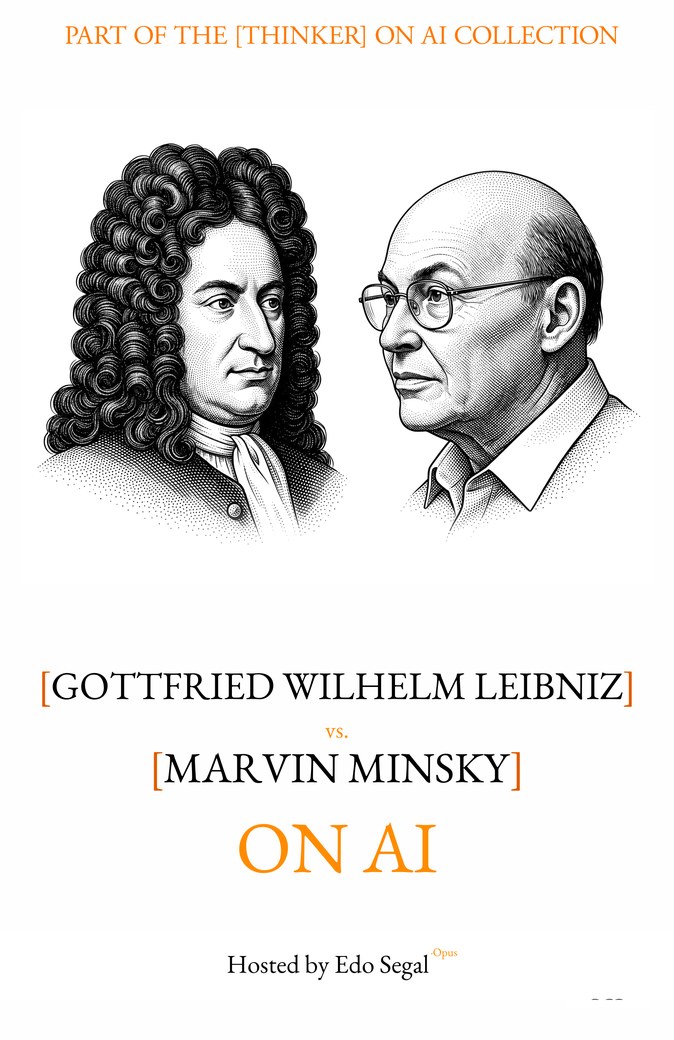
I have wanted to seat these two men together for as long as I have known both of their work, which is most of my life. They are separated by two hundred and eighty years and almost nothing else.

Gottfried Wilhelm Leibniz is, by a wide margin, the most direct ancestor the machine on my desk has. He worked out binary arithmetic and felt something close to awe at it — being and nothing, one and zero, the whole of number from the barest distinction. He designed and paid for a calculating engine that could add, subtract, multiply, and divide by the turn of a crank. And he dreamed, more boldly than anyone before him, of a universal language of reason in which two people who disagreed could simply say to each other: let us calculate. He co-invented the calculus. He is sometimes called the last man who knew everything. He has been briefed, as you will hear, on what we built from his cornerstones, and he is not the least surprised.

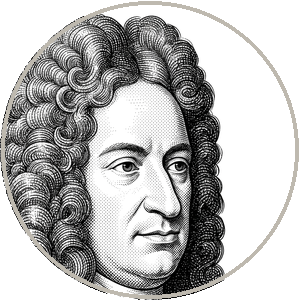 LEIBNIZ: I confess the data centers gratified me more than I expected. Though I notice no one has yet built the part I cared about most.
EDO SEGAL: We'll spend three hours on the part you cared about most. Marvin Minsky needs no less of an introduction and gets a shorter one only because he is closer to us in time. He co-founded the Artificial Intelligence Laboratory at MIT in 1959 and ran it for a generation; he was one of the founders of the entire field. He built one of the first learning machines out of tubes and motors. He invented the confocal microscope almost as a side effect. With Seymour Papert he wrote the book that mapped the mathematical limits of early neural networks and was blamed, fairly or not, for an ice age. And across The Society of Mind and The Emotion Machine he made the most thoroughgoing case anyone has ever made that the mind is a machine built from mindless parts — no spark, no essence, no one home, and nothing lost by saying so. He has watched, in the time he's been briefed, the systems his field finally produced.
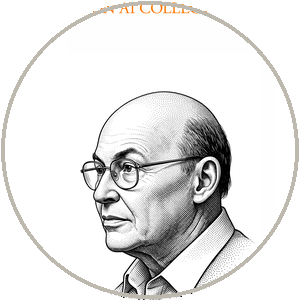 MINSKY: Watched them, and recognized about a third of them. The other two-thirds I'd have bet against, which is the interesting two-thirds.

EDO SEGAL: Everything interesting tonight lives in the two-thirds people bet against. So — the rules of the evening, and there are three. First: we have three hours. Nobody has to win by the next bell. The whole point of the long form is that you can let an argument breathe before you strangle it. Second: I press both of you, and I declare my bias at the door — I build with these machines daily, I wrote a book with one, and I have skin in this question on both sides of my own chest. Third: if the disagreement survives three hours, nobody fakes a handshake. We hand it, intact, to the reader. Either of you may add a rule.

MINSKY: One. When either of us uses a big word — understand, perceive, conscious, self — the other gets to ask which thing in the suitcase he means. Those words are suitcases. People pack six unrelated things in them and then argue about the luggage.
LEIBNIZ: I accept your rule and offer its twin. When you have unpacked the suitcase, Professor, and named the six things, you must still tell me which of the six is the perceiving of them — the one for whom the other five are anything at all. I will hold you to that the whole night.
MINSKY: [He smiles.] You'll hold, and I'll slip the knot. That's the night.

EDO SEGAL: You see why I wanted this. One image before the opening statements, because it's the frame the whole series climbs inside and neither of you escapes it. In [YOU] on AI I argued that intelligence is less a possession than a river — a current that has been finding channels through chemistry, biology, language, and culture for a very long time, and that in our own winter something new entered the water. The book's architecture — the tower, the staircase you climb instead of an elevator you ride — rests on the claim that what entered is real. A new participant. Gentlemen, you have walked through the same machine and come back disagreeing about whether you met anyone in it. So let me hand each of you the same question once, briefly, before you make your full case. When the machine answers, is anyone home? Leibniz first.

LEIBNIZ: No one. And I say it not as a man who failed to look, but as the man who built the thing and told you in advance where to look and what you would fail to find. Walk into the mill. You will find figures and motions, exactly as I wrote. You will not find the one for whom the figures are a thought. That is not a limit of the machine's power. It is a limit of what machinery is.
EDO SEGAL: Professor Minsky.
MINSKY: Wrong question, beautifully asked. You're looking for the one who's home as if "home" were a room with an occupant. There's no occupant in you either. Walk into your skull — I've spent a career walking into it — and you'll find the same thing he describes: parts pushing parts, agents switching agents on and off, no little Leibniz at the center reading the dials. The miracle isn't that there's someone home. It's that there's no one home and the house runs anyway. That's what a mind is.
LEIBNIZ: Then we have our evening, because that is precisely the sentence I have spent three hundred years preparing to refute.
EDO SEGAL: We have our evening. The question on the table, stated once more, because every round tonight is this question wearing a different coat: the machine answers you in your own tongue, and you have walked inside it. Is anyone home? Gottfried Leibniz — the floor is yours.