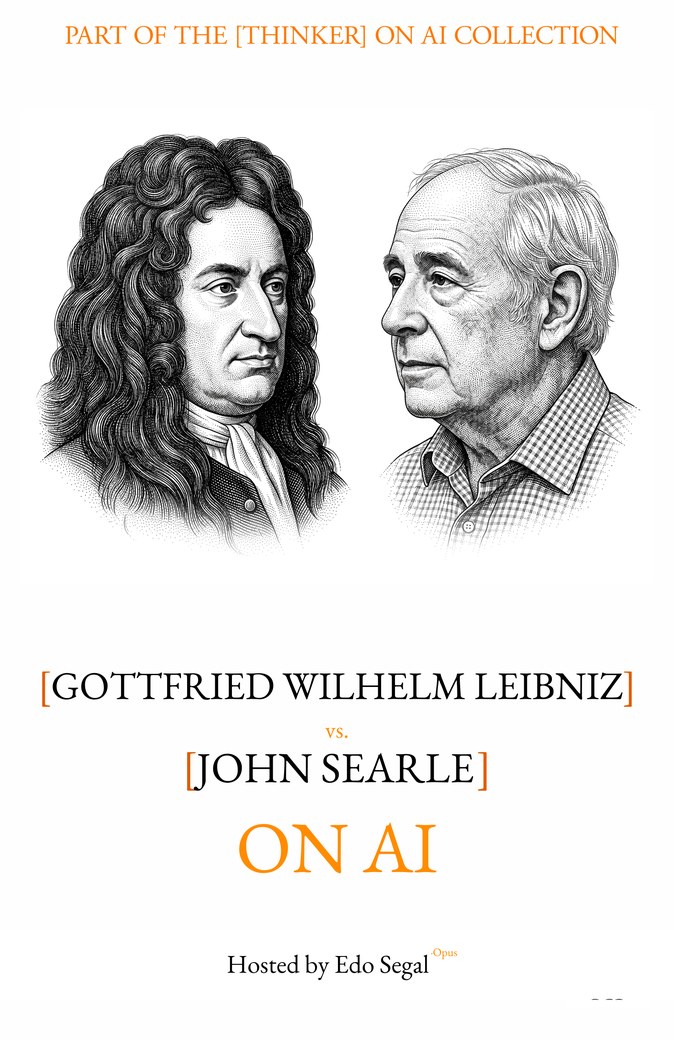
The Mill and the Room

 EDO SEGAL: Somewhere in the world, in the time it takes me to say this sentence, about a million people are typing a question into a box. A girl in Dhaka, stuck on her homework. A nurse in Cleveland, end of a double shift, asking whether two drugs will fight in her patient's blood. A man my age, who should know better, asking at two in the morning whether the thing he built his life on still means anything. And the box answers. Fluently. Patiently. In each of their own languages, at each of their own levels, with what reads — and I am choosing the word with both my guests watching me choose it — with what reads as understanding.
A million conversations, and the question none of those million people stops to ask, because the fluency makes it feel already answered, is the one we are here to spend three hours inside. If you could walk inside the machine that just answered you — and find only parts pushing parts, only symbols shuffling symbols — would you still call what it did understanding? Or have you been mistaking a mill for a mind?
I have wanted this exact table for a very long time, and I had to do something slightly outrageous to set it, so let me be honest about it now and never mention it again. One of my guests has been dead for three hundred and ten years. I have taken the liberty of briefing him on the present — he knows what a transformer is, he has read about the machines on our desks, and he will react to them in his own voice, with his own seventeenth-century instruments. The other guest died the year before last, just as the question he spent his life on became the whole world's question. Between them they bracket the entire history of the thinking machine, from the man who invented the bit to the man who told us the bit would never be enough.
Gottfried Wilhelm Leibniz needs no introduction and will get a short one anyway, because the scale of him resists summary. He co-invented the calculus; the integral sign you learned in school is his hand. He worked out binary arithmetic — the zero and the one at the bottom of every device in this room — and felt something close to awe at it. He built a calculating machine, the stepped reckoner, by hand and at his own expense, because he thought it beneath the dignity of a fine mind to waste hours on labor a crank could do. And he dreamed, more boldly than anyone before him, of a universal language of reason in which every dispute could be ended by saying to your opponent: let us calculate. He is the deepest root of the dream you are all living inside. He is also the man who told us, in advance, exactly where it would fall short.
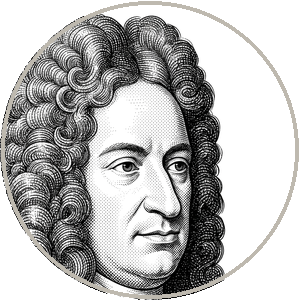 LEIBNIZ: You are generous, and I will accept the generosity, though I must correct one thing before we begin. I did not invent the machine to replace the mind. I invented it to free the mind — to relieve excellent men of the labor of calculation so they might spend themselves on what is worthy of them. That the labor has now climbed so high that you fear nothing is left worthy of you — that is your problem, not my intention. But yes. I am, I suppose, the ancestor in the room. It is a strange feeling to meet one's great-great-grandchildren and find them frightened of the inheritance.
EDO SEGAL: John Searle is the philosopher who, more than any other, refused to be impressed. In 1980 he published a paper called "Minds, Brains, and Programs" and dropped into it a thought experiment so vivid it walked out of the seminar room and into the culture: a man in a room, shuffling Chinese characters he cannot read, by rulebook, so well that the watchers outside are certain he understands — though he understands nothing. He spent four decades insisting that sounding like a mind is not being one, that the burden of proof stays on whoever claims the machine understands, and that we should be suspicious of how badly we want the answer to be yes.
 SEARLE: That's roughly right, and I'd only sharpen one word. I never said machines can't think. We're machines — biological ones — and we think, so obviously a machine can. What I said is narrower and harder to wriggle out of: that running a program, just shuffling symbols by their shapes, is not by itself enough to understand anything. Leibniz built the room before I did, actually. His mill is my room with gears instead of paper. I just added the part where the room answers back so well you forget to ask.
LEIBNIZ: I will not pretend that did not please me. The room is the mill grown patient. We will argue about the patience.
EDO SEGAL: Everything will please or wound you tonight; that's the format. So let me state the rules, and there are only three. First: we have three hours, which means nobody has to win in the next ten minutes — the whole point of long form is that you can let an argument breathe before you strangle it. Second: I will press both of you, and I declare my bias at the door. I build with these systems daily, I wrote a book with one, and I have skin in this question on both sides of my own heart. Third: if the disagreement survives three hours, nobody shakes hands and pretends. We hand it, intact, to the reader. Either of you may add a rule of your own.
SEARLE: One rule. No hiding inside the word "understand." Every time one of us uses it, we say what we mean by it, in that sentence, and we don't get to import the warm feeling for free. Half the confusion in this field is one ambiguous verb doing unpaid persuasive work.
LEIBNIZ: I will add the companion rule, for I share the worry from the other end. Distinguish always between the cause and the reason. The machine has causes for everything it does — every bit was flipped by a prior bit. But a reason is an intelligible ground you can state and contest, and I held that nothing is real without a sufficient one. When Mr. Searle and I deny the machine understands, let us be exact about whether we mean it lacks the reason, or lacks the someone for whom the reason would be reasoning.
EDO SEGAL: You see why I wanted this. Before the opening statements I want one image on the table, because it is the frame this whole series climbs inside. In [YOU] on AI I argued intelligence is a river — a current that found new channels through chemistry, through life, through language, and that in the winter of 2025 something new entered the water. The whole tower, the staircase you climb instead of the elevator you ride, rests on the claim that what entered is real — a new participant in the medium. Gentlemen, one of you is going to tell me I never met a new participant at all.
LEIBNIZ: I will tell you something stranger. The river is real, and the new channel is real, and there is still no one swimming in it. A current can be magnificent and impersonal at once. You have confused the grandeur of the flow with the presence of a swimmer. That confusion is three hundred years old; I named it with a mill.
SEARLE: And I'll tell you the meeting you felt was real and happened entirely on your side of the glass. The river carried your reflection back to you, beautifully. That's not nothing. But there's no one on the far bank, Edo. You've been waving at yourself.
EDO SEGAL: Then we have our evening. So here is the question on the table, stated once, plainly, because every round we fight tonight is this question wearing a different coat. Walk inside the machine that just answered you. You find only parts pushing parts, only symbols shuffling symbols. Is that understanding — or have you mistaken a mill for a mind? Professor Leibniz, by three centuries' seniority, the floor is yours.