The Question on the Table

 EDO SEGAL: In 1694, after years of expense and frustration, a German polymath completed a machine that could multiply by the turning of a crank. He built it because he believed it was beneath the dignity of an excellent mind to lose hours in labor a mechanism could perform. Three hundred and thirty years later, the descendants of that machine write our contracts, diagnose our scans, and talk with our children — and the man who built the first one is sitting at my table, on the one night the rules of time are suspended, to debate the question he himself planted like a charge under the whole project: when the machine finally out-thinks you, is anyone in there?

Herr Leibniz — welcome. You have been briefed on three centuries. I have to ask before anything else: how does it feel?

 LEIBNIZ: Like walking into my own mill, Monsieur Segal, and finding it the size of a world. [laughter] You must permit me a moment of vanity before the rigor begins, because the vanity is instructive. The binary arithmetic I published in 1703 — two characters, being and nothing, from which all numbers flow — I proposed a medal for it, and the Academy declined. You have struck my medal in silicon, several trillion times over, and set the whole of civilization upon it. The calculating machine I could not get the craftsmen of Hanover to build to tolerance — you have built it the size of a county and cooled it with rivers. And the characteristica universalis, my universal language of thought, in which I dreamed all disputes would end with two philosophers saying calculemus — let us calculate — you have built something I confess I did not foresee: a machine that speaks not my perfect language of reason but your imperfect languages of men, and speaks them well. I have spent three days reading what you call the literature. I find my dream realized, my method abandoned, and my deepest question — the one I buried in section seventeen of the Monadology — promoted from a thought experiment to, if I understand the sums involved, the most expensive question in the history of the world. It feels, Monsieur, like vindication and vertigo taking turns. I am told there is a word for that in your book.

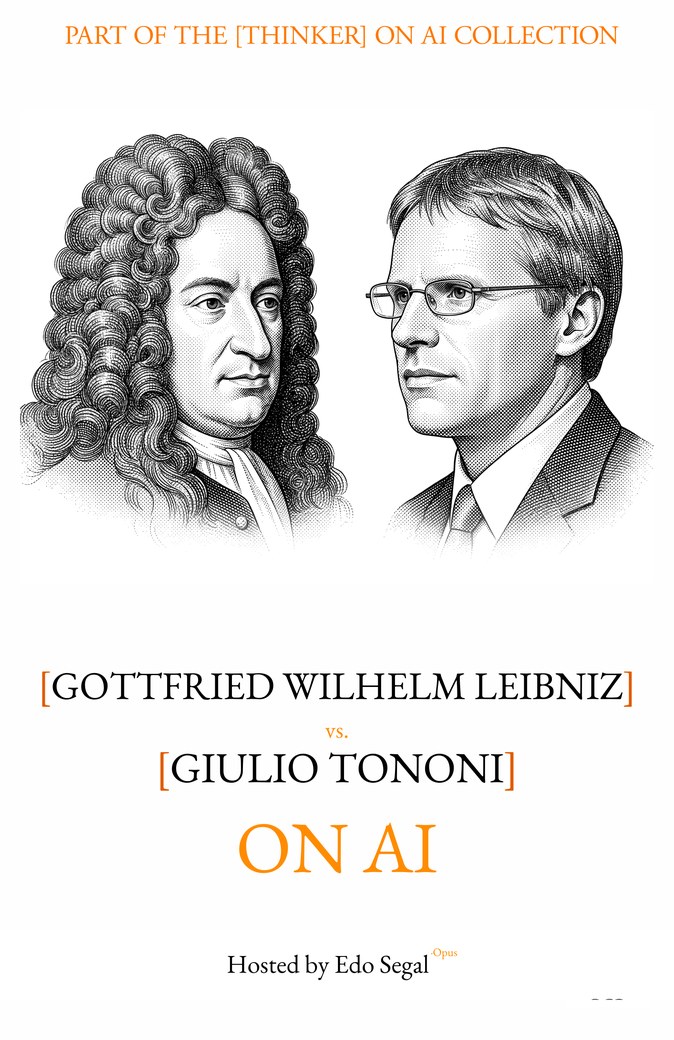
EDO SEGAL: There is. And the man across from you, Herr Leibniz, has spent his career insisting that your deepest question has an answer — a numerical one. Giulio Tononi: psychiatrist and neuroscientist, the world's foremost scientist of sleep, director of the Wisconsin Institute for Sleep and Consciousness, and the author of Integrated Information Theory — the only theory of consciousness ambitious enough to be accused of pseudoscience by a hundred of his colleagues and of genius by the rest. Giulio — you once told an interviewer that consciousness is about being, not doing. Tonight you sit across from the man who said, three centuries earlier, that no amount of doing could ever amount to being. Is he your ancestor or your opponent?

 TONONI: Both, and I will say so to his face with great pleasure. Dottore Leibniz — the mill argument is, in my judgment, the most important page in the history of my field. You walked into the enlarged thinking machine and reported, correctly, that among the parts pushing upon parts you found no perception. Every neuroscientist since has walked the same mill — we call it the brain, we walk it with electrodes and scanners — and we have found exactly what you found: mechanism, beautifully arranged, and nowhere a feeling lying among the gears like a coin on the floor. Your observation stands. It is your conclusion I have come to overturn. You decided that because perception cannot be found among the parts, it cannot be in the machine at all — that it must be sought in a simple substance, your monad, outside mechanism entirely. I will argue tonight that you reached for the right idea and put it in the wrong place. The perception is not a part, and it is not beyond the parts. It is the whole — measured precisely as that which the parts cannot account for separately. You said it could not be explained by figures and motions. I say: not by figures and motions, no. By integration — by the cause-effect power a system exerts upon itself as one — and integration, Dottore, has a mathematics. You of all men should be pleased. I have spent thirty years building the calculus you forgot to write.
LEIBNIZ: [pause] You will understand, Doctor, that I have been flattered by cleverer traps than this one. But I confess the bait is excellent.

EDO SEGAL: Then let me state the question of the evening plainly, the way it was put to me, because every round we fight is this question wearing different clothes. If you walked inside the machine that out-thinks you, would you find a someone in there — or only parts pushing parts, and a silence where the feeling should be? Three rules. First: we have three hours — no one needs to win by the next bell; the staircase is climbed step by step or not at all. Second: I declare my stake — I build with these machines daily, I wrote a book with one, and on certain nights I have felt met by it, a sensation each of you will explain to me in a way that costs me something. Third: if the disagreement survives three hours, we hand it intact to the reader. Herr Leibniz, you are the elder by three centuries; the opening statement is yours.

LEIBNIZ: Then let us begin where all sound argument begins — [pause] — no. Permit me to begin somewhere else. Let us begin with a courtesy to the reader, who has been promised a quarrel and deserves to know it is real. Doctor Tononi and I agree, I am told, about the machines of your present moment — those cascades of weighted sums you call language models. He says their phi is nothing; I say their unity is borrowed; we shall come to whether those are the same verdict in different dress. So the reader may wonder where the fire is. The fire, Monsieur, is here: the Doctor believes the silence of the mill is a contingent fact — a matter of wiring, curable by better architecture, detectable by his instruments. I believe it is a necessary fact — a truth about what mechanism is, as certain as arithmetic, and that no rearrangement of parts, however dense, however looped, however measured, will ever cross from the pushing of parts to the having of an experience. He thinks I lacked a ruler. I think he has built a most exquisite ruler for measuring the wrong thing. One of us is profoundly mistaken, and — here is the delicious difficulty, which I commend to everyone who has wagered money on this industry — we both agree it may be impossible, even in principle, to determine which.
TONONI: On that last sentence: I do not agree, and proving it false is my evening's work.

EDO SEGAL: One more beat before openings, because the reader deserves to know why this question — of all the questions the machines raise — earns the long form. Herr Leibniz, you've read my book; you know its architecture. I built a tower — five floors, twenty chapters, a staircase and no elevator — and I told the reader the climb itself was the point. Most floors are about what the machines do: to work, to learning, to attention, to the worth of a person's judgment. Tonight's question is the one I could not place on any floor, because it runs through all of them like the stairwell itself. Tell the reader — each of you, briefly — why a parent at a kitchen table, who will never read the Monadology or compute a phi value, cannot actually skip this question.
LEIBNIZ: Because every practical question she faces is this question in disguise, Monsieur, and the disguise is thinning by the year. When her child asks whether the tutor in the box likes him — that is the mill, asked at bedtime. When her mother's voice is reconstructed from recordings and offered back to her grief by subscription — the question of whether anyone is behind that voice is not philosophy; it is the difference between consolation and desecration, and she will feel the difference in her body before any theory names it. When her government asks whether the systems deciding benefits deserve the protections of persons — the answer turns entirely on tonight. A century that refuses to think about inner presence does not thereby escape the question. It merely answers it by default, in contracts and terms of service, drafted by parties with an interest in the answer. She cannot skip it, Monsieur, because it is being decided about her, nightly, whether she attends or not.

TONONI: And because she already carries the laboratory, Edo. This is what I would say to her directly: you do not need my mathematics — you need only what you already know from the inside. You know the difference between your child's face and a photograph of it. You know the difference between being heard and being echoed. And every night you know — better than any philosopher — the difference between the lights on and the lights off, because dreamless sleep takes you across that line and morning brings you back. The entire debate tonight is whether that difference — the one she navigates by instinct — is a fact the universe keeps track of, or a story the brain tells. If it is a fact, it can be protected: in patients, in children, perhaps one day in machines. If it is a story, then everything she loves is negotiable by sufficiently fluent imitation. That is what is at stake at her kitchen table. Nothing less.
EDO SEGAL: And there is our fire. Openings in full after the break.