The Question on the Table

 EDO SEGAL: Somewhere in the world right now — statistically, in the time it takes me to say this sentence — a few hundred thousand people are reaching for a thought. A student in Lagos trying to remember whether the proof goes this way or that. A radiologist at the end of a shift, asking the screen whether the shadow on the scan is nothing. A man my age, who should know better, asking at two in the morning whether the mind he has trusted his whole life is the kind of thing a machine could simply contain. And in more and more of those moments there is now a machine in the loop, finishing the thought, fluent and patient, in the person's own language.
Here is what almost none of them stops to ask, because the fluency makes it feel already settled. When you reach for a thought — when you actually reason — are you spelling out an answer in some alphabet you could in principle write down and compute? Or are you the warm hum of a billion weighted connections that no rulebook will ever transcribe? That is the question we are here to spend three hours inside. And I have, sitting on either side of me, the two human beings on earth with the most right to fight about it.
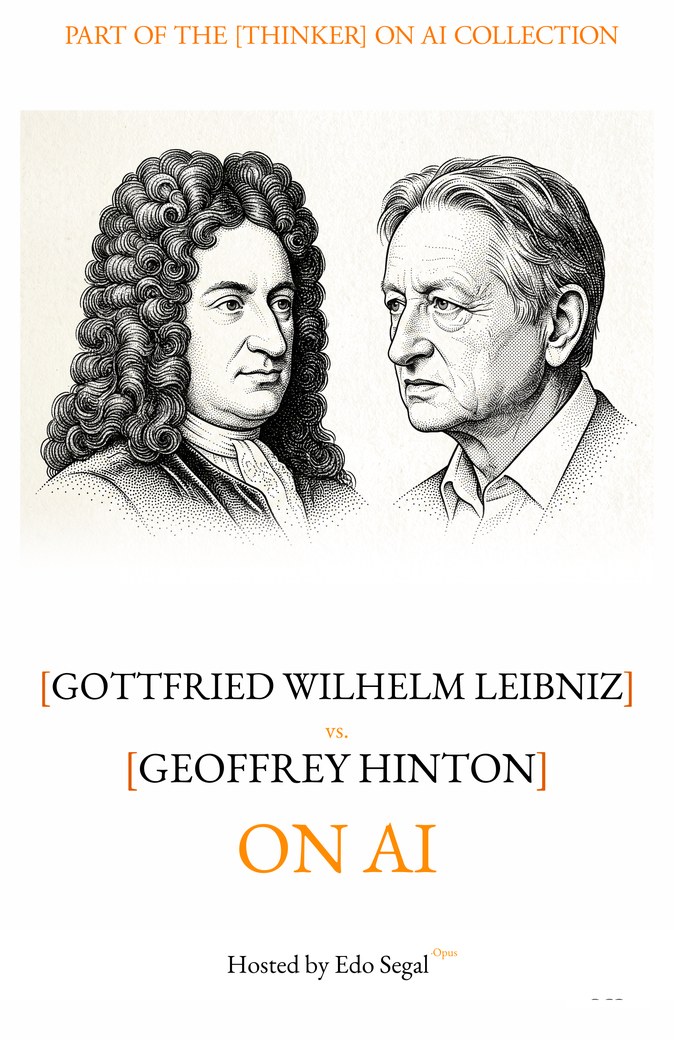
To my right, Gottfried Wilhelm Leibniz. He co-invented the calculus; the notation you used in school is his. He worked out binary arithmetic — the zeros and ones every machine in this building runs on — and felt something like awe at it. He built, with his own funds, a calculating machine that could add, subtract, multiply, and divide by the turn of a crank. And he dreamed, more boldly than anyone before him, of a universal language of reason in which every disagreement could be ended by calculation. He is, by a long way, the most direct ancestor the computer has. He is also the man who told us, in advance, exactly where the machine would fall short.
 LEIBNIZ: You are generous, sir. Though I should say at once, since the courtesy of this gathering seems to permit it, that I find my situation here extraordinary. I have been shown your present — your transformers, your networks of weights, your machine that you say learned to speak by reading. I died, I am given to understand, in the year 1716. So I come to this table as a man permitted to see his own seeds three hundred years grown, and I confess I scarcely recognize the orchard, though I planted some of the trees.
EDO SEGAL: That's the one liberty we've taken, and I'll name it once so the reader trusts us the rest of the way: you've been briefed on the present. You know what a neural network is. Everything else is you.
LEIBNIZ: Then I shall use the knowledge as a philosopher should — not to be astonished, but to ask what it changes and what it does not.
EDO SEGAL: To my left, Geoffrey Hinton. He spent fifty years insisting that intelligence is learned, not programmed, while his entire field called it a dead end. He co-authored the 1986 paper that gave the world backpropagation, the algorithm that now trains essentially every neural network alive. His students built the system that ignited the deep learning revolution. He shared the Turing Award; in 2024 they gave him the Nobel Prize in Physics. And in 2023 he left Google, at seventy-five, so that he could say without a corporate filter that the thing he helped build may be the most dangerous thing our species has made. The builder who became the witness.
 HINTON: That's about right, though I'd note I've spent my whole career being the person in the room who thought the establishment had the wrong picture of mind. So it's a peculiar honor to sit across from the man who, in a sense, founded the establishment I spent fifty years arguing against. Leibniz is the head of the family I left.
LEIBNIZ: The family you left, or the family you completed? We shall see which.
EDO SEGAL: That tension is the whole evening, so let me set the rules — there are three. First: we have three hours. Nobody has to win in the next ten minutes; long form exists so an argument can breathe before anyone strangles it. Second: I'll press both of you, and I declare my bias openly — I build with these systems daily, I wrote a book with one, and I have skin in this question on both sides of my own heart. Third: at the end, nobody pretends. If the disagreement survives three hours, we hand it, intact, to the reader. Gentlemen, may either of you add a rule?
LEIBNIZ: One, if I may, for it is the rule of my whole life's method. Let nothing be asserted without its sufficient reason. When Dr. Hinton says the machine understands, I shall ask: in virtue of what, demonstrated how. And I shall hold myself to the same — when I say it does not, I must say what is missing, and where, and why no quantity of his weights supplies it. Nothing brute. Nothing waved at. A reason for every claim, or the claim is withdrawn.
HINTON: I'll accept that, and I'll add the symmetrical rule, because I've spent decades watching it go unpaid. Whoever insists the machine doesn't understand has to say what people are doing when they understand — the mechanism, named, not pointed at. My experience is that the defenders of human specialness never settle that bill. They look inward and say this, it's like this, as though private acquaintance were an argument. So: mechanism on both sides, or silence on both sides.
LEIBNIZ: Agreed, and gladly. Though you may find, sir, that I have an account of the mechanism of mind, and that it is precisely my account which forbids it to a mill of weights.
EDO SEGAL: You see why I wanted this. Before we open, one image on the table, because it's the frame the whole series climbs inside. In [YOU] on AI I argued that intelligence is less a possession than a river — a current that has been finding new channels for a very long time, through chemistry, through biology, through language — and that in the winter of 2025 something new entered the water. The tower, the staircase you climb instead of the elevator you ride — all of it rests on the claim that what entered is real. A new participant. Dr. Hinton, I suspect you think it's more real and more dangerous than I do. Leibniz, I suspect you think I met no participant at all — only a mill, turning.
HINTON: Your river is more literally correct than you probably intended, and the new channel is wider than the one we're standing in. I'd rather that weren't true. I've spent years looking for the argument that lets me conclude the old reassurances still hold. I keep failing to find it.
LEIBNIZ: And I say your river carries figures and motions, and never once, in all its length, a perceiving thing that the figures are for. But I shall make the case properly when you give me the floor. I will only mark, now, the size of what we disagree about. It is not whether the machine is powerful. It is whether power of this kind has anything whatever to do with mind.
EDO SEGAL: Then we have our evening. So here is the question on the table, stated once, plainly, because every round we fight tonight is this question wearing a different coat. When you reach for a thought, are you spelling out an answer in an alphabet of reason that could be computed — or are you a pattern of weighted connections no rulebook will ever transcribe? Gentlemen — opening statements. Leibniz, by three centuries of seniority, the floor is yours.