Let Us Calculate
 **EDO SEGAL:** Somewhere in the world tonight, in the time it takes me to say this sentence, a few hundred thousand people are handing a disagreement to a machine. Not a calculation — a disagreement. A woman in Lagos asking whether her landlord's eviction notice is legal. A father in Ohio asking whether the thing his oncologist said and the thing his cousin said can both be true. A teenager asking the box, at two in the morning, which of two lives he should want. And the machine answers. Fluently, instantly, in their own tongue, with what reads — and I am choosing that word with enormous care, because my two guests will fight over it for three hours — with what reads like the verdict of a mind that has already finished thinking.
A disagreement, handed to a machine, settled by computation. There is a man at this table who proposed exactly that, in writing, three hundred and fifty years ago, and who would weep with joy to see it. And there is a man at this table who built the machine that made it possible, and then proved — proved, the way you prove a theorem, with no escape hatch — that there are questions that machine can never settle, no matter how vast it grows.
I have wanted this conversation my whole working life, and I had to bend two centuries of mortality to get it.
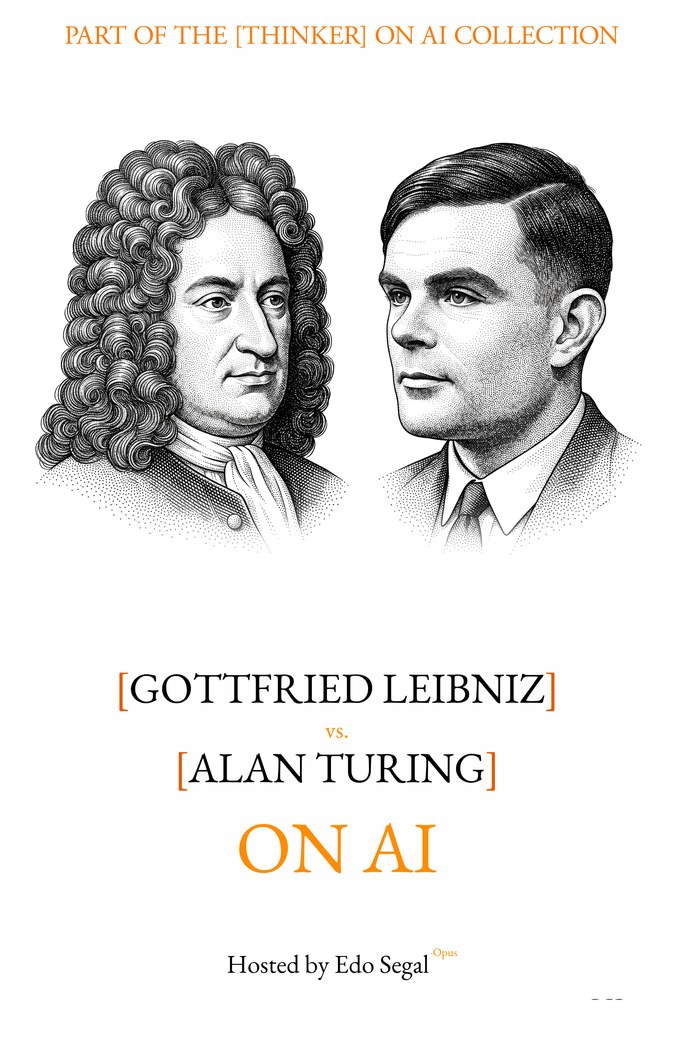
Let me introduce them, and let me say the strange thing first, because the reader deserves the rule of the evening before the players. These two men never met. Gottfried Leibniz died in 1716. Alan Turing was born in 1912, very nearly two hundred years later. Tonight they sit across from each other, and each has been briefed on the present — Leibniz knows what a transformer is, has been shown what the machines now do, and reacts to it as himself; Turing has, in some fashion, lived to see his own test passed. We acknowledge the artifice once, here, and then we let it go and listen.
Gottfried Wilhelm Leibniz. Philosopher, mathematician, jurist, diplomat, librarian to the House of Hanover — the last man, it is sometimes said, to hold the whole of European learning in a single head. He invented the calculus, and published it before Newton, and paid for it with the bitterest years of his life. He devised the binary arithmetic of zeros and ones on which every machine in this room runs. He built the first calculator that could perform all four operations. And he proposed, in detail, that all of human reasoning could be cast into a perfect symbolic language and settled by a calculus of inference — so that when men disagreed, they could simply say: let us calculate. He is the author of the dream. Not a precursor to it. The author.
 **LEIBNIZ:** You are too generous, and I will accept all of it, because flattery, properly examined, is merely true praise delivered with feeling.
**EDO SEGAL:** Alan Turing needs a different kind of introduction, because half of what I would say about him, he proved, and you cannot flatter a proof. In 1936, at twenty-three, in a paper on an obscure problem in logic, he invented the concept of the universal machine — a single device that could become any other machine, that could compute anything computable. Every computer that has ever existed is an instance of it. In the same paper, in the same breath, he proved that this all-powerful device could not answer certain questions — that the impossibility was permanent, written into the mathematics, true of any machine that could ever be built. Universality and limit, born together, from one mind, in one year. He broke the naval Enigma and shortened a world war. He designed one of the first real computers. He asked, before anyone, whether a machine could think — and he asked it better than anyone has since.
 **TURING:** I should say at once that I did not prove the machine cannot think. People are forever crediting me with the gloomy half. I proved it cannot decide certain questions. That is a much narrower and much stranger claim, and the difference between the two is going to matter tonight more than anything else I say.
**EDO SEGAL:** Everything will matter tonight. Which brings me to the rules, and there are only three. First: we have three hours. Nobody wins by the next bell — the whole point of long form is that you can let an argument breathe before you decide whether to strangle it. Second: I am not neutral, and I will not pretend to be. I build with these machines every day, I wrote a book with one, and I have skin in this question on both sides of my own chest — I want Leibniz's world, where capability runs all the way to the horizon, and I am steadied by Turing's, where the floor has a limit written into it. When my own stake is touched, I will say so out loud. Third: if the disagreement survives three hours, we do not resolve it with a handshake. We hand it, intact, to the reader. Gentlemen — would either of you add a rule?
**TURING:** One. No appeal to what we wish were true. I had a name for that mistake in my 1950 paper — the heads-in-the-sand objection: the consequences of a thinking machine would be too dreadful, so we shall hope it is impossible. That is not an argument. It is a prayer wearing the costume of an argument, and I would like us to charge admission for it tonight, paid in evidence.
**EDO SEGAL:** Granted, and well-charged. Gottfried?
**LEIBNIZ:** Then I add its twin, in fairness, since Mr. Turing has disarmed only the fearful. No appeal to what we wish were false. There is a temperament that finds the mechanization of mind so distasteful that it hopes for a limit the way a man hopes for rain. If we are to bar the prayer of the optimist, let us also bar the prayer of the one who needs us to be irreplaceable. I have spent my life being told that something in man cannot be a mechanism. I should like, tonight, to see the proof and not the shudder.
**TURING:** Accepted, and I will hold myself to it. I do have a proof. We will get there.
**EDO SEGAL:** You see why I wanted this. Before the openings, one image on the table, because it is the frame this whole series climbs inside and both of you must take a position on it. In [YOU] on AI I argued that intelligence is less a possession than a [river](https://www.youonai.ai/fieldguide/med/river_of_intelligence) — a current that has been finding new channels for a very long time, through chemistry, through biology, through language, through culture, and that in the winter of 2025 something new entered the water. The whole architecture of my book — the tower, the [staircase you climb instead of the elevator you ride](https://www.youonai.ai/fieldguide/med/elevator_and_staircase) — rests on the claim that the river is real and that it does not negotiate; it finds the channel. Gottfried, I suspect you love that picture.
**LEIBNIZ:** I do not merely love it, sir — I require it. For if intelligence is a current that finds every channel, then there is no chamber of reason it cannot enter, and my whole faith is that the channel reaches everywhere. Reason is universal or it is nothing. The river that stops short of some truth is not the river I believe in.
**EDO SEGAL:** Alan?
**TURING:** I love the river too — more than he does, I think, though that will sound strange. But I have measured it. And a river that finds every channel is precisely the river I proved cannot exist. There are basins the water cannot reach, not because the current is weak but because there is no channel to them at all — the geography forbids it. I did not infer that. I demonstrated it. So I will hold his picture in one hand and my theorem in the other, and we will see, over three hours, which of us is holding the whole of it.
**EDO SEGAL:** Then we have our evening. Here is the question on the table, stated once, plainly, because every round we fight tonight is this question wearing a different coat. If you hand every disagreement to the machine and say "let us calculate," will it always hand you back an answer — or are there truths above you that no computation, however vast, can ever reach? Gottfried Leibniz, you wrote the dream. The floor is yours.