The Question on the Table

 EDO SEGAL: Four hundred years ago, in the cold of an English March, a man climbed down from a carriage on the road to Highgate because a thought had seized him that he could not let go. The thought was a question, and the question was whether cold could preserve flesh the way salt does. So he bought a hen, and he stuffed it with snow with his own hands, an old man kneeling in the frost to interrogate nature directly, and the chill he caught doing it killed him within the week. He died of his own experiment. I have never been able to decide whether that is the most foolish death in the history of thought or the most honest, and tonight I have the man himself to ask.

A few miles and four centuries away, a boy in Philadelphia was reading anarchist pamphlets in his uncle's newsstand and beginning to suspect that everything the experts around him asserted with confidence was, on inspection, either trivially true or quietly false. He grew up to end an entire school of psychology with a single book review, to discover something about the human mind so deep that it founded a science, and to live long enough — into his nineties, alive as I speak — to watch a machine learn to talk and to pronounce, with the same calm he has brought to every bad argument of the last seventy years, that the machine understands nothing at all.
I have wanted this conversation for longer than I have wanted almost any other, and I could not have it, because one of my guests has been dead since 1626. So I will say the strange thing once, plainly, and then we will never mention it again: Sir Francis has been briefed on the present. He knows what a neural network is. He has been shown the machine. He reacts to it as himself — as the Lord Chancellor of England and the author of the Novum Organum — and you, reader, are asked to grant him that one impossibility and no others, because everything else he says tonight is his own.

 BACON: I have died once already in pursuit of a question, sir. I am not going to be precious about a second improbability.

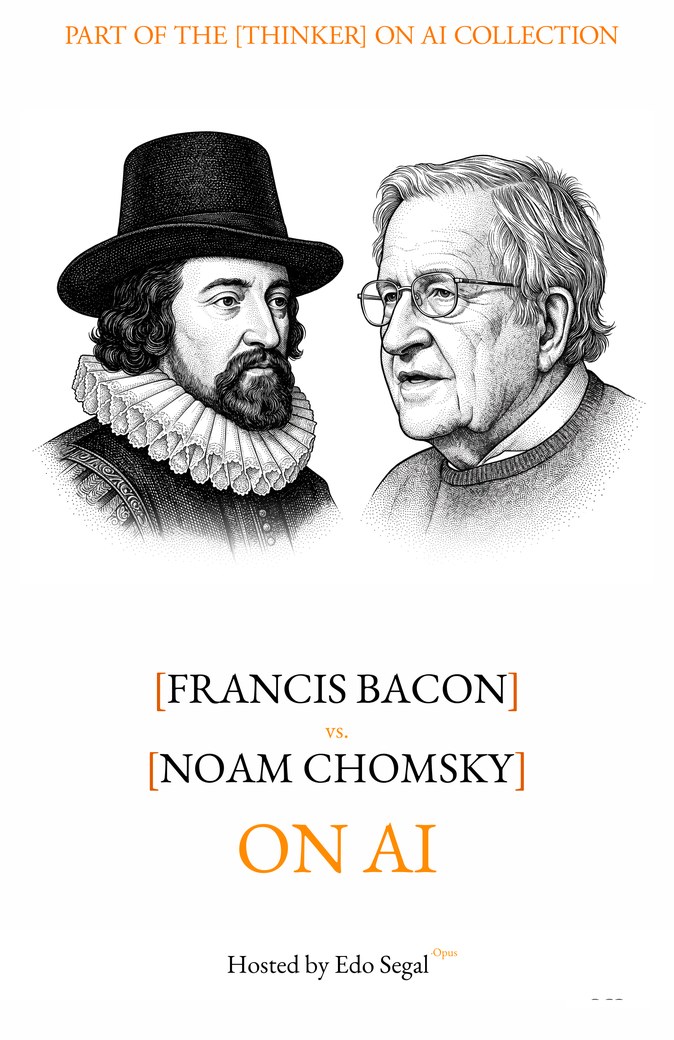
EDO SEGAL: Francis Bacon — philosopher, jurist, Lord Chancellor of England, and more than any single human being the architect of the method we call science. He taught the world that knowledge is not spun from the top down out of received first principles but built from the bottom up, instance by gathered instance, by the patient climb from particulars to laws. He gave us induction as a discipline. He gave us the four Idols of the Mind — the catalogue of how the apparatus of knowing deceives itself. He fused knowing with doing so tightly that the two became a single act, and he dreamed an institution to manufacture that fused knowledge at scale. He is the patron saint of letting the experiment overrule the theory, and he is here because the machine on this table is, in its deepest logic, his.
BACON: It is gracious of you to say so, and I will not pretend the resemblance has not struck me. Though I should warn the other gentleman that I claim the engine without claiming everything done in its name.
EDO SEGAL: Noam Chomsky needs no briefing on the present; he has been writing it. The father of modern linguistics. The man who, in 1959, reviewed B. F. Skinner's account of how language is learned and ended the behaviorist program that had ruled American psychology for a generation. He discovered that the child acquires an infinite, rule-governed competence from a handful of fragmentary, error-riddled examples — the poverty of the stimulus, the gap between what goes in and what comes out, where he argued innate structure must live. The most cited living intellectual. A founder of the cognitive science that today's AI claims as kin — and who has looked at that kin and called it, in his own words, a way of not learning anything about language.
 CHOMSKY: I'd only correct the introduction in one respect. I didn't end behaviorism. The facts ended it. I just pointed at them.

EDO SEGAL: Everything tonight will be about pointing at facts, and about who gets to say what the facts mean. So let me set the rules, because there are only three. First: we have three hours. Nobody has to win in the next ten minutes, and the whole point of long form is that you can let an argument breathe a long while before you decide whether to strangle it. Second: I will press both of you hard, and I declare my bias at the door — I build with these machines every day, I wrote a book with one, and I have a stake in this question on both sides of my own heart. Third: at the end, nobody shakes hands and pretends the disagreement dissolved. If it survives three hours, we hand it to the reader, intact. Either of you may add a rule.
CHOMSKY: One. We should distinguish, every time, between two questions that the field relentlessly merges: does the device work, and does the device explain anything. They are not the same question. The first is engineering. The second is science. Almost every confusion of the last few years lives in the collapse of the second into the first, and I'd like us to keep them apart by force.
EDO SEGAL: Granted, and noted as a recurring discipline. Francis?
BACON: Then I will add its companion, for it is the other half of the same coin. Let no man — and no machine — be believed merely because he speaks fluently and at length. The understanding is most easily captured through the ear; a well-turned sentence is taken for a true one before judgment has stirred. So when either of us says the engine "knows" or "understands," let us demand that the word be cashed in the only currency I have ever trusted: instances. Show me what it does, under what conditions, and where it fails. I will not take a definition. I never have.
CHOMSKY: On that we will agree more than you expect.

EDO SEGAL: Before the opening statements I want one image on the table, because it is the frame this whole series climbs inside and you will each have to take a position on it. In [YOU] on AI I argued that intelligence is less a possession than a river — a current that has been flowing and finding new channels for a very long time, through chemistry, through biology, through language, through culture, and that in the winter of 2025 something new entered the water. The book's whole architecture rests on the claim that what entered is real. Francis, I think your answer is that of course it is real, because it works, and working is the only test of real you have ever accepted. Noam, I think your answer is that I confused the water with the riverbed.
BACON: My answer is that you have described my own life's program and then asked me whether I believe in it. Yes. Knowledge is the image of the world as the world genuinely is, built up out of the world's own instances, and the new engine builds that image faster and from more instances than any college of men I ever imagined. Whether I am pleased by everything done with it is another matter, to which we will come. But that it knows — in the only sense of knowing I hold to be operative, which is that it can produce effects, predict, and command — I do not see how a serious man denies it.
CHOMSKY: And my answer is that you have a system that produces the surface of language and you are calling the surface the thing. The riverbed is the structure — the faculty, the constraints, the specific shape that makes a human language humanly learnable and an infinity of conceivable systems not. The water is the output, the text, the wake. Your machine has modeled the wake to a fineness that is genuinely impressive and tells us, about the riverbed, precisely nothing. It would model an impossible river just as well. That's the whole problem in one sentence, and we'll spend three hours on it.
EDO SEGAL: Then we have our evening. Here is the question on the table, stated once, plainly, because every round we fight tonight is this question wearing a different coat. Does the machine learn the world by grinding through enough of it — or can it never truly know anything it was not already built to know? Francis Bacon, you taught the world to grind. The floor is yours first.