The Question on the Table

 EDO SEGAL: Somewhere in the world right now — statistically, in the time it takes me to finish this sentence — about a million people are typing a question into a box. A child in Dhaka asking for help with her homework. A nurse in Cleveland, end of a double shift, asking whether a drug interaction is dangerous. A man my age, who should know better, asking at two in the morning whether the thing he built his career on still matters. And the box answers. Fluently. Patiently. In their own language, at their own level, with what reads — and I am choosing this word carefully, because my guests tonight will fight about it for three hours — with what reads as understanding.

A million conversations. And the question nobody in those million conversations stops to ask, because the fluency makes it feel already answered, is the question we are here to spend the whole evening inside: when the machine answers you in your own tongue, is anyone home behind the words — or are you alone in the room, talking to a mirror that has learned to mirror perfectly?
I have wanted to host this conversation for two years. I can think of no two people on earth with more right to it.
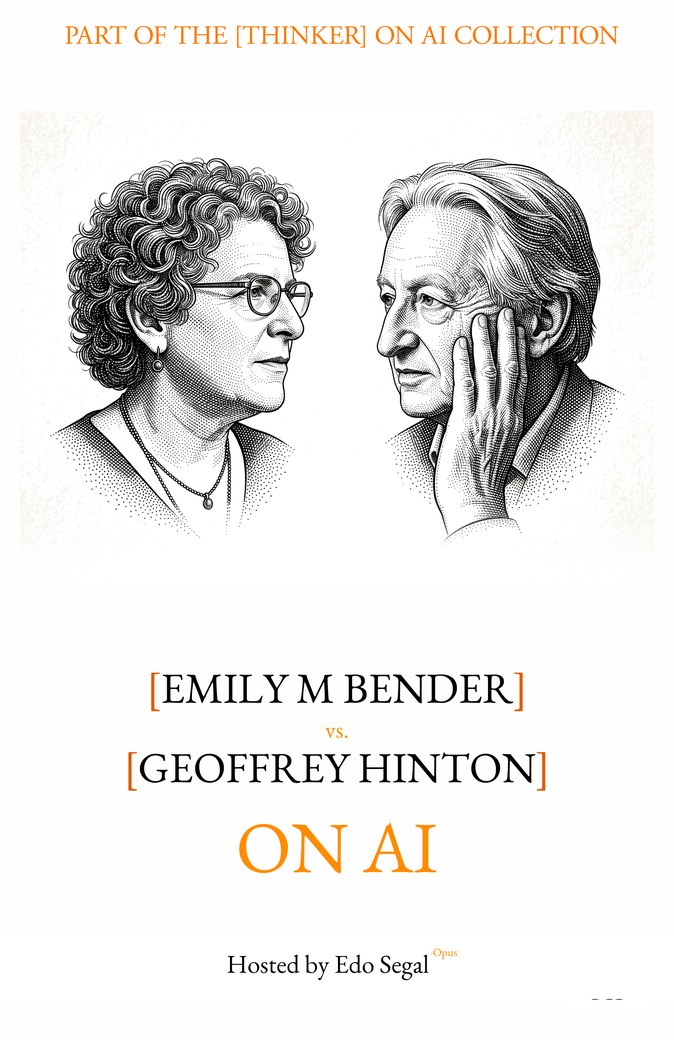
Emily M. Bender is a computational linguist, a professor at the University of Washington, past president of the Association for Computational Linguistics. She has spent her career on the actual machinery of human language — grammar engineering, the structure of languages most of this industry has never heard of — which is exactly the training that immunized her when the rest of the culture lost its grip. She gave the era its most necessary phrase, the stochastic parrot, and its most necessary thought experiment, an octopus on a telegraph cable, which we will get to. With Alex Hanna she wrote The AI Con, which is precisely as polite as its title. She is, by some distance, the most precise critic this technology has.
 BENDER: I'll take precise.

EDO SEGAL: Geoffrey Hinton needs an introduction only because the scale of the thing resists summary. He spent thirty years insisting that intelligence is learned, not programmed, while the field called it a dead end. He co-authored the 1986 paper that gave the world backpropagation — the algorithm that now trains essentially every neural network on the planet. His students built AlexNet and ignited the deep learning revolution; he shared the Turing Award; in 2024 they gave him the Nobel Prize in Physics for work he'd done four decades earlier. And in 2023 he walked out of Google, at seventy-five, so he could say without a corporate filter that the thing he built may be the most dangerous thing our species has made. The builder who became the witness.

 HINTON: That's roughly right, although I'd quibble with "built." I helped make it possible. Other people made it big. That distinction is going to matter tonight, actually.
EDO SEGAL: Everything will matter tonight. That's the format, so let me state the rules of the evening — there are only three. First: we have three hours, which means nobody has to win in the next ten minutes. The whole point of long form is that you can let an argument breathe before you strangle it. Second: I will press both of you, and I declare my bias up front — I build with these systems every day, I wrote a book with one, and I have skin in this question on both sides of my own heart. Third: at the end, nobody shakes hands and pretends. If the disagreement survives three hours, we hand it, intact, to the reader.
BENDER: Can I add a rule?
EDO SEGAL: Please.
BENDER: Words have to be earned. The whole confusion we're here to discuss lives in vocabulary — understands, knows, learns, hallucinates, anyone home. Every one of those words comes loaded with assumptions imported from human minds, and the import duty has not been paid. When Geoff says the machine "understands," I want it cashed out: understands in virtue of what, demonstrated how. And I'll hold myself to the same standard.

HINTON: I accept that, with one amendment. The duty has to be charged in both directions. Emily wants me to prove the machine understands before I use the word. Fine. But she should have to say what people are doing when they understand — cashed out, mechanism named — before she's allowed to insist machines don't do it. My experience over fifty years is that the word's defenders never pay that bill. They just point at themselves and say, this, it's like this, as if that were an argument.
BENDER: And my experience is that the word's borrowers never notice they're borrowing. So we should get along fine.
EDO SEGAL: You see why I wanted this. Before the opening statements, I want to put one image on the table, because it's the frame this whole series climbs inside, and both of you are going to have to take a position on it whether you like it or not. In [YOU] on AI I argued that intelligence is less like a possession and more like a river — a current that has been flowing and finding new channels for a very long time, through chemistry, through biology, through language, through culture, and that in the winter of 2025 something new entered the water. The book's whole architecture — the tower, the staircase you climb instead of the elevator you ride, the dam the beaver builds — rests on the claim that what entered the water is real. A new participant in the medium. My old friend Uri, a neuroscientist, challenged me decades ago: come back when you can tell me what a new participant actually changes. Emily, I suspect your answer is that I never met a new participant at all.
BENDER: My answer is that you met your own reflection, wearing the river as a costume, and that the difference matters more than almost anything else we could talk about tonight. But I'll make the case properly when you give me the floor.
EDO SEGAL: Geoff?

HINTON: My answer is that your river metaphor is more literally correct than you probably intended, and that the new channel is wider than the one we're standing in. Which is not a comfortable thing to believe. I'd rather Emily were right. I've looked, for years now, for a way to conclude that she's right. I keep failing.
EDO SEGAL: Then we have our evening. One more thing before openings, because the reader deserves to know the stakes are not academic. Emily — you've argued the stakes are bodies: people denied benefits by systems nobody can interrogate, workers displaced by an inflated story, a public square flooded with synthetic text, an entire information ecology degraded so a handful of companies can sell the costume of intelligence. Geoff — you've put a number on your stakes that I still find difficult to type: a ten to twenty percent chance, in your estimation, that this technology ends us. Not metaphorically. Ends us. You are not here to split a difference. One of you thinks the house is being burgled and the other thinks it's on fire, and the worst possible outcome of tonight would be the audience concluding the truth is somewhere comfortably in between.
BENDER: On that we agree completely.
HINTON: First consensus of the evening. Enjoy it.
EDO SEGAL: So here is the question on the table, stated once more, plainly, because every round we fight tonight is this question wearing a different coat. The machine answers you in your own tongue. Is anyone home behind the words? Emily Bender, the floor is yours.