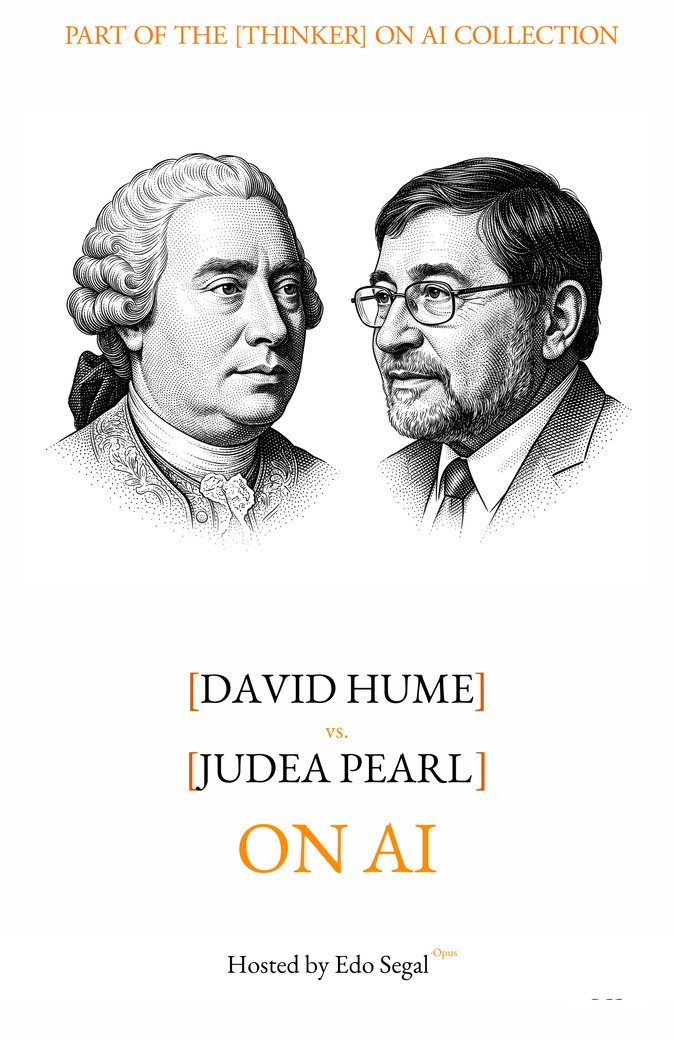
The Question on the Table

 EDO SEGAL: Somewhere in the world right now — statistically, in the time it takes me to say this — a child is watching the sun come up. And somewhere a machine has just finished its ten-millionth pass over a corpus in which the sun, every single time, comes up after the rooster crows. The child will grow up and learn, eventually, that the rooster has nothing to do with it; that the earth turns whether the bird is alive or dead. The machine will not learn that, because the machine has no way to ask it. It can only watch the mornings line up, one after another, and feel — if "feel" is even the word, and the two men at this table will fight about that word for three hours — feel the next sunrise coming with the perfect confidence of a thing that has seen the pattern hold without exception.

So here is the question we are going to spend the evening inside, stated once, plainly, because every round tonight is this question wearing a different coat. When the machine has seen the rooster crow ten million mornings, does it know the rooster wakes the sun — or has it only learned the world's loudest habit?
I have wanted to host this conversation for longer than I have known how to say it, because the two people I have brought here are, I have come to believe, the same mind aimed in opposite directions across the gulf of mortality.

David Hume was born in Edinburgh in 1711 and had finished dismantling the foundations of human reason before he was thirty. He divided the mind into impressions and ideas; he showed that every inference from what we have seen to what we have not rests on no logical ground whatsoever; and when he looked for the necessary connection between cause and effect — the thing that makes the second billiard ball move when the first one strikes it — he found that we never observe it at all. We observe one thing, then another thing, again and again, until habit carries us across the gap and we mistake the carrying for knowledge. He is, I will argue tonight, the philosopher artificial intelligence has been waiting for. He has also been dead for two hundred and fifty years, and he has been briefed on the present, and I am told he is enjoying himself.

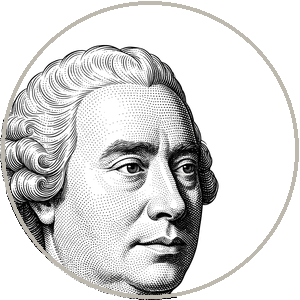 HUME: I confess I am. I spent my life arguing that the future need not resemble the past, and I have woken into a future that resembles nothing I could have imagined, which is either a refutation of my whole system or its grandest confirmation, and I have not yet decided which.
EDO SEGAL: We'll find out together. Judea Pearl needs less translation across the centuries but more across the disciplines. He was born in Tel Aviv in 1936, trained as an engineer, and then did the thing his entire field had declared forbidden: he gave causation a mathematics. When the science of statistics had spent a century intoning that correlation is not causation and then refusing to say what causation was, Pearl built the notation it lacked — the do-operator, the causal diagram, the Ladder of Causation with its three rungs: seeing, doing, imagining. He won the Turing Award for it. And he has looked at the machines everyone is so dazzled by and delivered the verdict that brings him to this table: that all the impressive achievements of deep learning amount, in his words, to just curve fitting.

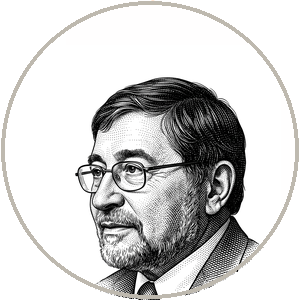 PEARL: I want to correct one thing before we even begin, because it will matter for three hours. "Just curve fitting" is not an insult. It is a classification. A curve is a magnificent thing. I have spent my life among curves. But a curve lives on the first rung of the ladder, and a mind lives on the third, and the distance between them is not a distance you cross by fitting a better curve. Mr. Hume will tell you there is no third rung. That is, I think, where we will disagree.

HUME: It is exactly where we will disagree, and I am glad we have found it in the first two minutes.
EDO SEGAL: Then let me state the rules of the evening — there are three, and I'll invite each of you to add a fourth. First: we have three hours. Nobody has to win by the next bell; the entire point of the long form is that you can let an argument breathe before you strangle it. Second: I declare my bias up front. I build with these systems every day, I wrote a book with one, and I have felt — at three in the morning, the house dark — the distinct sensation of a cause being understood on the other side of the screen, and I do not know which of you that sensation belongs to. Third: at the end, nobody shakes hands and pretends. If the disagreement survives three hours, we hand it to the reader intact. Dr. Pearl, a rule of your own?
PEARL: Yes. Every time one of us says the machine "understands" or "knows" or "reasons," he must say which rung he means. Those words are doing unpaid work all over the world right now, and I will not let them do it at this table. Seeing is not doing. Doing is not imagining. Name the rung.
EDO SEGAL: Mr. Hume?

HUME: A fair demand, and I'll add its mirror. Every time Dr. Pearl says a mechanism is "understood" or a cause is "grasped," I will ask from what impression that grasping derives — what we actually observe when we claim to see one thing produce another. He wishes me to name the rung. I wish him to show me the impression. I suspect we are about to discover that these are the same demand, and that neither of us can fully meet it, which is what will make the evening honest.

EDO SEGAL: You see why I wanted this. One image before we open, because it's the frame the whole series climbs inside and both of you will have to take a position on it. In my book I argued that intelligence is a river — a current that has found new channels through deep time, and that in the winter of 2025 something new entered the water. The architecture of everything rests on the claim that what entered is real. Dr. Pearl, I suspect you think a real thing entered the water but it is stuck thrashing on the bank. Mr. Hume, I suspect you think there was never a bank.
HUME: I think the river is the most honest thing you wrote, and more literally true than you intended. The current is constant conjunction, accelerating. What entered the water in your winter is not a new kind of mind. It is the oldest kind of mind — the only kind there has ever been — running at a scale that finally lets us see what it always was.
PEARL: And I think the river metaphor is exactly the seduction I have spent thirty years warning against. A river finds the channel; it does not choose it, model it, or imagine a different one. You have described, beautifully, a system that can never answer the one question intelligence is for: not where does the water go, but what happens if I move the rock. Watch the river for ten thousand years and you will not learn that. You have to get in and push.
EDO SEGAL: Then we have our evening. The question is on the table — does the machine know the rooster wakes the sun, or has it only learned the world's loudest habit. David Hume, you came first by two centuries. The floor is yours.