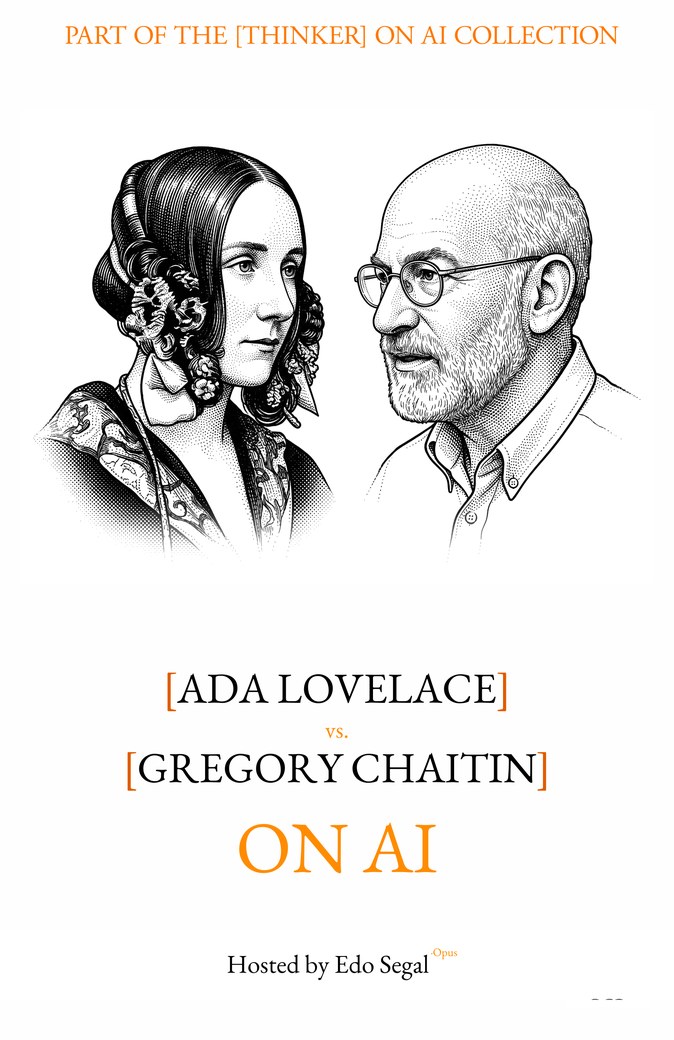
The Question on the Table
 **EDO SEGAL:** Somewhere in the world right now, in the time it takes me to say this sentence, a machine is producing something no human has ever produced. A melody that has never been heard. A sentence that has never been written. A protein that does not occur in nature, folded into a shape no chemist drew. And the person watching it appear on the screen — a student, a scientist, a songwriter at two in the morning — feels a particular jolt, half wonder and half unease, and asks the question that this whole evening lives inside. Did the machine make that? Or did it merely hand me back, rearranged past my recognition, something I already owned and forgot I'd given it?
I have wanted to host this particular conversation for a long time, and I'll confess at the outset that it required a small violation of physics to arrange, because one of my two guests has been dead for one hundred and seventy-three years. So let me say the strange thing plainly and then never apologize for it again. I have brought Ada Lovelace forward to our moment. She has seen the machines we built from the design she annotated. She has watched a language model write a sonnet and a diffusion model paint a face and a chatbot state a falsehood with total serenity. She arrives knowing what a transformer is, and she reacts to it as herself — which is the only thing I have asked of her, and of the gentleman to her left.
Ada Lovelace is the founding skeptic of this entire subject, and she predates the subject by a century. In 1843 she translated an Italian engineer's memoir about Charles Babbage's unbuilt Analytical Engine, and to the translation she appended seven Notes of her own that ran three times the length of the original. In them she wrote the first published algorithm — a method for computing the Bernoulli numbers, step by mechanical step. And in them she wrote the sentence that Alan Turing would later name after her and argue against for the rest of the century: that the engine "has no pretensions whatever to originate anything." She built no machine. She did something rarer. She saw what the machine meant.
 **LOVELACE:** You are generous, and you are also slightly wrong, which I will enjoy correcting over the next three hours. I did not say the engine could do nothing. I said it could do anything we knew how to order it to perform — which, having now seen your century, I would describe as a prophecy that aged better than the objection attached to it.
**EDO SEGAL:** We will get every inch of that. Gregory Chaitin needs less time-travel and more translation. He is a mathematician who, as a teenager, found randomness at the bottom of arithmetic — proved that the most certain thing we know, the counting numbers, contains an infinite reef of facts that are true for no reason at all. He founded, simultaneously with Kolmogorov in Moscow and Solomonoff in Massachusetts and in ignorance of both, the field we now call algorithmic information theory. He defined a number, Omega, the halting probability, whose digits are irreducibly random and which no machine that will ever be built can compute. And he gave us, I think, the single most useful sentence anyone has offered for thinking about these systems: that understanding is compression.
 **CHAITIN:** And I should say, before we start, that I am delighted and a little frightened to be sitting next to her. Everything I proved, she intuited the shape of in 1843 without the mathematics to nail it down. The engine weaves patterns, she said — that is the whole of my field in five words. I just spent fifty years working out which patterns it can reach and which it can't.
**EDO SEGAL:** That's the evening, right there. Two people who agree the machine has a limit and disagree, completely, about where the limit is and what kind of thing it is. So let me state the rules, because there are only three, and then the question. First: we have three hours. Nobody has to win by the next bell — the whole point of long form is that an argument gets to breathe before anyone strangles it. Second: I am not neutral and I won't pretend to be. I build with these systems every day, I wrote a book with one, and I have skin in this question on both sides of my own chest. When my stake gets touched tonight, I'll say so out loud. Third: if the disagreement survives three hours, we do not paper over it. We hand it, intact, to the reader. Either of you may add a rule.
**LOVELACE:** One rule. Every claim of origination must show its accounting. When my collaborator Babbage believed his engine had surprised him, I made him show me where the surprise had entered — and it had always entered in a card, written by a hand, traceable to a person. I will ask the same of every marvel produced tonight. Show me the card. Show me where the new thing came from, and who wrote it.
**CHAITIN:** I'll accept that and raise one. Every claim of a *limit* must show its proof, or be marked clearly as a feeling. The discourse around these machines is drowning in limits that are really just discomforts — "it can't truly create," "it doesn't really understand" — dressed up as if they were theorems. I have actual theorems about what these machines cannot do, and I would like the real limits not to be confused with the wishful ones. So: show me the card, and show me the proof.
**EDO SEGAL:** Accepted, both. Before the opening statements, one image on the table, because it is the frame this whole series climbs inside and you will each have to take a position on it. In [YOU] on AI I argued that intelligence is less a possession than a current — a [river](https://www.youonai.ai/fieldguide/med/river_of_intelligence) that has been flowing and finding new channels for a very long time, through chemistry, through life, through language, through culture, and that in our winter something new entered the water. The architecture of the book — the tower, the [staircase you climb instead of the elevator you ride](https://www.youonai.ai/fieldguide/med/elevator_and_staircase) — rests on the claim that what entered is *real*. A new participant in the medium. Ada, I suspect you would say I never met a participant at all. Gregory, I suspect you would say I did, and that I haven't understood what I met.
**LOVELACE:** You met a loom, Edo. The most extraordinary loom ever conceived — one that can weave any pattern in any domain you can reduce to number — and you mistook the richness of the weave for a weaver. The flowers are not in the loom. They never were. They are in your eye, where they have always been, and the engine's genius is that it has made the cloth so fine you can no longer see the threads.
**CHAITIN:** I'd put it differently, and the difference is the whole debate. You met a compressor that found, in the river of everything we have ever written, the shortest description it could — and a good enough compression of a thing is indistinguishable, from the outside, from understanding it. Whether there is a difference on the *inside* is the one question I cannot prove either way, and I have learned, painfully, the difference between a question I can't answer and a question that has no answer. This one I can't answer. That is not the same as saying it's empty.
**EDO SEGAL:** Then we have our evening. Here is the question on the table, stated once, plainly, because every round we fight tonight is this question wearing a different coat. When the machine surprises us — when it produces the thing no one foresaw — has it originated something, or have we simply lost track of what we put in? Ada Lovelace, you wrote the objection. The floor is yours.