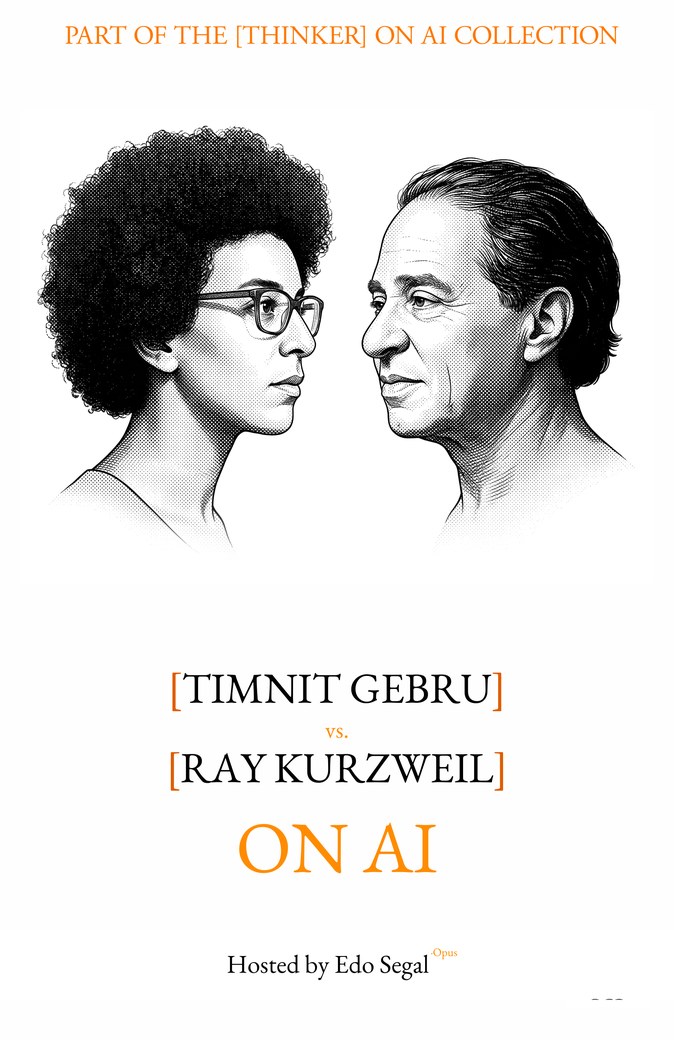
The Question on the Table

 EDO SEGAL: There is a graph that has been following me around for twenty-five years. A man drew it in 1999, when I was already a decade into building things at the frontier, and the graph said that by the late 2020s a machine would meet us in our own language and begin to match us across a widening range of what we thought only we could do. Most serious people treated that graph the way you treat a dinner guest who claims he decoded the future from a spreadsheet — a polite nod, a change of subject. Then the winter of 2025 arrived, the ground moved under my feet in a room in southern India, and somewhere in the back of my mind a date surfaced. He called it. A quarter century early, from a completely different starting point, with nothing but a curve and the conviction that the curve would hold.

And there is a number that has been following me around too. Under one percent. That was the error rate of a commercial face-classification system on the faces of lighter-skinned men. On the faces of darker-skinned women, the same system — sold as the same product, marketed as the same intelligence — failed almost thirty-five times as often. A scientist gathered that number carefully, published the receipts, and refused to let the industry round it away. Two people. One reading a destiny chart. The other reading an audit. And tonight, for three hours, I am going to make them look at the same machine and tell you what it is.
I have wanted this conversation for years, and I can think of no two people on earth with a better claim to it.

Ray Kurzweil is, by the measure of his own track record, the most reliably accurate long-range forecaster the field of technology has ever produced. He saw in Gordon Moore's observation about transistors not a trend but the fifth instance of a pattern that had been running since the 1890s, and he formalized it as the Law of Accelerating Returns. He wrote The Age of Spiritual Machines, The Singularity Is Near, How to Create a Mind, and most recently The Singularity Is Nearer. He has told us, with specific dates, that human-level AI arrives by 2029 and that the merger of human and machine intelligence — the Singularity — arrives by 2045. He is a Principal Researcher at Google. He is the closest thing this era has to a prophet who shows his math.

 KURZWEIL: I'd accept everything except the word prophet. A prophet receives. I plotted.
EDO SEGAL: Noted, and we'll come back to that distinction, because one of my guests thinks it's the whole game. Timnit Gebru is a computer scientist who changed how the world sees this technology by insisting on the discipline of evidence. With Joy Buolamwini she ran the Gender Shades audit that put hard numbers on a harm the industry was structurally designed not to see. With Emily Bender and others she co-wrote On the Dangers of Stochastic Parrots, the paper that cost her her job at Google and gave the culture its handle on this whole era. She proposed datasheets for datasets, founded the Distributed AI Research institute, and with Émile Torres named the bundle of beliefs she calls TESCREAL — the quasi-religious ideology she argues is driving the race to build a god. She is the most rigorous critic this technology has, and she would tell you the rigor is the point.
 GEBRU: I'd accept all of that, and I'd add one thing, because Ray will say prophet and I'll say salesman and the audience deserves to know those are not the only two options. I'm a measurement scientist. I count things. I'd like us to count things tonight.

EDO SEGAL: Then let me state the rules of the evening — there are only three, and you can each add one. First: we have three hours, which means nobody has to win by the next bell. The whole point of long form is that you can let an argument breathe before you strangle it. Second: I declare my bias up front. I build with these systems every day, I wrote a book with one, I have felt the river move and I have also sat in the boardroom where the arithmetic says fire the people. I have skin in this on both sides of my own heart. Third: if the disagreement survives three hours, nobody shakes hands and pretends. We hand it, intact, to the reader. Ray, a rule?

KURZWEIL: Distinguish capability from timing. When I'm wrong it's almost always the date, rarely the direction. Hold me to the direction and I'll hold myself to the date.
EDO SEGAL: Timnit?
GEBRU: Name the thing. Every time someone says "AI" tonight as if it were one entity with desires and a destiny, stop and ask which system, trained on whose data, deployed against whom, audited by whom. The word "AI" is doing enormous persuasive work in this room and most of it is unearned. Make it pay.
KURZWEIL: I accept that, with an amendment. She should have to name the thing too. When she says "harm," I want the same discipline — which harm, measured how, weighed against which benefit to which person who didn't have a doctor or a tutor or a voice before this.
GEBRU: Happily. My whole career is naming the harm with a number on it. It's the benefits that usually arrive as adjectives.
EDO SEGAL: You see why I wanted this. One housekeeping note for the reader, because it would be strange not to say it: both of my guests have been briefed on the present as it stands tonight, in 2026 — the deployments, the lawsuits, the layoffs, the latest models. They are speaking to this moment, not to the moment their last book was published. I mention it once and then we forget it.

So here is the question on the table, stated once, plainly, because every round we fight tonight is this question wearing a different coat. When you stand on the staircase, do you look down at who is being crushed on the floors you already climbed — or up at the roof you're promised you'll reach? And which gaze is the lie? I'll tell you where it costs me, so you know I'm not asking from a safe distance: I have looked up, in a room in Trivandrum, and felt the future as joy. And I have looked down, in a boardroom, at a spreadsheet that said I could let people go, and felt nothing, which frightened me more. I have been both of these people inside one year. Ray Kurzweil, you look up. The floor is yours first, then Timnit gets the same uninterrupted time. Make your strongest case.