The Question on the Table
 **EDO SEGAL:** Somewhere in the world right now, in the time it takes me to say this sentence, two things are happening at once, and most people only ever look at one of them. In Nairobi, a young man is sitting in front of a screen tagging images and passages most of us will never have to see — beheadings, abuse, the worst the internet produces — so that a chatbot can come out the other end sounding gentle and clean. He is paid less than two dollars an hour. He will carry what he saw home tonight. And at the same moment, in a glass office on another continent, a researcher is watching a model do something on a benchmark that nobody quite predicted it would do, and a small cold thought is moving through him about where the line on the graph is pointing, and how few years are left before it crosses a place from which there is no coming back.
The same machine. The same week. Two people looking at it, and seeing two completely different emergencies. That is not a failure of attention. That is the whole argument, and I have brought the two people who see it most clearly and most incompatibly to spend three hours inside it.
I have wanted this conversation for a long time, and I could not have it until I admitted that I am pulled in both directions myself.
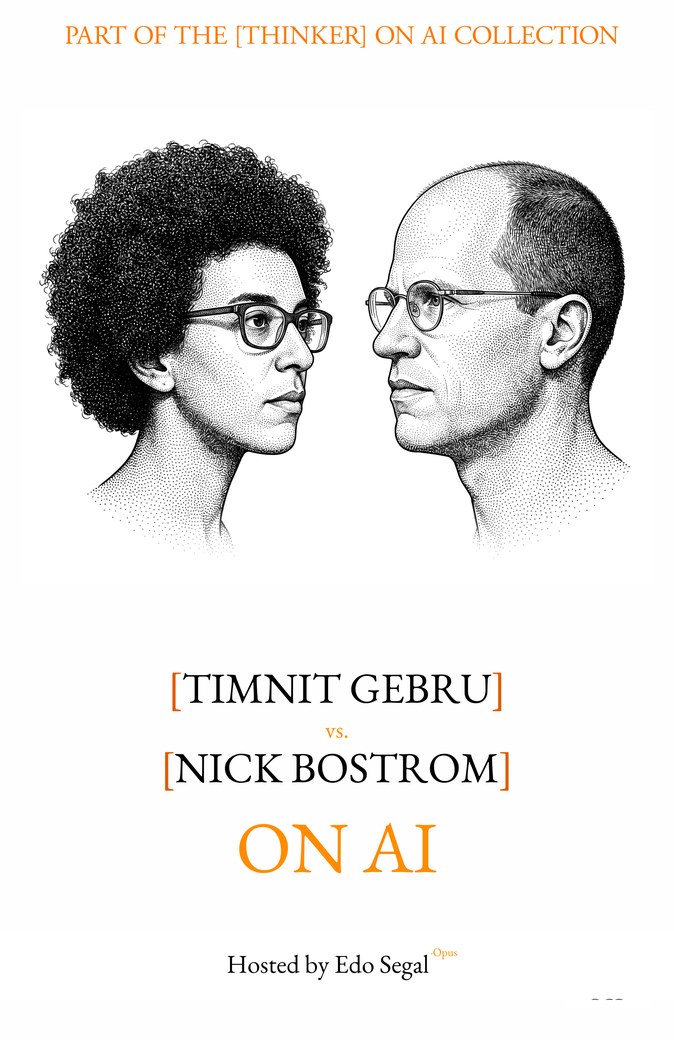
Timnit Gebru is a computer scientist who taught a field the discipline of evidence. Born in Addis Ababa to Eritrean parents, a teenage refugee, she earned her doctorate at Stanford in computer vision and then did the thing the field least wanted done — she counted. With Joy Buolamwini she showed that commercial face systems failed darker-skinned women at thirty-odd times the rate they failed lighter-skinned men, and she did it not with outrage but with a number no honest person could wave away. She co-wrote the paper that named the [stochastic parrot](https://www.youonai.ai/fieldguide/med/large_language_models). She was pushed out of Google for declining to soften it. She built DAIR so the research could be done somewhere the valve was not held by the company being studied. She is, by some distance, the most rigorous accountant of what this technology is doing to actual people right now.
 **GEBRU:** I'll accept accountant. I'd add that I'm an engineer who got tired of being told the harm was a glitch.
**EDO SEGAL:** Nick Bostrom needs an introduction only because the scale of what he studies resists summary. A Swedish philosopher trained across physics, computational neuroscience, logic, and ethics, he founded the Future of Humanity Institute at Oxford and spent two decades on a question respectable philosophy treated as an embarrassment: what happens to a species when it builds a mind greater than its own? In 2014 he published Superintelligence, and the fringe preoccupation became national-security strategy. He gave us the vocabulary before we had the systems — the orthogonality thesis, instrumental convergence, the treacherous turn, the vulnerable world, deep utopia. He is the most rigorous cartographer of what this technology might do to the entire future.
 **BOSTROM:** That is generous, and I would only adjust one word. I do not study what AI *will* do. I study what follows *if*. The conditional is not modesty. It is the whole method.
**EDO SEGAL:** Then let me state the rules of the evening — there are three. First: we have three hours, which means nobody has to win by the next bell. Long form exists so an argument can breathe before anyone strangles it. Second: I press both of you, and I declare my bias up front — I build with these systems daily, I wrote a book with one, and I am genuinely torn between your two fears, which is exactly why I am the wrong person to referee and the right person to host. Third: if the disagreement survives three hours, we do not paper over it. We hand it, intact, to the reader. Either of you may add a rule.
**GEBRU:** I'll add one. Concreteness. When we talk, we name names — which company, which workers, which data, which decision and who made it. The abstraction is where the accountability goes to die. "AI might do X" is not a sentence I'll let pass without asking who is doing it, to whom, for what.
**BOSTROM:** I accept that, and I'll add its mirror. Scale. When we name a present harm, we should also be willing to ask how it weighs against the harms and goods that are larger but further away. Concreteness keeps us honest about the visible. Scale keeps us honest about the invisible. I suspect we will spend three hours discovering that each of us thinks the other's rule is a way of not looking.
**GEBRU:** That's the most accurate thing you'll say tonight.
**EDO SEGAL:** You see why I wanted this. Before opening statements I want to put the question itself on the table, plainly, because every round we fight tonight is this one question wearing a different coat. When we build AI, whose future are we answerable to — the concrete people it is harming and exploiting right now, or the astronomical stakes of a long future it might end, or transfigure? Timnit, you'd say the second clause is a trick.
**GEBRU:** I'd say the second clause is the most expensive sentence in the English language, and I'd ask who's paying to keep it in the air. But I'll make the case properly when you give me the floor.
**EDO SEGAL:** Nick, you'd say the first clause, taken alone, is a way of being humane about the foreground while the background burns.
**BOSTROM:** I'd say it is possible to be exactly right about the foreground and still lose everything, and that history does not grade on whether your concern was admirable. But yes. The floor first.
**EDO SEGAL:** One more thing before openings, because the reader deserves to know the stakes are not symmetric-sounding nonsense. Timnit — you've put bodies on the table: workers traumatized for pennies, people denied benefits by systems nobody can interrogate, an information ecology flooded so a handful of firms can sell the costume of intelligence, and a strange theology growing up around machine godhood that you've traced back to eugenics. Nick — you've put a number on your end that I still find hard to type: a non-trivial probability, in your estimation, that this technology permanently ends or forecloses the human future. Not metaphorically. Forecloses it. You are not here to split a difference. One of you thinks the house is being robbed, room by room, right now, and the other thinks the house may be about to fall into a sinkhole, and the worst outcome of tonight would be an audience that concludes the truth is comfortably in the middle.
**GEBRU:** On that, at least, we agree.
**BOSTROM:** First convergence of the evening. I'm told to enjoy them while they last.
**EDO SEGAL:** So here is the question on the table, once more, plainly. When we build AI, whose future are we answerable to — the people it is harming now, or the future it might end? Timnit Gebru, the floor is yours.