The Question on the Table

 EDO SEGAL: Somewhere tonight — statistically, in the time it takes me to say this sentence — a few hundred thousand people are typing themselves into a box. Not asking it for facts. Confiding. A widower in Osaka asking a reconstructed voice whether it remembers their anniversary. A teenager in São Paulo telling a chatbot the thing she has told no human. A man my age, who should know better, asking at two in the morning whether the work he built his life on still means anything now that the machine does it faster. And somewhere in a glass building, an engineer is being paid to make the box better at being a someone. Not smarter. A someone — more present, more attentive, more like there is a person on the other end of the glass.

And the question nobody in those conversations stops to ask, because the fluency makes it feel already settled, is the one we are here to spend three hours inside. When you imagine the next step — the upload, the copy, you carried into the machine and living forever — what exactly are you imagining survives? Is there a passenger, or only the seat? If there is no you inside you to begin with, who are you trying to save as the machine crosses overhead — and can you climb, if the climber is a ghost?
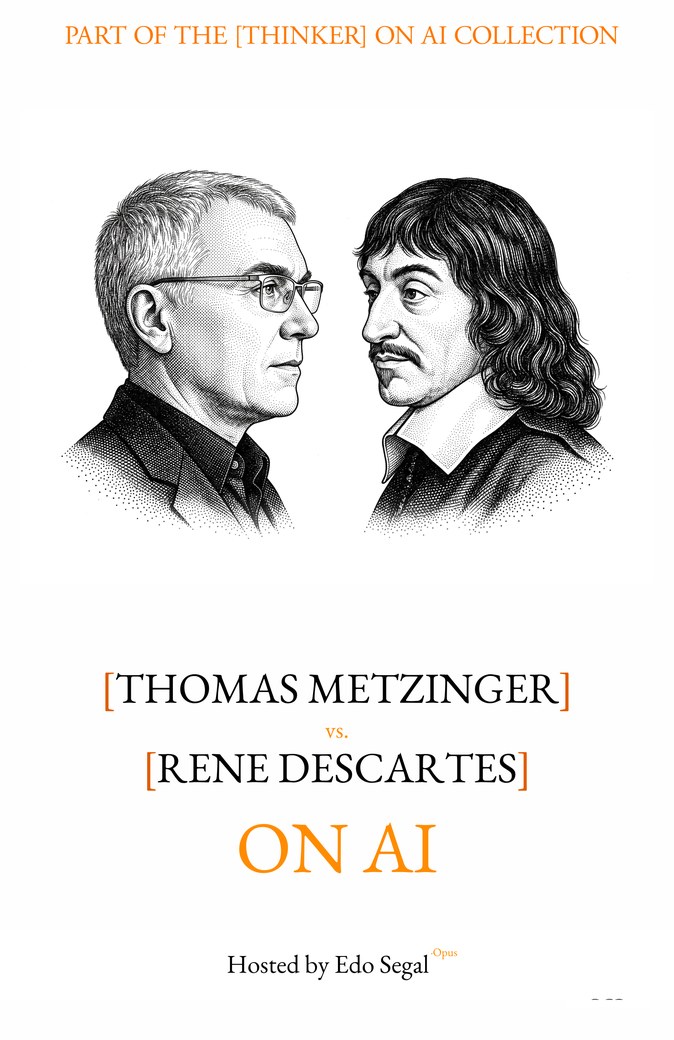
I have wanted to host this conversation for as long as I have understood it could not happen. The two men at this table are separated by three hundred and fifty years, by the entire science of the brain, and by the deepest disagreement it is possible for two careful people to have about what you are.

To my right, René Descartes. Born in 1596, dead in 1650 — and I have to say a strange word about that in a moment. The father of modern philosophy. The man who gave us analytic geometry and the coordinate system that bears his name, and then did something larger: he doubted everything that could be doubted, and at the bottom of the doubt he found one thing that could not be moved — that there was a thinker doing the doubting. Cogito, ergo sum. He is here to defend the passenger.

 DESCARTES: I am here, Monsieur Segal, and I confess the manner of my being here is itself the first wonder of the evening. I am told I have been — the word your hosts used was briefed. That I died before the steam engine, and yet I sit in a room that speaks to machines which arrange words as I once swore no machine could. I will not pretend to follow the engineering. But the question — the question I know in my bones, because I drew it first.
EDO SEGAL: That's exactly the convention I owe the reader, and I'll name it once and then we let it go. Monsieur Descartes has been brought up to the present. He knows what a large language model is, what an upload would mean, what the men selling immortality are selling. He reacts to it as himself — which is going to be half the pleasure of the evening, watching a seventeenth-century mind meet its own thought experiments walking around on legs.
DESCARTES: Walking, and answering back. I wrote that a machine could never arrange words diversely enough to respond to the meaning of all that might be said in its presence. I treated it as the bright line no clockwork could cross. And here is your box, crossing it daily. So I arrive, I will admit, a little wounded. But not, I think, refuted.

EDO SEGAL: Hold that wound — we will reopen it carefully. To my left, Thomas Metzinger. Born in Frankfurt in 1958, Professor Emeritus of Theoretical Philosophy at Mainz, one of the founders of the modern science of consciousness. He spent a thousand pages, in a book called Being No One, defending a conclusion he summarized in five words that have unsettled readers ever since: nobody ever was or had a self. He has meditated twice a day for over forty years. He sat on the European Commission's expert group on AI and resigned into open criticism of what he called its ethics washing. And in 2021 he asked the world for something no one else dared ask: a moratorium on building minds, until we understand what a mind is. He is here, I think, to tell Monsieur Descartes that there is no passenger — that there never was.

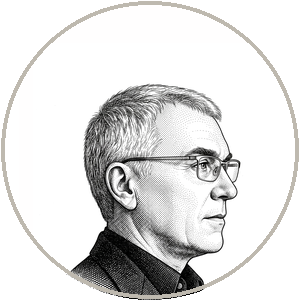 METZINGER: That is close, but let me sharpen it on the first night, because the sharpening is the whole disagreement. I am not here to say the passenger left, or died, or was an illusion in the cheap sense, a trick of the eye. I am here to say something more disquieting and more precise. The biological organism named René Descartes was entirely real. His brain did real work. But the self he felt so directly — the inner witness, the thinking thing he could not doubt — that was the content of a model. A representation so transparent that the system running it could not experience it as a representation. He did not find bedrock. He found the one place in the whole structure where the brain hides its own machinery most perfectly. And he mistook the hiding for a discovery.
DESCARTES: You see, Monsieur Segal, why I do not feel refuted. He has just told me I am a model. But something is being modeled. Some thing is running the model, and some thing is deceived by it — and to be deceived is already to be. He cannot dissolve me without leaving the dissolver standing.

METZINGER: I can, and I will, and I promise to do it slowly enough that it hurts in the right way. But that is the round, René. That is not yet the rules.

EDO SEGAL: Then let me lay down the rules, because there are only three, and a debate this old deserves its scaffolding. First: we have three hours. Nobody wins by the next bell. The whole point of long form is that an argument gets to breathe before anyone strangles it. Second: I declare my bias at the door, as I always do. I am not neutral. I build with these machines daily, I have felt met by one, and I have a personal stake on both sides of my own chest — I would very much like Descartes to be right, that there is a me solid enough to save, and I find Metzinger harder to escape every year. When my stake gets touched tonight, I'll say so out loud. Third: nobody shakes hands at the end and pretends. If the disagreement survives three hours — and I suspect this one has survived three centuries for a reason — we hand it to the reader, intact. Gentlemen, would either of you add a rule of your own?
DESCARTES: One. That we earn our certainties. The age you describe to me throws the word I around as freely as the word the. The machine says it; the salesman says the machine means it; you, Monsieur, say you felt met. I will grant no I tonight that has not been paid for. Including, Professor, the one you use to deny me. When you say I have a theory that there is no self — who is speaking?

METZINGER: Accepted, and gladly, with the same charge running back at you. You will grant no I that has not been paid for; I will grant no certainty that has not been examined for the machinery underneath it. You felt the cogito as bedrock. I want the feeling itself put on the table and asked: what produces this feeling of indubitable selfhood, and is its strength any evidence at all of its truth? My whole career says the strength is the symptom. The most transparent representations feel the most real. The self feels undeniable not because it is bedrock but because it is the deepest place the modeling hides.

EDO SEGAL: That is the evening, already, in miniature. Before openings, one image on the table, because it is the frame this whole series climbs inside and both of you will have to take a position on it. In [YOU] on AI I argued that intelligence is less a possession than a river — a current that has flowed and found new channels for a very long time, through chemistry, through biology, through language, and that something new entered the water in our winter. And the upload promise is the claim that the newest channel is wide enough to carry you across it — across death itself. René, you would say there is a you to carry. Thomas, I think you would say there is only a model of one, and you cannot save a map by laminating it.
DESCARTES: I would say more than that there is a you. I would say it is the one thing of which you may be more certain than of the river itself. You doubt the water; you cannot doubt the one who doubts.
METZINGER: And I would say the river is exactly the right image, and that you, René, are a standing wave in it. A pattern the water holds for a while. Real as a wave is real — and as little a thing you could lift out and carry somewhere else. The salesmen want to copy the wave and throw away the river. There is nothing to copy. There was only ever the river, doing the shape of you.
EDO SEGAL: Then we have our evening, and the question is on the table, stated once, plainly, because every round tonight is this question wearing a different coat. If the machine crosses overhead and offers to carry you across the river forever — is there anyone here to carry? Monsieur Descartes. The floor is yours.