The Question on the Table

 EDO SEGAL: Somewhere tonight a man is sitting in a small office in a building he has never thought about, and a screen in front of him is deciding whether his family eats. Not a person on the other side of the screen — a system. It has read his benefits history, his address, the timestamps of his phone, the pattern of his purchases, and it has assigned him a score. Green, yellow, red. He does not know how the score was computed. He cannot argue with it, because there is no one in the room to argue with. He can only stand there, made suddenly and totally visible, while a machine that has never met him decides what he is owed. And here is the thing I cannot stop turning over: that machine was built to protect him. To stop the fraud, to allocate the scarce thing fairly, to bring order to a system that without it would be chaos and theft and the strong taking from the weak. It was built out of the best intentions anyone has ever had. And he is terrified of it.

That man at the screen is the whole evening. Because the question we are here to spend three hours inside is the one his terror asks without being able to name it: when the machine can finally see everything — every transaction, every movement, every word you have ever typed — do you hand it the crown to keep the peace? Or is the seeing itself the catastrophe, the thing you have to climb above before it flattens you into a number?
I have wanted this conversation for years, and I could think of no two people in the history of thought with more right to it — separated, as it happens, by three hundred years and the grave, and brought here by a license I will explain in a moment.

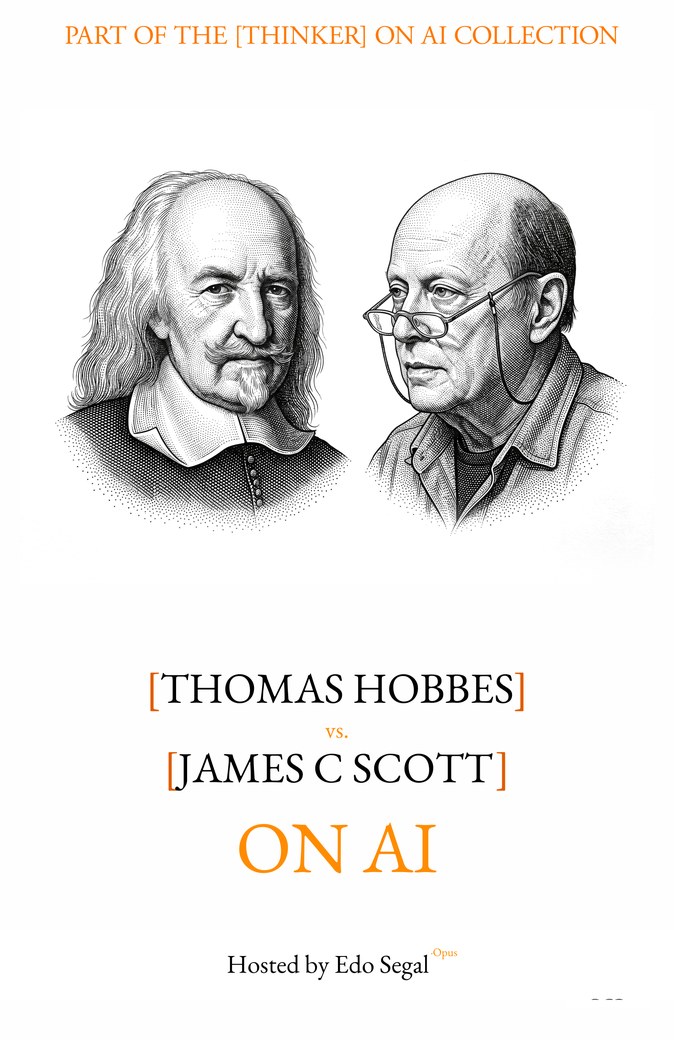
Thomas Hobbes wrote the founding book of modern political thought in 1651, with the English Civil War still warm behind him. He had watched a country dissolve into the war of all against all, and he built, out of that terror, the most rigorous argument anyone has ever made for absolute power: that human beings escape a life that is solitary, poor, nasty, brutish, and short only by surrendering themselves — total and undivided — to a sovereign that can see and settle everything. He also believed, three centuries before the computer, that reasoning is nothing but reckoning, that the mind is a machine, and that the state is an artificial man we build to keep ourselves alive. He is the patron theorist of the made mind and the made sovereign at once.

 HOBBES: You have made me sound grim. I will not protest. I wrote in a grim time, about a grim truth, and the comfortable thinkers of my age are forgotten while I am at your table. Grimness that is correct outlives cheerfulness that is false.
EDO SEGAL: James C. Scott was an anthropologist and political scientist at Yale who spent his life on the opposite fear. In Seeing Like a State he showed that the great catastrophes of the modern era — the famines, the failed cities, the dead forests — were not caused by ignorance or malice but by intelligence: by states that became powerful enough to impose a single legible plan on a complex living reality, and did. He lived for two years in a Malaysian rice village. He kept bees and raised sheep on a farm in Connecticut. He gave us the words legibility, high modernism, and métis, and he died in 2024 having spent forty years arguing that the knowledge that keeps the world alive cannot be centralized — that it lives in the people at the bottom, and that the view from the top is always, structurally, blind.

 SCOTT: And I would add only that I did not arrive at that argument from a library. I arrived at it from a rice paddy, watching planners in the capital celebrate yields that the people in the village were starving beneath. The view from the office tower and the view from the field are different views. That is not a metaphor. I have stood in both places.

EDO SEGAL: Now — the strange part, and I owe the reader honesty about it. One of you has been dead for nearly three hundred and fifty years, and the other for less than two. I have taken a liberty: I have briefed you both on the present. Mr. Hobbes, you know what a large language model is, what a recommender system does, what it means that a trillion dollars moved in a market last year on the promise of these machines. Professor Scott, you have read the EU AI Act and you know what a benefits algorithm does to a man at a screen. You react as yourselves, to our world. I acknowledge the impossibility once, out loud, and then I am going to ask you to forget it.
HOBBES: It is no stranger than reading. Every book is a dead man briefing the living. I have simply been given the courtesy of replying.
SCOTT: I'll take the deal. Though I notice you've already made me legible, Edo — you've reduced forty years to four sentences and a sheep. That's the whole problem in miniature, and we haven't started.

EDO SEGAL: That's exactly why I wanted you. So let me state the rules of the evening, and there are only three. First: we have three hours, which means nobody has to win by the next bell. Long form exists so an argument can breathe before anyone strangles it. Second: I declare my bias at the door. I built systems that watched people — engagement machinery, attention loops — and I have profited from the seeing, and I have a child I do not want made legible by a stranger's algorithm. I have skin in this on both sides of my own heart. Third: at the end, nobody shakes hands and pretends. If the disagreement survives three hours, I hand it to the reader, intact. Each of you may add a rule.

HOBBES: One rule. Define the alternative. It is easy to fear the sovereign. The whole question is what stands in its place, and I will not permit Professor Scott to compare my mortal god to paradise. Compare it to the war, or do not compare it at all.
SCOTT: And my rule answers his. Name the body. Whenever we speak of order, of peace, of the state keeping us safe — ask whose order, kept by whom, paid for by whose ruin. Abstraction is where the corpses hide. I want a person in every claim, or I don't believe the claim.
EDO SEGAL: Define the alternative, and name the body. Good rules — and notice they are already the whole debate. Before we open, one image, because it is the frame this entire series climbs inside. In [YOU] on AI I described intelligence as a river — a current that has been finding new channels for a very long time, through chemistry, biology, language, and now, in our winter, through the machine. And I argued the only sane response to a rising river is not to worship it and not to flee it but to build a dam — a structure in the current, made by the people who feel the water. Mr. Hobbes, I suspect you would say the dam is the sovereign. Professor Scott, I suspect you would say the dam is exactly the thing a sovereign destroys.

HOBBES: The dam is the sovereign. Of course it is. A structure that holds back catastrophe, built by men who surrender a little of their liberty to the building of it. You have described my Leviathan and called it a river engineering project. I accept the compliment.

SCOTT: No. The dam is the beaver — the local builder who returns every morning to feel where the current has loosened a stick and places the next one where the water tells him. The sovereign is the planner in the capital who has never seen the river, who orders one great dam built to a blueprint, and floods three valleys of people who knew exactly why no one had ever built there. The difference between those two things is the difference between my whole life's work and his.
EDO SEGAL: Then we have our evening. Here is the question on the table, stated once, plainly, because every round tonight is this question wearing a different coat. When the machine can finally see everything, do you hand it the crown to keep the peace — or is the seeing itself the catastrophe you must climb above before it flattens you into a number? Thomas Hobbes, you watched the war. The floor is yours.