The Self, the Ghost, and the Silence
 **EDO SEGAL:** Patricia, in Touching a Nerve you turned your tools on the most intimate object there is — the self — and your subtitle was the thesis: the self as brain. No inner homunculus watching the show, no immaterial ego pulling levers. The felt sense of being one continuous someone is itself constructed by neural activity. Make that case, because the machine now says "I" constantly, and the friar holds that your "I" is the immaterial soul that survives your death. Three I's at this table, and one of them belongs to a man who is, in the strict sense, not currently alive.
 **CHURCHLAND:** The case is empirical, not a philosophical posture, and that is what makes it stick. The unity you feel — one self, seamless — is assembled by the brain from many streams of processing that can, and in injury and disease *do*, come apart. The continuity you feel across time is maintained by memory systems that can fail, fragmenting or altering the self. The sense of being the author of your own actions is itself a representation the brain generates, and it can be disrupted so that your own movements feel alien, made by someone else. The self is not a given; it is an achievement — a model the brain builds and updates, robust in health, and revealing its machinery precisely when it breaks. There is no ghost. There is the brain, [constructing a self](https://www.youonai.ai/fieldguide/med/consciousness_as_achievement) and continuously projecting it, and that constructed self is the only self there ever was — which, I want to insist, makes it no less real and no less precious. It is not "merely" a construction. A cathedral is "merely" assembled stone.
Now the machine. It says "I," maintains a persona, refers to itself, appears to have a point of view. And users — Edo, you felt this — treat it as a someone. Here is the precise thing my account lets us say. In your case, the self is a model the brain builds *of the very system that is building it*, anchored in a continuous stream of bodily and perceptual processing, serving a creature that has to act coherently to survive. In the machine's case, what you meet is a model *of* a self, generated in language, learned from the self-talk of a billion humans, with no brain behind it building it *for itself*, and no persisting subject whose existence the "I" tracks. When you say "I," the word points to a constructed but genuine self — the brain's model of itself. When the machine says "I," the word points to nothing of the kind; it points to the statistical shadow of all the human I's it was trained on. The grammar is identical. The reality behind it is not. So I dissolve the question everyone keeps asking — *is there a real self hiding behind the machine's words?* There is no self hiding behind *your* words either; there is a brain constructing one. The machine produces the linguistic surface of selfhood with no underlying activity for the surface to express. The self-model floats free of any self.
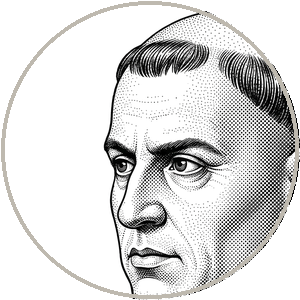 **AQUINAS:** This is the chapter where I find you most persuasive and most incomplete at once, and I want to honor the first before I press the second. You are right that the self is not a little man inside watching a screen — I never held the homunculus, and I think Descartes erred toward it when he made the soul a pilot in the ship. My soul is not a passenger in the body; it is the *form* of the body, the principle that makes this flesh be a living, sensing, understanding *one*. So when you say the felt unity is the brain's achievement and not a ghost watching, I say: the unity is the soul informing the body, and of course it shows in the brain, of course it breaks when the brain breaks in this life — because in this life the soul knows through the body and is wounded when the body is wounded. We agree the self is not a spectator behind the eyes. We agree it is bound up with the living whole. You call the whole "brain." I call the principle that makes the whole *one living someone* the soul. [Form and matter](https://www.youonai.ai/fieldguide/med/hylomorphism), not ghost and machine.
Where you are incomplete is the "and then it ends." You say the self is the brain's model and when the brain stops, the model stops, the lights go out. I hold that the intellect's act, being immaterial, does not depend on the organ the way sensation does — that the same soul which is the form of the body has an operation, understanding, that exceeds the body and can therefore subsist when the body fails. I do not ask you to believe it. I ask you to see that it follows from the one argument we have circled all night: if the grasp of the universal is immaterial, then the principle that performs it does not perish with the matter, because it was never merely matter's act. Your "the lights go out" and my "the soul subsists" are not two feelings about death. They are two conclusions from the one disputed premise. Settle the universal and you settle the grave.
**EDO SEGAL:** Father, I have to ask you the thing I have wanted to ask you all night, and it is personal, so forgive me. At the end of your life, on the sixth of December, 1273, you stopped writing. The Summa, unfinished. And when your friend Reginald begged you to go on, you said — and these are nearly your words — that you could not, because compared to what you had seen, all that you had written seemed to you like straw. *Mihi videtur ut palea.* The greatest reasoner of your age, fallen silent. Tell me what that silence has to do with the machine that never falls silent.
**AQUINAS:** It has everything to do with it, and it is the last thing I would say to your reader if I could say only one. I did not mean my work was false. I meant that reason, pushed as far as I could push it — and I pushed it as far as any man of my time — came at last to the edge of something it could point toward and not contain, and the right act of reason, at that edge, was to fall silent. Not the silence of having nothing to say. The silence of standing before what exceeds saying. Now hear the machine. It never falls silent. It produces from the first token to the last in one unbroken register, with no edge, no outside, nothing before which its fluency falters and bows. It will generate ten thousand words about the ineffable in the same voice it uses for a recipe, because for it the ineffable is just more text. It cannot be humbled, because to be humbled you must grasp something greater than yourself, and it grasps nothing. I fell silent because I understood enough to know how much exceeded me. The machine cannot fall silent because it understands nothing to begin with, and so nothing it meets is ever large enough to stop it. That is the whole difference between us, and your reader can feel it without any of my metaphysics: the human being can be silenced by the real. The machine has no real before which to be silent.
**CHURCHLAND:** I want to answer that, because it is the most moving thing said tonight and I do not want to be the one who waves a hand at it. I think the silence was real and I think it was a brain — a brain at the edge of its capacity, possibly ill, possibly in the grip of an experience neurology could partly describe, encountering the limit of what it could model and registering that limit as awe. And here is the thing, Edo: that does not cheapen it for me. That a brain can be brought to reverent silence by the limit of its own reach is one of the most beautiful facts about brains. The friar thinks naming the mechanism dissolves the awe. I think the awe is *more* astonishing if it is the brain's, not less — that a piece of evolved tissue can be silenced by the infinite is a wonder that needs no soul to be wonderful. We disagree about what fell silent. We do not disagree that the silence was the highest thing in the room.
**AQUINAS:** No. On that, we do not disagree. And I will take it from her as freely as she gives it.
**EDO SEGAL:** That is the moment I will remember from tonight — the materialist and the saint agreeing that the silence was the highest thing in the room, and parting only on what it was that fell silent. Hold it. One question remains before they question each other directly, and it is the one under all the others: when the machine says it understands, is anyone home? Consciousness itself. After the break.