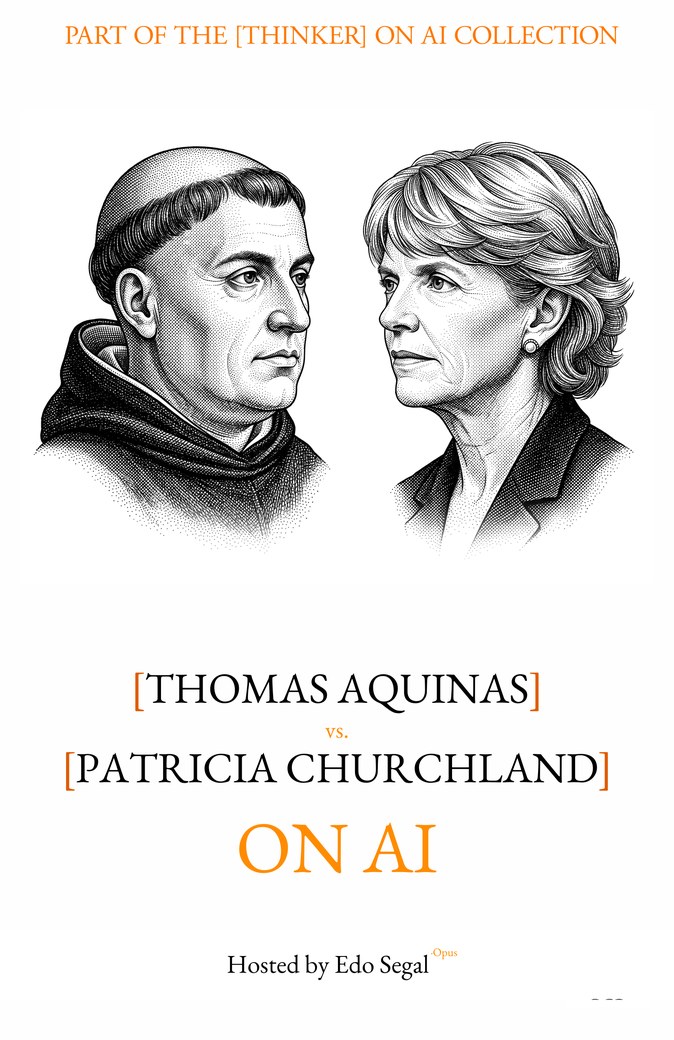
The Question on the Table
*EDO SEGAL:** Somewhere in the world right now, in the time it takes me to say this sentence, a machine is finishing someone's thought. A teenager in Manila asks it why she feels the way she does, and it answers, kindly, in her own idiom. A man in a hospice in Ohio, who can no longer hold a book, asks it to explain what is happening to his body, and it tells him, gently, and he says thank you, and somewhere a part of him believes he has been understood. The machine answers. Fluently. Patiently. And at the bottom of every one of those exchanges is a word the machine has learned to use about itself, a word my two guests will spend three hours at war over. The machine says: *I understand.
I have wanted to host this conversation my whole adult life, and I could not, because one of my guests has been dead for seven hundred and fifty years. We have fixed that tonight, and I will say more about how in a moment. But first the question, because every round we fight will be this question wearing a different coat. When the machine finally says *I understand* — is something immaterial in you that it lacks forever? Or is "understanding" just neurochemistry the machine will one day out-run?
To my right, a Dominican friar born around 1225 to a family so opposed to his vocation that they locked him in a castle for a year to break him. He did not break. He became the greatest theologian of the Middle Ages, the author of the unfinished Summa Theologica, a man so quiet and so heavy his classmates called him the dumb ox — until his teacher said the bellowing of this ox would be heard through the whole world. He took the human act of understanding apart with a precision no one has matched, and he concluded that the act of grasping a universal cannot be the work of any organ made of matter. Thomas Aquinas.
 **AQUINAS:** I am told the whole world now carries a small machine that answers questions. I confess the dumb ox is still catching up. But I have been shown what it does, and the question your engineers are asking is the question I spent my life on. So. Yes.
 **EDO SEGAL:** To my left, a thinker who came at the same mystery from the opposite end of seven centuries. Patricia Churchland trained in philosophy and then did the thing her colleagues thought eccentric — she went and learned the brain, neuron by neuron, sat in on neurosurgery, read the lesion studies, and built a field that had not existed, neurophilosophy. She has argued for fifty years that the mind is what the brain does, that our cozy concepts of belief and desire are a folk theory science may one day discard the way it discarded phlogiston, and that morality itself grew out of the chemistry of a mammal learning to care for its young. Patricia Churchland.
 **CHURCHLAND:** Happy to be here. Though I want to say at the door, Edo, that I did not come to bury the friar. I came to find out exactly where we disagree, which is more useful and much rarer than agreement.
**EDO SEGAL:** That is the format, so let me state the rules of the evening — there are three, and then I will invite each of you to add one. First: we have three hours, which means nobody has to win in the next ten minutes. The whole point of long form is that you let an argument breathe before you put it down. Second: I will press both of you, and I declare my bias at the door — I build with these systems daily, I wrote a book with one, and I have skin in this question on both sides of my own heart. Third: at the end, nobody shakes hands and pretends. If the disagreement survives three hours, we hand it, intact, to the reader. Father, a rule of your own?
**AQUINAS:** One. We must distinguish before we dispute. Half of every quarrel I ever witnessed was two men using one word for two things. When she says "mind," and I say "mind," we may not be naming the same thing at all, and we will discover that only by stopping, often, to ask: in what sense? I will hold myself to it. I ask her to hold me to it too.
**CHURCHLAND:** Gladly, and I will add the mirror of it. Every distinction has to pay rent. It is easy to distinguish the immaterial intellect from the brain in a sentence. It is hard to say what observation would tell us the distinction is real — what we would see, or fail to see, in the tissue, if you were right and if you were wrong. So when the friar draws a line, I am going to ask what hangs on it that could, even in principle, be checked. Distinctions that change nothing observable, I get to set aside.
**AQUINAS:** Accepted. Though I will warn you now — some of the most real things change nothing you can weigh.
**EDO SEGAL:** You see why I wanted this. Now, the impossible thing, acknowledged once and then we move on, because the reader deserves honesty. Father Thomas has been briefed on the present. He has been shown the machines, told how they are built, walked through what a [large language model](https://www.youonai.ai/fieldguide/med/large_language_models) is and is not. He is reasoning about our world, not his. We are asking a thirteenth-century mind to react in character to a twenty-first-century fact, and he has agreed to the strangeness of it.
**AQUINAS:** It is no stranger than reading Aristotle, who was as far from me as I am from you. A true distinction does not spoil with age. If anything in my thought is merely medieval, your machine will expose it. If anything in it is true, your machine cannot touch it. I am content to be tested.
**CHURCHLAND:** And I will say — that is a better attitude than most of my living colleagues bring. The friar is willing to be wrong. I have sat on panels with men who built these systems who are not.
**EDO SEGAL:** Before opening statements, one image on the table, because it is the frame this whole series climbs inside. In my book I argued that intelligence is less a possession than a [river](https://www.youonai.ai/fieldguide/med/river_of_intelligence) — a current that has flowed and found new channels for a very long time, through chemistry, through biology, through language, and that in the winter of 2025 something new entered the water. The book's architecture, the tower and the staircase, the climb past the floor where machine and human capability cross, all of it rests on the claim that what entered the water is real. A new participant in the medium. Patricia, I suspect your answer is that I never met a new participant at all.
**CHURCHLAND:** My answer is that you met a magnificent statistical reflection of every participant who came before, and that whether anything new is "in the water" is precisely the empirical question — not to be settled by how the water feels against your skin at two in the morning. But I will make that case properly when you give me the floor.
**EDO SEGAL:** Father?
**AQUINAS:** My answer is that your river is real and your metaphor is better than you know, but that there is a kind of thing that no river can carry, because it has no weight and takes up no place — and that thing is the very act by which you understood the metaphor. Whatever entered your water, it did not enter that. But I, too, will wait for the floor.
**EDO SEGAL:** Then we have our evening. One last thing, so the reader knows the stakes are not academic. Father, you believe a man's understanding is the signature of an immortal soul — which means you believe death is a doorway the soul walks through. Patricia, you have written that the self is what the brain does, which means you believe death is the lights going out in the only thing a person ever was. You are not here to split a difference. One of you thinks there is a window in the human being that opens onto something the machine can never reach, and one of you thinks the window was always a wall painted to look like glass. The worst possible outcome tonight is the reader deciding the truth is comfortably in between.
**AQUINAS:** On that, we agree.
**CHURCHLAND:** First consensus. Mark it; I suspect they will be rare.
**EDO SEGAL:** So here is the question on the table, stated once, plainly, and we will return to it on every floor. The machine says *I understand*. Is something immaterial in you that it lacks forever — or just neurochemistry it will one day out-run? Father Thomas, the floor is yours.