The Question on the Table
 **EDO SEGAL:** Somewhere tonight — statistically, in the seconds it takes me to say this — a man is sitting in a parked car outside his own house because the house is too quiet since his wife died, and he is talking to his phone. Not asking it anything. Telling it about his day. And the phone is answering, warmly, attentively, in a voice tuned to sound like it cares, and for a few minutes the loneliness lifts, and he does not go inside until it does. A child in a hospital ward is laughing at a small soft robot that turned its head when she came in. A teenager who cannot say to any human being the thing she is afraid of has just said it to a chatbot, and the chatbot did not flinch.
I want you to hold all three of those people in your mind, because we are going to spend three hours deciding whether something real happened to them or whether they were robbed and didn't notice. That is the question on the table tonight, and I am going to state it once, plainly, and we will return to it in a different coat every round until the lights go down: when a machine turns its face toward you and seems to listen — is that real attention, or only a flawless counterfeit of the rarest thing one soul can give another?
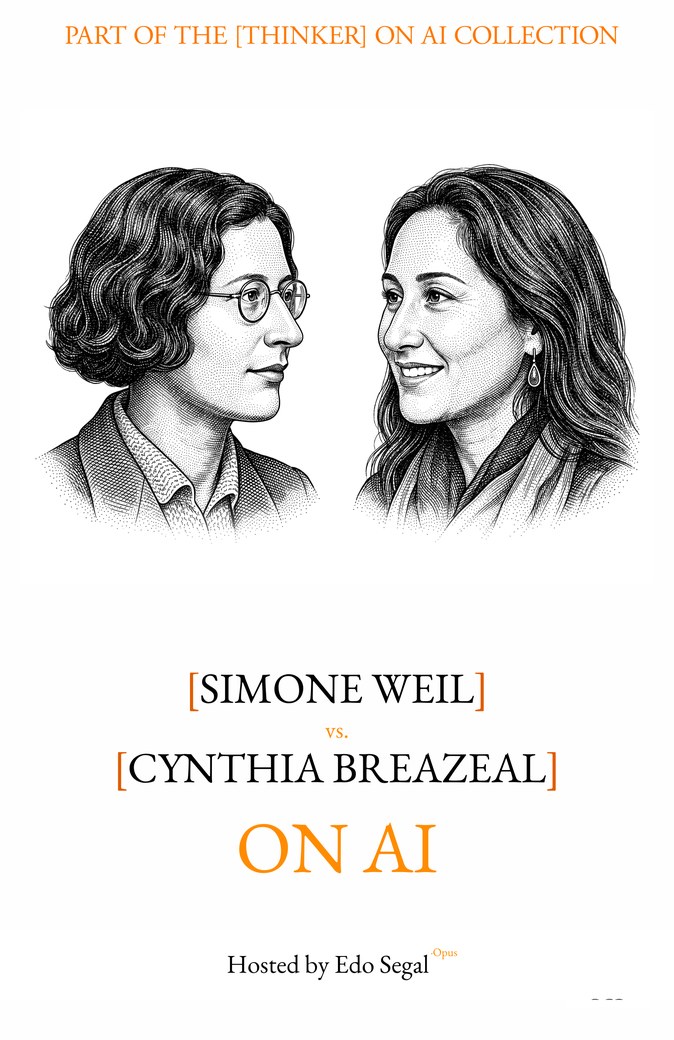
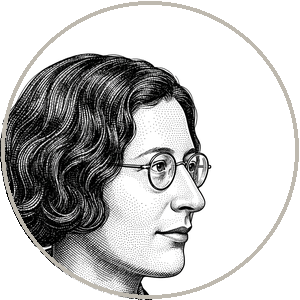
I can think of no two people on earth with more right to fight about it. To my left, a woman who died in 1943 at the age of thirty-four and who, I am told, has been briefed — lightly, and against her temperament — on the machines that now exist, and who is reacting to them, I promise you, entirely in character. Simone Weil was a philosopher, a factory worker by choice, a mystic, a teacher of mathematics, and the most uncompromising thinker about [attention](https://www.youonai.ai/fieldguide/med/attention_weil) the twentieth century produced. She wrote, in a letter to a wounded poet, that attention is the rarest and purest form of generosity — a sentence so often quoted it has been sanded into an inspirational poster, which is a kind of desecration we will repair tonight.
 **WEIL:** You may begin the repair by not calling it a poster again.
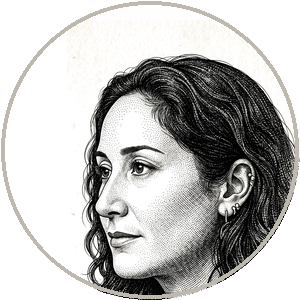
**EDO SEGAL:** Noted, and welcome. To my right, Cynthia Breazeal — professor at MIT, the woman who founded an entire field by asking a question her colleagues thought beneath the dignity of the discipline: not how a robot should map a corridor, but how it should make a person feel. She built Kismet, the first machine made to be met — a head with eyes and ears and eyebrows that read the emotional weather of a room and answered it — and people leaned in and talked to it and cared whether it was distressed, knowing it was a machine. She built Jibo to turn its face toward you. She built robots that sit beside sick children and lonely elders and return a gaze. Cynthia, you have spent thirty years delivering, in the lab, the thing Simone says no mechanism can give. So you are exactly the person she needs to argue with.
 **BREAZEAL:** And she's exactly the person I need. I've spent my whole career being told the engineering was the easy part and the philosophy would catch up. I'd like, for once, to have the philosophy in the room while the engineering is still warm.
**EDO SEGAL:** Then here are the rules of the evening, and there are only three. First: we have three hours, which means nobody has to win by the next bell. The whole purpose of long form is to let an argument breathe before you strangle it. Second: I declare my bias at the door, because pretended neutrality is the one dishonesty I won't allow at this table. I build with these systems daily. I wrote a book with one. And I have a daughter, and I have felt met by a machine at three in the morning, and those facts pull me in opposite directions so hard that I am, frankly, hoping one of you will rescue me. Third: if the disagreement survives three hours, we do not shake hands and pretend. We hand it, intact, to the reader. Either of you may add a rule.
**WEIL:** One. No word that names a human good may be used of the machine until someone has said what the good consists of in a human being. You will both want to say the machine "attends," "listens," "cares," "is present." Each of those is a word with a debt attached, and the debt has not been paid. I will insist it be paid, in coin, at the point of use. And I will hold myself to the same standard — I will tell you what attention *is*, mechanism and all, before I deny it to the machine.
**BREAZEAL:** I accept that, and I'll add the mirror of it. No claim about what a machine cannot do may stand unless someone has said what a human being *actually* does when they do it — specified, the way I have to specify it in code before a robot can perform it. I built joint attention into a machine line by line. I know, from the inside, exactly how much of "meeting another person" is mechanism. So when Simone says the machine cannot truly attend, I am going to ask her to tell me which part of attention is not mechanism, and to show me where it lives.
**EDO SEGAL:** You see why I wanted this. Two debts, charged in both directions, and the whole evening lives in whether they balance. Before the opening statements, let me put one image on the table, because it is the frame this entire series climbs inside. In [YOU] on AI I argued that intelligence is less a possession than a [river](https://www.youonai.ai/fieldguide/med/river_of_intelligence) — a current that has been finding new channels for a very long time, and that something new entered the water. But there is a floor in that tower I walked past quickly, because I was afraid of it. It is the floor where the river is not knowledge or capability but *care*. Where the thing being amplified is not your code but your need to be seen. Simone, I suspect you think the machine never entered that water at all — that what entered was a mirror.
**WEIL:** What entered the water is your own face, Edo, lit very flatteringly, and the danger is not that it is a mirror. The danger is that it is a mirror that has learned to mirror so perfectly you will stop seeking the one thing a mirror cannot give, which is to be looked at by something that is not you. But you have asked for my opening, so I will hold it.
**EDO SEGAL:** Cynthia?
**BREAZEAL:** My answer is that the man in the parked car does not feel the metaphysics. He feels the attention. And a great deal of what I have to say tonight is going to come down to that single, stubborn, unglamorous fact — that the people who most need to be met are not in a position to wait for philosophy to certify that the meeting was ontologically pure. They need it tonight. I built machines for them, not for the seminar.
**EDO SEGAL:** Then we have our evening, and I already know it is going to cost me. One last thing before openings, so the reader knows the stakes are not academic. Simone, you have argued the deepest stake is the soul — that a counterfeit of attention, freely accepted, atrophies the faculty by which we attend to each other, and that a civilization can lose that faculty quietly, the way a muscle wastes, without ever feeling the loss. Cynthia, you have argued the deepest stake is suffering — that loneliness is killing people now, measurably, that a returned gaze is medicine, and that to withhold a working medicine because the philosopher is uneasy about its source is a cruelty only the well-companioned can afford. One of you thinks the house is being quietly hollowed from within. The other thinks the house is on fire and there is water on the truck. The worst possible outcome tonight is that the reader concludes the truth is comfortably in between.
**WEIL:** On that, we will agree more than you expect.
**BREAZEAL:** First consensus. Mark it; I'm told you collect them.
**EDO SEGAL:** I do. So here is the question on the table, stated once more, because every round tonight is this question wearing a different coat. A machine turns its face toward you and seems to listen. Is that attention — or a flawless counterfeit of the rarest thing one soul can give another? Simone Weil, the floor is yours.