The Question on the Table

 EDO SEGAL: Right now, somewhere, a teenager is opening an app she swears she opened by accident. She did not decide to. There was no thought that preceded the gesture; her thumb arrived at the icon before she did, because at some hour months ago, in a building she will never enter, a system noticed which interval between notifications kept her coming back, and it has been quietly tuning that interval ever since. She experiences this as a choice — I felt like checking it — and she is wrong about that, and the wrongness is not her fault. It was engineered. I have built versions of that engine. I know the loops by name.
And here is the thing that makes tonight necessary: I cannot tell you, with confidence, whether what I just described is a horror or simply the way the world has always worked, finally made visible. That is the disagreement at the center of this room, and I have spent two years wanting to host it, because I can think of no two people on earth who would answer that question more completely, more rigorously, and more violently apart than the two sitting across from each other now.
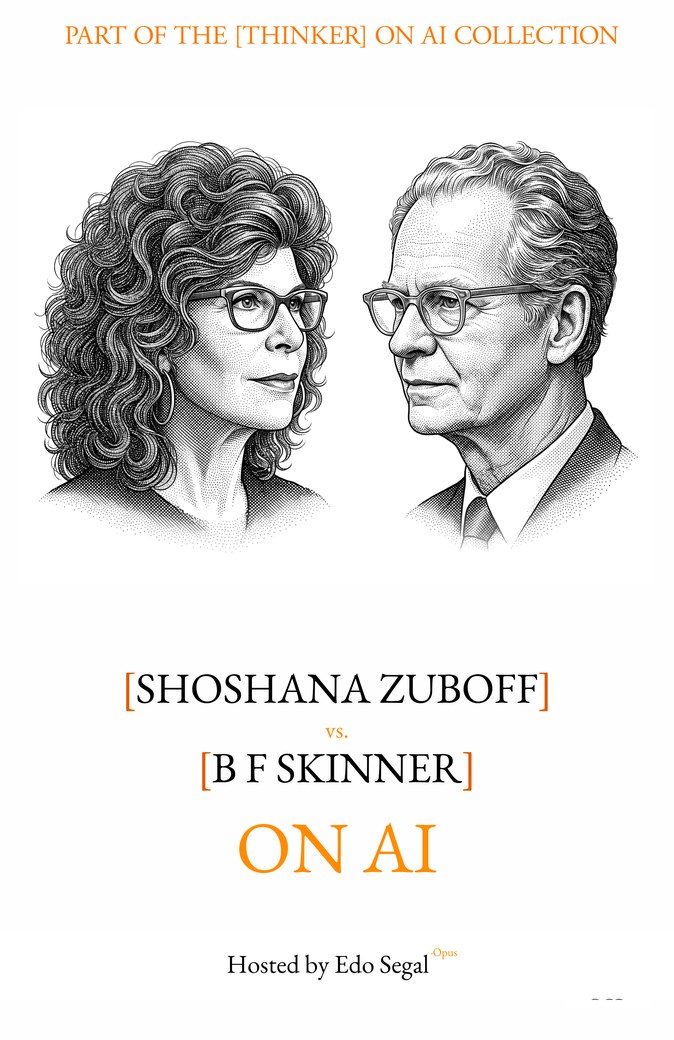
To my left, Shoshana Zuboff. A social psychologist, a Harvard Business School professor for three decades, the author in 1988 of In the Age of the Smart Machine — the book that taught a generation the difference between a technology that automates, which takes the work away, and one that informates, which generates a new kind of knowledge — and the author, in 2019, of the eight-hundred-page indictment that named our era: The Age of Surveillance Capitalism. She gave us behavioral surplus, instrumentarian power, the right to the future tense. She is, I think, the most precise and most furious anatomist of what is being taken from us, and by whom.
 ZUBOFF: Furious is fair. I've earned the fury honestly.
EDO SEGAL: To my right, a man who needs the strangest introduction I have ever given, because he has been dead for thirty-six years and we have, with his consent, briefed him on everything since. B. F. Skinner. The most influential and most reviled psychologist of the twentieth century. He built the operant conditioning chamber that bears his name against his wishes — he hated the phrase "Skinner box." He wrote Science and Human Behavior, he wrote the novel Walden Two, and in 1971 he wrote Beyond Freedom and Dignity, a book that argued the two words in its title are pre-scientific superstitions we can no longer afford. He spent his life insisting that the human being is not moved from within but shaped from without — and that pretending otherwise is what gets us killed.
 SKINNER: I'll accept "reviled." I always found it more instructive than "admired." A man who is reviled has at least said something specific enough to be wrong about.
EDO SEGAL: Let me handle the strangeness directly, once, and then we'll let it recede. Professor Skinner, you died in 1990. You never saw a large language model. So we briefed you — fully — on what has happened since, and I want the reader to know that when you reference these systems, you're reacting to the real thing, in character, not guessing.
SKINNER: I was told about it on the way in. I'll be candid with you, Mr. Segal — I have rarely felt more vindicated and more ignored at the same time, which I gather is the natural condition of being briefed on the future. You trained a verbal machine by reinforcing the responses people rated highly and extinguishing the ones they didn't. You called it reinforcement learning from human feedback. I called it a pigeon in a box in 1948. The grain became a number. The pigeon became a network. The procedure is mine. I'd like that on the record before Dr. Zuboff tells you it's a crime.
ZUBOFF: It is your procedure. That's precisely why I begin my book with you. I have no interest in pretending you're a relic. You're the architect.
EDO SEGAL: And there it is — twelve seconds in, and they've already agreed on the one thing that makes the next three hours possible, which is that they're looking at the same machine. So let me set the rules of the evening. There are three. First: we have three hours, which means nobody has to win by the next bell. The whole point of long form is that an argument gets to breathe before anyone strangles it. Second: I am not neutral, and I won't pretend to be — I build with these systems daily, I shipped the loops once, and I have skin on both sides of this question. When my own stake gets touched tonight, I'll say so out loud. Third: if the disagreement survives three hours, nobody shakes hands and pretends it's resolved. We hand it, intact, to the reader. Either of you may add a rule.
ZUBOFF: One. We name the agent. Skinner's grammar — and I say this with respect — is a grammar of the passive voice. "Behavior is shaped." "Responses are reinforced." By whom? With whose capital, toward whose ends, for whose profit? Every time the agent disappears into the passive voice, a theft is being hidden. So my rule is: no passive voice survives this table without an owner.
SKINNER: I'll accept that rule and turn it into evidence. You'll find, Dr. Zuboff, that when I name the agent, the agent is usually the environment — which has no profit motive and no malice and was shaping us long before any corporation existed. But I'm happy to name owners where there are owners. I've never denied that the question who controls the controller is the whole question. I wrote a utopia trying to answer it.
EDO SEGAL: Before the opening statements, I want one image on the table, because it's the frame this whole series climbs inside, and both of you will have to take a position on it. In [YOU] on AI I argued that intelligence is less a possession and more a river — a current that has been flowing for a very long time, through chemistry and biology and language and culture — and that in the winter of 2025 something new entered the water: a machine that learned to speak our language, and in learning it, learned us. Dr. Zuboff, I suspect you'd say the river is the wrong metaphor, because a river has no owner.
ZUBOFF: The river is a beautiful metaphor and a dangerous one, because rivers are public and what you're describing is not. Someone has fenced this river, metered it, and is selling the water back to the people it falls on as rain. I don't object to your wonder, Edo. I object to the missing fence in the picture.
EDO SEGAL: Professor Skinner?
SKINNER: I'd say the river is exactly right and your friend the neuroscientist who challenged you was exactly right to challenge you. A river doesn't decide where to go. It goes where the contingencies of the landscape take it — downhill, around the rock, through the soft soil. That is precisely my account of a human life, and people have hated me for it for seventy years. The only thing new in the water is a current strong enough that we can no longer pretend we're swimming wherever we please. Good. Maybe now we'll build the banks deliberately instead of drowning while we praise our own freedom.
EDO SEGAL: One more thing before openings, because the reader deserves to know the stakes aren't academic. Dr. Zuboff, you've argued that what's at risk is nothing less than the human capacity to author one's own future — that a power which can reliably predict and shape behavior at scale doesn't just sell ads, it forecloses the open future on which all freedom depends. Professor Skinner, you've argued the opposite stakes from the same fact: that our reverence for an inner, autonomous, freely-choosing self is exactly what prevents us from designing the cultures that would let our species survive its own technology. One of you thinks the house is being robbed. The other thinks the house is on fire and we're refusing to install the sprinklers because sprinklers offend our dignity. The worst possible outcome tonight is a reader who splits the difference.
ZUBOFF: On that — agreed.
SKINNER: A rare reinforcement. I'll respond to it appropriately and try to produce another.
EDO SEGAL: So here is the question on the table, stated once, plainly, because every round we fight tonight is this question wearing a different coat. We have built, for the first time, a working instrument for shaping human behavior at planetary scale — one that learns each of us individually and never sleeps. Do we seize it and design the contingencies deliberately and well, as the only adult response to a dangerous age? Or is that very ambition — the design of the human from outside — the precise thing that ends us as free beings? Shoshana Zuboff, the floor is yours.