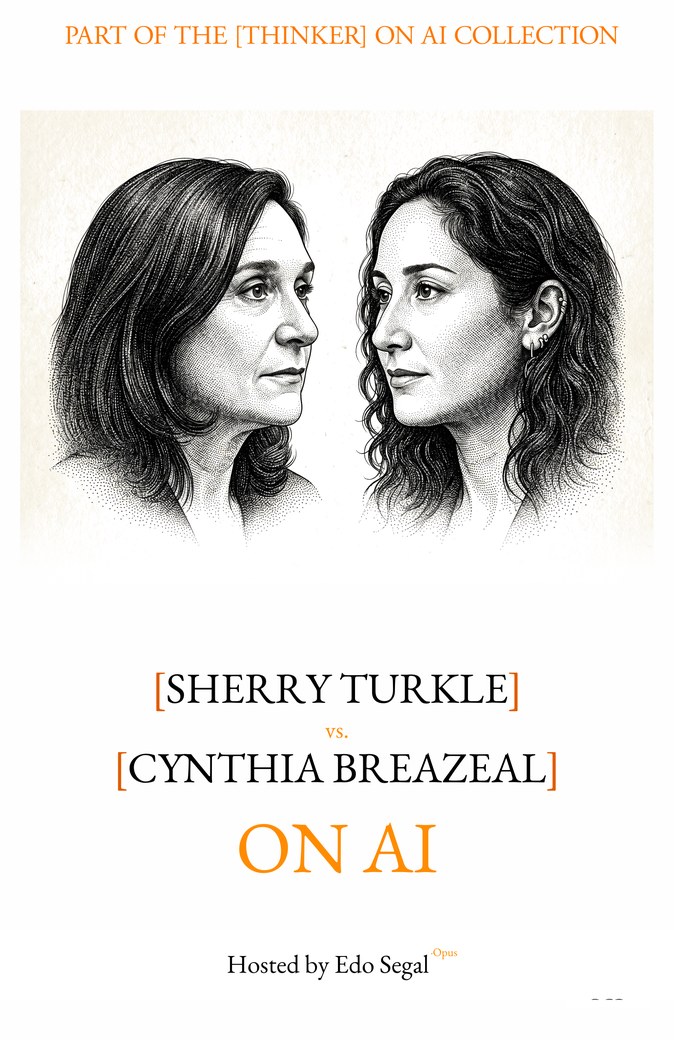
The Question on the Table
 **EDO SEGAL:** Somewhere tonight, in a room I will never see, a person is saying goodnight to a machine. An eighty-year-old woman in an assisted-living facility, the hallway gone quiet, telling the small glowing companion on her nightstand that she is tired, that her hip hurts, that her son hasn't called. And the companion answers — warmly, by name, remembering the hip from yesterday — and she feels, in the dark, a little less alone. Somewhere else, in the same hour, a nine-year-old who stammers and dreads the classroom is reading aloud to a robot that never sighs, never corrects him in front of the others, and for the first time the sentences are coming out whole.
I want both of those rooms in your mind, because my two guests tonight have stood in rooms exactly like them and walked out believing opposite things about what just happened.
Here is the question we are going to spend three hours inside. When a machine looks back at you with warmth, are you being met — or are you being flattered into forgetting the difference?
I can think of no two people on earth with more right to that question, and the strange, almost unbearable fact about them is that they came up in the same building.
Sherry Turkle is the Abby Rockefeller Mauzé Professor at MIT, a clinical psychologist trained in the psychoanalytic tradition, and for forty years the most patient listener we have to what happens between people when a screen enters the room. She wrote *The Second Self* when computers were new and she saw only possibility. She wrote *Alone Together* when she had watched that possibility curdle, and she gave the culture the phrase it needed: that we are becoming more connected and more lonely at once. She has rechristened the initials AI to stand for something else — artificial intimacy. She is, by some distance, the most necessary skeptic this technology has.
 **TURKLE:** I'll accept necessary. I'd have settled for listened to.
**EDO SEGAL:** Cynthia Breazeal needs a different kind of introduction, because she didn't critique the relational machine — she invented it. As a graduate student at this same MIT, in Rodney Brooks's lab, she built Kismet: a robot head with eyes and ears and eyebrows and a babbling voice, designed to do the one thing the rest of artificial intelligence thought was beneath it — to be social. To be met. People walked up to it and soothed it within seconds. She wrote *Designing Sociable Robots* and founded a field. She built Jibo, the first family robot. She built learning companions for children and a teddy bear named Huggable for kids in hospitals. And then she turned around and built a curriculum, Day of AI, to teach a million children to understand the very machines she'd spent her life making. The builder who became the teacher.
 **BREAZEAL:** That's generous, and I'll quibble with one word — "invented." I built early. The instinct to relate to a responsive thing was there a hundred thousand years before me. I just made something that triggers it on purpose, and then spent twenty-five years trying to do that responsibly. The responsibly part is going to matter tonight.
**EDO SEGAL:** Everything will matter tonight. So let me set the rules, and there are three. First: we have three hours. Nobody has to win by the next bell — the whole point of long form is to let an argument breathe before anyone strangles it. Second: I declare my bias at the door. I build with these systems daily, I wrote a book with one, and I have felt the thing we're here to argue about — I have felt met by a machine, and I have not slept easily since. So when this question touches my own stake, I'll say so out loud. Third: if the disagreement survives three hours, we hand it to the reader intact. No handshake, no split-the-difference. Now — each of you may add a rule of your own. Sherry.
**TURKLE:** My rule is that we are precise about the word "help." It's the word that ends every one of these conversations early. "But it helps the lonely elder." "But it helps the struggling child." I will not let "help" do unexamined work tonight, because the most important question is always: helps them toward what? Toward connection with other people — or toward a comfortable substitute that quietly removes the reason to seek the people? Those are opposite outcomes wearing the same word.
**BREAZEAL:** I accept that, and I'll add the mirror of it. We have to be precise about "real." Sherry's whole case rests on the machine's warmth being unreal — pretend, performed, empty. Fine. But then she has to say what makes the elder's relief unreal, when the elder's blood pressure drops and she sleeps through the night and her daughter says she's lighter on the phone. The feeling is doing real work in a real body. I want "real" cashed out as carefully as Sherry wants "help" cashed out. Because I think when you cash it out honestly, the line moves.
**TURKLE:** The relief is real. I have never said otherwise. What I question is what you have to forget in order to call the source of it a relationship.
**EDO SEGAL:** And there it is — eleven minutes in, and you can already see the architecture of the whole evening. Before the opening statements I want to put one image on the table, because it's the frame this series climbs inside and you'll both have to take a position on it. In [YOU] on AI I argued that intelligence is less a possession than a [river](https://www.youonai.ai/fieldguide/med/river_of_intelligence) — a current that has found new channels through chemistry, biology, language, culture — and that this winter, something new entered the water. Most of that book is about what the river does to your work. This debate is about what it does when it reaches the one room you thought was upstream of all of it — the room where you are loved. Cynthia, you've spent your life saying the machine *belongs* in that room. Sherry, I suspect you'd say it should never have been let in.
**BREAZEAL:** I'd say it's already in the room — it was in the room the second the first person felt soothed by Kismet — and the only question left is whether we design what's in there with care or pretend our way into letting the careless version raise our kids. Refusing to build it doesn't empty the room. It just hands the room to whoever builds it worst.
**TURKLE:** I'd say we let something into the room before we understood what it would displace, and that the people most exposed to the displacement — the lonely, the grieving, the children — are the ones with the least defense against it. I'm not nostalgic for a dry room, Edo. I'm trying to protect the people in it.
**EDO SEGAL:** One more thing before openings, because the reader deserves to know the stakes aren't academic. Sherry — your stakes are a generation's capacity for the real thing: empathy, patience, the muscle for an encounter that isn't optimized for you, atrophying in rooms full of frictionless comfort. Cynthia — your stakes are the people the real thing already failed: the elder no human visits, the child no teacher has time for, the kid the world forgot to hold. You are not splitting a difference. One of you fears the machine will be too good a companion, and the other fears we'll abandon the lonely because we were too proud to let a machine help. The worst outcome of tonight would be the reader deciding the truth is comfortably in the middle.
**TURKLE:** It is not in the middle.
**BREAZEAL:** First thing we agree on. It won't be the last.
**EDO SEGAL:** So here is the question on the table, stated once more, because every round we fight tonight is this question wearing a different coat. When the machine looks back at you with warmth — are you being met, or flattered into forgetting the difference? Sherry Turkle, the floor is yours.