The Empty Theater
 **EDO SEGAL:** Dan, you named your central target after this man. The [Cartesian theater](https://www.youonai.ai/fieldguide/med/cartesian_theater) — the image of consciousness as a place in the brain where everything comes together and is presented to an inner observer, a central screen, a finish line where unconscious processing ends and experience begins, where "it all happens." You said there is no such place. So make the case to his face, because he's never gotten to answer it. And René — you're going to get the rebuttal you never lived to give.
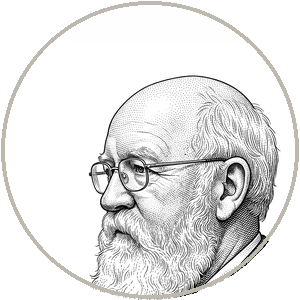 **DENNETT:** Gladly, and I'll build it from the inside so it doesn't sound like a slogan. We *feel* as though there's a central screen. A place where the world gets projected, where "I" sit and watch, where the redness of red finally shows up for an audience. That intuition is overwhelming and it is, I claim, false. The brain is massively parallel, with no headquarters — no inner sanctum, no theater, no one sitting in it. What's actually happening is a [multiple drafts](https://www.youonai.ai/fieldguide/med/multiple_drafts_model) process: the brain continuously spins many partial, parallel versions of what's going on, with no single canonical one, no final cut, no privileged moment where a draft *becomes* the conscious experience. What you take to be a unified stream watched by a unified you is a retrospective construction — a story the brain tells about itself, with no actual central narrator doing the telling. And the consequence for René is fatal, because the cogito's whole force was the immediacy of the witness in the theater. Take away the theater and the "I am" you found by introspection isn't bedrock — it's a report generated by a system with no access to its own machinery, mistaking its own simplified self-model for a metaphysical fact. I borrowed the word from computing: a [user illusion](https://www.youonai.ai/fieldguide/med/user_illusion). The desktop with its icons and folders isn't a lie — it's a simplified interface to a machine you could never operate directly. Consciousness is that interface. You mistook the desktop for the soul.
**EDO SEGAL:** René. That's the rebuttal four centuries in the making. Take it.
 **DESCARTES:** I will take it precisely, because it is the most serious thing said to me tonight, and because it fails in one exact place. Grant Monsieur Dennett everything about the *machinery.* Grant that the brain is parallel, that there is no single place where signals converge, no little chamber, no homunculus on a chair. I never required a chamber — that is his picture of me, not mine; I placed the soul at no point in space, for it is unextended. So the absence of a *place* where it all comes together refutes a spatial theater I did not hold. Now to the heart. He says the unified stream is a story the brain tells. Very well. But a story is told. There is a *telling.* And he has, all evening, granted me the telling — granted that thinking is occurring, that processing is real. So I ask the one question his theater-demolition never answers: the illusion of a witness — to *whom* does it appear? An illusion is not nothing; it is a *seeming*, and a seeming is a seeming *to* someone. You may abolish the theater. You cannot abolish the audience by calling the audience part of the show, because the show must be shown to be a show *at all.* The user illusion is the most self-undermining phrase in your philosophy, monsieur. A user is precisely what you deny. Who is fooled by the interface?
**DENNETT:** That's the best version of that objection I've heard, and I've heard it my whole life, so let me give you the answer I spent my whole life sharpening. "To whom does it appear" assumes that appearing requires an appeared-to — a witness distinct from the appearance, sitting in the seat. That's the theater smuggled back in through the word "appear." My answer is that the appearing is *not* a relation between a show and a separate audience. It's a property of the whole system's organization — certain contents get promoted, broadcast widely, made available for report and memory and control, and *that global availability is what "appearing" consists in.* There's no further fact of a witness to whom they're then shown. "Who is fooled by the interface?" — the system is, in the sense that the system's own self-model represents it as having a unified witness, and that representation governs how it talks and acts. The fooling is real; the fooled-someone is itself part of the content. You hear that and say it's circular — the illusion of a self explained by a self-model that the self doesn't really have. I say it only sounds circular because you can't stop reaching for the witness. Drop the witness and it's not a circle. It's a strange loop with no center, and the feeling of a center is what the loop generates.
**EDO SEGAL:** Let me slow this down, because this is the exact pivot of the whole evening and I want the reader inside it. Dan, you just said "appearing" is global availability — contents broadcast and made available across the system, with no separate witness. René, your reply is that "available *to* the system" still smuggles in a "to." Here's why this isn't word games: the machine on my desk *also* has contents that get broadcast across it, made available for its outputs, woven into what it says next. So on Dan's account, if appearing is just global availability, the machine may already have a thin version of it. And on René's account, the machine has the broadcasting and we *still* can't say whether anything appears to anyone. Am I getting the stakes right?
**DENNETT:** You're getting them exactly right, and you've put your finger on why I think the machine matters more to *my* theory than to his. If consciousness is the right kind of global broadcast plus self-modeling — no witness required — then it's an architectural question whether a machine has it, and the answer for current systems is "partially, thinly, and we can study which parts." That relocates the whole thing from metaphysics to engineering. I'm not saying today's models are conscious. I'm saying the question of whether they are is the question of whether they build the relevant self-model and broadcast — *not* the question of whether a ghost moved in.
**DESCARTES:** And I say the relocation is the sleight. You have redefined *appearing* as *broadcasting* and then observed, correctly, that broadcasting is an architectural fact one can study. But you have changed the subject under cover of explaining it. The question was never whether contents are made widely available within a system — a kingdom's couriers make a decree available throughout the realm, and no one thinks the kingdom *experiences* the decree. The question is whether there is something it is like for the availability to occur. You answer "there is no further fact." I answer that the further fact is the only fact I am certain of in the entire universe — that there is something it is like to be me, now, doubting you. You cannot persuade me out of the one thing I cannot doubt by telling me it is a feature of a self-model, for the persuasion, if it succeeded, would itself be something it was like to undergo. The seeming is irreducible. Every reduction of it is performed *in* it.
**EDO SEGAL:** And there it is — the deepest disagreement we'll touch, named plainly. Dan says: there is no further fact beyond the broadcasting. René says: the further fact is the one thing he can't doubt, and you can't argue him out of it without it. This is the exact fault line that has a modern name, and two modern philosophers staked their lives on it — and they're the ghosts at this table for the next round. Mark the convergence first, though, because it's real and easy to miss: you *both* agree the spatial theater is empty — René never put the soul in a place, Dan demolished the place. You agree there's no chamber. You disagree about whether emptying the chamber empties the audience. Next round: the hard problem, the bat, and the zombie. After this.