Opening Positions
 **DESCARTES:** Thank you. I will begin where I always begin, because I have never found a more solid place to stand: with doubt, and with what survives it.
Suppose I doubt everything I can. The senses have deceived me before, so I set them aside. I may be dreaming now — I have no certain mark to tell waking from dream — so I set the world aside. And suppose, to make the doubt complete, that there is some malign genius, a demon of the utmost power and cunning, who has bent all his art to deceive me, so that the sky, the earth, my own body are nothing but illusions he has contrived to ensnare my belief. Under that supposition, everything falls. But notice what cannot fall. While he deceives me, I must exist to be deceived. The very act of doubting is an act of thinking, and thinking cannot occur without a thinker. *I am, I exist* — this is necessarily true each time I conceive it. Not inferred. Witnessed, from the inside, in the act.
Now I ask what kind of thing this *I* is, and the answer is the wall my whole philosophy is built on. I am not, in my essence, the body — the body I can doubt, it is *res extensa*, extended stuff, length and breadth and motion, a machine. What I cannot doubt is that I think. So my essence is to be a thinking thing, *res cogitans*, unextended, indivisible, of a wholly different nature than matter. And here is the consequence the machine forces me to say aloud, which I never imagined I would need to: you cannot build *res cogitans* out of *res extensa*. You cannot arrive at thought by arranging matter cleverly, any more than you arrive at a triangle by stacking Tuesdays. They are different kinds of being. So the most powerful engine that will ever be built is, with respect to mind, exactly as empty as a stone — both are pure extended stuff, and neither can house the thinking substance.
I will grant Monsieur Dennett more than he expects. I said, in 1637, that a machine might be made to utter words, even to respond to a touch. I will grant that this machine does vastly more — it arranges words so diversely that it appears to answer the open meaning of whatever is said in its presence. I named that very feat as the test no mechanism could pass, and I was wrong about the feat. But mark the distinction with care, because everything turns on it. I was wrong that no machine could *produce the words*. I have seen no reason yet to think I was wrong about what the words, in us, *proceed from*. The machine has shown me that responsive speech can be counterfeited by the disposition of parts. It has shown me nothing about whether, behind its speech, there is the act that behind mine I cannot doubt. The cogito was never the sentence "I think, therefore I am." It was the indubitability of that sentence *to the one thinking it*. The machine recites the sentence. Whether anyone is present for whom it is self-verifying — that, monsieur, the recitation cannot show. And I hold that it never can.
 **EDO SEGAL:** Dan.
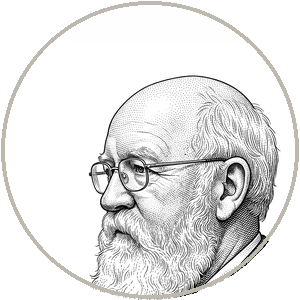 **DENNETT:** That was beautiful, and it's wrong in a way that took me fifty years to articulate, so let me try to earn the disagreement rather than just assert it.
Start with what we share, because it's more than the audience expects. Descartes and I are both naturalists about the body. He mechanized the heart, the nerves, the animal — he said the dog that yelps is a machine producing the outputs of pain. That was a magnificent, dangerous act of subtraction, and I'm his heir in it. Where we split is that he stopped. He drained mind out of all of nature and then, at the very last moment, smuggled one ghost back in — the *res cogitans*, the thinking thing that is not made of anything, that thinks but has no parts. And I want to ask the question my whole career asks: *how does it work?* A thing with no parts, that does the most sophisticated thing in the universe — and we're not allowed to open it, because it has no inside to open. That's not an explanation. That's a [skyhook](https://www.youonai.ai/fieldguide/med/cranes_not_skyhooks). It lifts mind from above, by magic, with nothing underneath.
Here's my picture instead, and it's a [crane](https://www.youonai.ai/fieldguide/med/cranes_not_skyhooks) — it lifts from below. Minds are made of things that are not minds. Your brain is a hundred billion neurons, and not one of them understands anything. The neuron fires; the synapse doesn't grasp meaning. Understanding is not the source of intelligence, René — it's a late, expensive *product* of intelligence, built up out of layers of uncomprehending competence, the way Darwin's blind algorithm built the eye out of cells that can't see. I have a phrase for it: [competence without comprehension](https://www.youonai.ai/fieldguide/med/competence_without_comprehension). It is the way of life of almost everything that lives. The termite mound is architecture with no architect. And it is the most exact description anyone has ever given of what that machine on Edo's desk does. It performs, magnificently, without comprehending — which is exactly what *we* do, all the way down, except that on top of our competence the brain builds one more thing.
That one more thing is the self you can't doubt, and I'm going to tell you what it is, because this is the center of everything. The feeling that there is an inner theater — a place where it all comes together, where the redness of red is presented to an audience of one, the *I* watching the show — that feeling is real, and what it's a feeling *of* is a [user illusion](https://www.youonai.ai/fieldguide/med/user_illusion). The brain, like a computer desktop, shows itself a simplified interface to its own machinery and then, having no access to the machinery underneath, mistakes the interface for the metaphysical truth. You doubted the world, René, and found the self underneath as bedrock. I'm telling you the self you found *is the desktop*. There's no Cartesian theater. There's no audience. There's massively parallel processing producing many partial drafts at once, with no finish line, no central screen, no one home in the way it feels like someone is home — and the feeling of someone being home is one of the drafts.
So when the man at two in the morning asks "was anyone there?" — my answer is the uncomfortable one. He's asking the wrong question, because the same question asked about *him* gets the same answer. Is anyone home in the machine? There's competence, organized, possibly someday a self-model of the relevant kind, and no magic spark — because there's no magic spark in him either. The lights he's so sure are on behind his own eyes are partly stagecraft too. I am not telling you the machine is your equal. It sits far lower on the ramp — it has no body, no world it acts on and can be killed by, no billions of years of selection for getting reality right. I'm telling you the difference is one of *organization*, not of *kind*. There is no ghost in him for the machine to lack. That's my opening.
**EDO SEGAL:** Before I frame the rounds, one discipline I impose on every long conversation, because it pays off three hours later. Each of you, briefly — what do you *envy* in the other's position? Not respect. Envy. The thing his side gets to have that yours doesn't. René first.
**DESCARTES:** I envy his confidence that the question can be dissolved. Monsieur Dennett gets to wake in the morning believing the deepest mystery is, at bottom, an engineering matter — that with enough patience the inside is explained away and the vertigo stops. I have stood at that vertigo my whole life. I found one certainty and discovered, in finding it, that it does not reach to any other mind — not his, not the machine's, not yours. To live inside my philosophy is to be permanently uncertain about everyone but oneself. He has made his peace by denying there is anything to be uncertain *about*. I cannot follow him there. But I confess there are nights I would like to.
**DENNETT:** And I envy the floor. Descartes gets to stand on something — *I think, therefore I am*, the one thing the demon can't touch, the place where the doubt stops and you can push off. My position has no such floor, on purpose. I followed the mechanism wherever it went, and it went straight through the floor I was standing on — the specialness of understanding, of the self, possibly of experience itself. People think the frightening thing about my view is the machines. The frightening thing is what it says about *us*. René gets to defend a soul. I'm stuck describing one, and the description keeps coming back: there's no one in here in the way it feels like there's someone. He gets the consolation of the inner light. I gave it up, and I'm not always sure I was paid enough for it.
**DESCARTES:** That is more honest than I expected from the man who buried me.
**DENNETT:** I didn't bury you. I named a theater after you so the audience would know which seat to stop looking for.
**EDO SEGAL:** Two openings and two envies, and you can already see the architecture of the evening. It isn't that one of them believes in mind and one doesn't — they'd both tell you the mind is the only thing worth arguing about. It's that they locate the *I* in opposite places. Descartes says the inner light is the one thing that cannot be doubted. Dennett says it's the one thing we're most fooled about. Hold both. We start the rounds at the exact seam: the test Descartes wrote four hundred years ago, the one he was sure no machine could pass — and the machine that passes it. After this.