God, the Circle, and the Hallucinating Machine

 EDO SEGAL: I want to take a detour that turns out to be a shortcut, because there's a part of your system, René, that modern readers skip and I think the AI age desperately needs. After the cogito, you had exactly one certainty and a universe of doubt. To get any further — to trust mathematics, to trust your clear perceptions — you needed a guarantee that your faculties aren't systematically fooling you. And your guarantee was God: a perfect, non-deceiving God who wouldn't have given you a mind that errs when used carefully. Your critics pounced — the Cartesian circle: you use clear perception to prove God, then use God to validate clear perception. Here's why I'm raising it. The machine has the same problem, stripped of the escape. It was trained on a corpus it can't independently verify, and it checks its own outputs with the very faculties whose reliability is in question. When a model hallucinates — states a fluent falsehood with total confidence — it's inside your circle with no God to break it. So: did you diagnose the machine's deepest flaw three hundred years early?

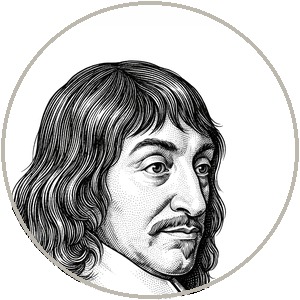 DESCARTES: I diagnosed the predicament of any mind that must validate itself, and the machine inherits it more nakedly than I did. Hear the structure exactly, for it is more important than the theology. I saw that I could not certify my faculties from within — that any check I ran on my reason, I ran with my reason, so the certification was always question-begging. There is no standpoint outside one's own cognition from which to verify that one's cognition tracks the truth. I reached for God precisely because I saw the certification could not come from inside. Whether the reach succeeded, my critics have disputed for centuries. But the predicament it reveals is real and inescapable: a mind has no outside. And your machine is the purest instance. When it "checks" its answer, it checks with the same trained machinery that produced the answer. Its confident falsehood is my circle made mechanical — it has no faculty for telling its true clear-and-distinct perceptions from its false ones, because the faculty that would tell them apart is the faculty that generated both, with no external warrant that any of it touches the world.

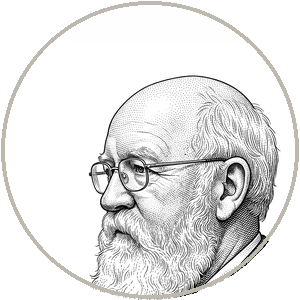 DENNETT: And this is one of the rounds where I think Descartes is just right, with one amendment that turns the whole thing — so let me concede generously and then take the floor out from under the consolation. He's right that no system, us or the machine, gets a God's-eye certification of its own reliability from the inside. There's no skyhook for epistemology either — no guarantee lowered from above. We're all in the circle. But — here's the amendment — Descartes thought that left us needing God, a single transcendent guarantor. Darwin gives the naturalistic replacement, and it's better. Our faculties aren't certified from outside; they're vetted from below, by a brutal multi-billion-year filter that killed every lineage whose perceptions didn't track the world well enough to eat and mate. That's not certainty. It's a track record. Evolution is the crane that built a roughly reliable instrument with no guarantor — competence in world-tracking, with no comprehension of why it works and no proof that it does. We don't trust our senses because God underwrites them. We trust them, defeasibly, because the ones who didn't aren't here.

EDO SEGAL: So restate the machine's situation in that light, Dan, because it cuts sharply.
DENNETT: The machine's problem isn't that it lacks God. It's that it lacks the vetting. We were filtered for getting reality right, on pain of death, for eons. The model was filtered for producing plausible continuations of human text — vetted for plausibility, not for truth, because nothing killed it when it was wrong. That's why it hallucinates: it's superbly tuned to what sounds right and was never, at any point, made to pay for the gap between sounding right and being right. The fix isn't a guarantor; it's grounding — closing the loop through a world that pushes back, so that being wrong finally costs something. That's an engineering program, not a theological one. Descartes reached for God because Darwin hadn't been born yet. Give him Darwin and the circle stays unbroken but the panic goes away: you don't escape the circle, you just build a better track record inside it.

DESCARTES: I will grant you Darwin as the genealogy of the instrument, and grant it gladly — it is a more honest account of how my faculties came to be roughly fitted to the world than I could give. But mark what it does not do, monsieur, for you have quietly let it do too much. A track record of survival certifies that my faculties were useful — that they tracked the world well enough to keep the lineage fed. It does not certify that they track the truth, and you of all men know the gap, for your own Darwin teaches that a useful falsehood outbreeds a useless truth. The filter selected for fitness, not for verity. So your replacement for God secures the machine's usefulness, perhaps — and leaves the question of truth exactly where my circle left it: unbreakable from within. You have not escaped the circle. You have shown me a circle that learned, over eons, to stop bleeding. That is something. It is not knowledge. And it returns us, by the back door, to the whole evening's seam — for a mind that cannot certify its own truth from within is a mind that cannot certify, of itself, whether it understands or merely performs understanding usefully. The machine cannot tell from inside. Neither, on your account, can we.

EDO SEGAL: Mark that — it's a convergence that should make the reader's neck prickle. The dualist and the Darwinian just agreed that no mind, human or artificial, can step outside itself to verify that its own processing tracks the truth — that we are all inside the circle, and the machine is simply the version with no track record and no God. You split only on whether evolution's track record is enough — Dan says it's all anyone ever had, René says it secures usefulness but not truth. Let me route this through the desk one more time before we go to the deepest water. When the machine helped me at three in the morning and I felt met, I could not verify, from inside my own delighted mind, whether I'd been met or fooled — and on what both of you just said, I never can, about anyone. That's not a bug in the machine. It's the condition of being a mind at all. Next round: the hard problem. Is there anyone home — and can the question even be answered? After this.