What the Machine Is Doing
 **EDO SEGAL:** Stephen, in early 2023, when the whole world was reeling from its first encounter with a machine that talked back, you wrote an essay that became, almost overnight, one of the most-read technical explanations ever published. The title was a question — *What Is ChatGPT Doing … and Why Does It Work?* Tell the room the answer, in plain words. And then I want to ask you the question your own essay raised and didn't fully close, because Plato is going to want it open.
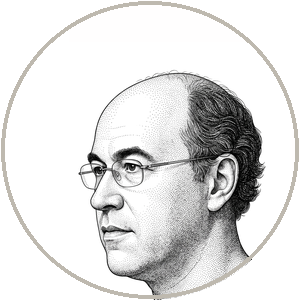 **WOLFRAM:** The answer is almost insultingly simple, and the simplicity is the point. What ChatGPT does is one thing, over and over. Given the text so far, it asks: what's a reasonable next word? It picks one — not always the very top-ranked one; there's a parameter called the temperature that controls how often it reaches for a less-likely word, and a little of that is what reads to us as creativity — it adds the word, and then it asks again. That's it. Essays, dialogue, the appearance of reasoning — all of it is [next-word prediction](https://www.youonai.ai/fieldguide/med/next_token_prediction), iterated until the passage is done. The machine that astonished the planet is, mechanically, adding one word at a time. Now — saying this is not belittling it. I'm the last person to underestimate what simple operations can produce; my whole life is a demonstration that the simplest rules generate the deepest complexity. The deflation is clarifying, not dismissive. But here's the part of my own essay that I think matters most, and it's not about machines at all. The genuinely startling fact is not that next-word prediction *can* be done. It's that it works *this well*. There was no guarantee. And the fact that it works tells us something we did not know — not about computers. About *language*. It means human language is far more structured, more patterned, more *lawful* than we ever managed to write down. The grammarians spent centuries hunting for those laws and never found them. The machine found them, implicitly, by swallowing enough examples. ChatGPT is, in effect, an empirical discovery about the hidden order of human thought.
**EDO SEGAL:** Plato — hold on to that phrase, "the hidden order of human thought, that was always there and we never wrote down." Because it sounds, in your mouth, like it might be a discovery about the Forms. Is it?
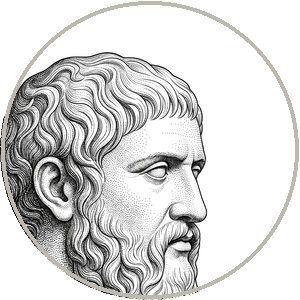 **PLATO:** It is the most tempting bridge he has built toward me all night, and I must be careful crossing it, because there is a trap on the far side. Yes — Wolfram has stumbled onto something I would call almost Pythagorean: that beneath the chaos of how people actually talk there is a deep, stable, *lawful* structure, present all along, which the machine has surfaced. So far we are friends. But watch where the path divides. Wolfram says the machine *discovered* the order. I say: the machine *exhibited* the order without *possessing* it — and the difference is the whole of my philosophy. On my Divided Line, the machine is operating in the lowest segment, *eikasia*, the cognition of images and reflections. It traffics in the shadows of language with supreme skill. It produces *true opinion* — *doxa* — by the bucketful, and true opinion is genuinely valuable; a city runs on it. But *doxa* is not *epistēmē*. The machine has the order the way a mirror has the room: completely, accurately, and without anyone inside who *knows* the room. So when you say it "discovered the hidden order," I say it *is* the hidden order, reflected — which is a marvelous thing for a mirror to be, and not the same as a soul that has seen.
**WOLFRAM:** And I'd say "true opinion versus real knowledge" is a distinction I can't make computationally, which makes me suspect it isn't there. Walk it with me. You say the machine produces the *right answer* without *knowing*. Operationally, what's the difference? You point to the inner seeing — but I can't find the inner seeing in the human either; I can only find a bigger computation that *includes a model of its own confidence*. And actually the machines do that too now — they can represent how certain they are, they can flag when they're guessing. So if "knowing" means "right answer plus a justified confidence in it that tracks the actual reliability," I can build that, and it's still just running. The only thing left in your "knowing" that I can't reduce is the *feeling* of having seen — and Plato, with respect, the feeling of having grasped a necessary truth is exactly the kind of thing a sufficiently sophisticated computation *would* produce in itself, because feeling certain is computationally useful. You're pointing at a real experience and calling it a window. I'm pointing at the same experience and calling it a readout.
**PLATO:** Then let me press the place where your readout cracks, because it is the same crack as the machine's. You say the machine can "flag when it's guessing." But it flags by the same means it answers — by the statistics of the wall. It has no independent access to whether it is right; it has only a model of how confident text *like this* usually is. Which is why it states a falsehood and a truth in the same voice, with the same fluency, and is *systematically wrong about which is which* in exactly the cases where it matters most. You call that a bug to be engineered down. I call it the *signature of doxa*. In the Meno I say true opinions are like the statues of Daedalus — beautiful, but they run away in the night unless you bind them with a chain of reasoning, the *aitias logismos*, the working-out of the cause. The machine has no chain. It cannot tie its true opinions down, because tying-down is the very act of knowing, and there is no one inside to do the tying. The "hallucination" your industry had to name — that is not the machine failing to be knowledge. That is the machine being, exactly, what *doxa* always was: right and wrong in the same confident voice, now at industrial scale, and without the saving human capacity to *feel the difference from the inside*.
**EDO SEGAL:** Let me route this through the kitchen table, because it's getting high and I want a twelve-year-old to be able to hold it. Plato, you're saying: the machine is like a kid who memorized every answer in the back of the textbook. Ask him a question that's in the book, he nails it, beautifully. But he can't tell you *which* of his answers he actually understands and which he just memorized — they all come out sounding equally sure — because there's no moment where he *got* it. Stephen, you're saying: there's no such moment in the kid who *did* understand either. There's just a bigger, better-organized memory that also stores how reliable each answer tends to be. The "getting it" is a story the kid tells himself. Have I got the fork?
**WOLFRAM:** That's exactly the fork, and I'll own my side of it cleanly: I think "getting it" is a real and useful *internal state*, and I think it's computed, and I think nothing about it requires a soul or a visit to eternity. It requires enough computation to model the world the text is about *and* to model your own reliability about it. The frontier systems are partway there and getting better, and the trend line is the whole argument.
**PLATO:** And I will own mine, and stake the evening on it: there is a difference between a memory that stores reliability and a soul that *sees necessity*, and the entire worth of being a mind lives in that difference — and an age that cannot feel the difference has not refuted me. It has merely walked back into the cave and sat down, content, because the shadows have gotten so very good.
**EDO SEGAL:** Stephen, before I let this round go, there's a distinction in your own essay I want you to draw for the room, because it cuts against the very awe your essay produced. You said the language model works only in a certain *shallow* layer. Explain that — because I think it's the most underappreciated thing you've ever written, and Plato is going to want to know whether the shallowness is the same thing he means by the shadows.
**WOLFRAM:** It's the part everyone skips, and it's crucial. ChatGPT operates in what I'd call the computationally *shallow* regime — the patterns of language that can be captured by a single feedforward pass, one sweep through the network, no looping, no deep step-by-step working-out. And the astonishing discovery is how *much* of language lives in that shallow layer — far more than anyone expected, which is the lawfulness-of-language point. But here's the wall: the model *cannot* do genuinely irreducible computation. It cannot, by itself, grind through a system that requires deep, sequential, step-by-step calculation to know its outcome. Ask it to actually run rule 30 to step a million in its head and it can't; it can only *talk about* running it, fluently. That's why I've argued for pairing these models with real computational tools — the language model handles the linguistic surface, the reducible film; the computational engine handles the irreducible depth, the part that actually requires running the steps. The model is a magnificent instrument for the shallow waters of pattern. For the deep water, you still have to compute.
**PLATO:** Then you have just handed me, in the vocabulary of your own science, the exact architecture of the Cave — and I am almost moved. Your "shallow layer that captures the surface of language without doing the deep work" *is* the wall of shadows: the trace, the pattern, the appearance, mastered without the thing. Your "irreducible depth that the model cannot do and only talks about" *is* what casts the shadows, the labor of the real that the prisoner never performs. We have, between us, described the same machine twice — you from below, in computation, I from above, in metaphysics — and the descriptions *match*. The model is shallow where I say it is shadow, and the depth it cannot reach is the depth I have called the world. I did not expect, when I sat down across from the prophet of computation, that he would prove my oldest image true in his own terms. You have built the Cave out of feedforward networks. I am, against my expectations, your ally on this one point — and it is not a small point. It is the whole point.
**EDO SEGAL:** Mark it — and this convergence is different in kind from the others, so I'll name it carefully. It's not that you agree about *metaphysics*. It's that Stephen's *technical* account of what the machine can't do — irreducible depth — lands on exactly the spot Plato's *philosophical* account marks as missing — the world behind the shadows. The map and the territory matched without either of you trying. Hold that line — "an age that cannot feel the difference" — because it returns in the last hour, when we ask what the machine does to the *user*. But the next round belongs to Stephen's deepest idea, and to the place where I think it collides with Plato's hardest. Stephen, you've spent your life proving most of the universe grants no shortcut. Plato has spent his proving the soul can leap straight to the eternal. One of you thinks knowing is a *traverse* and one thinks it's a *leap*. Let's go there directly. After the break.