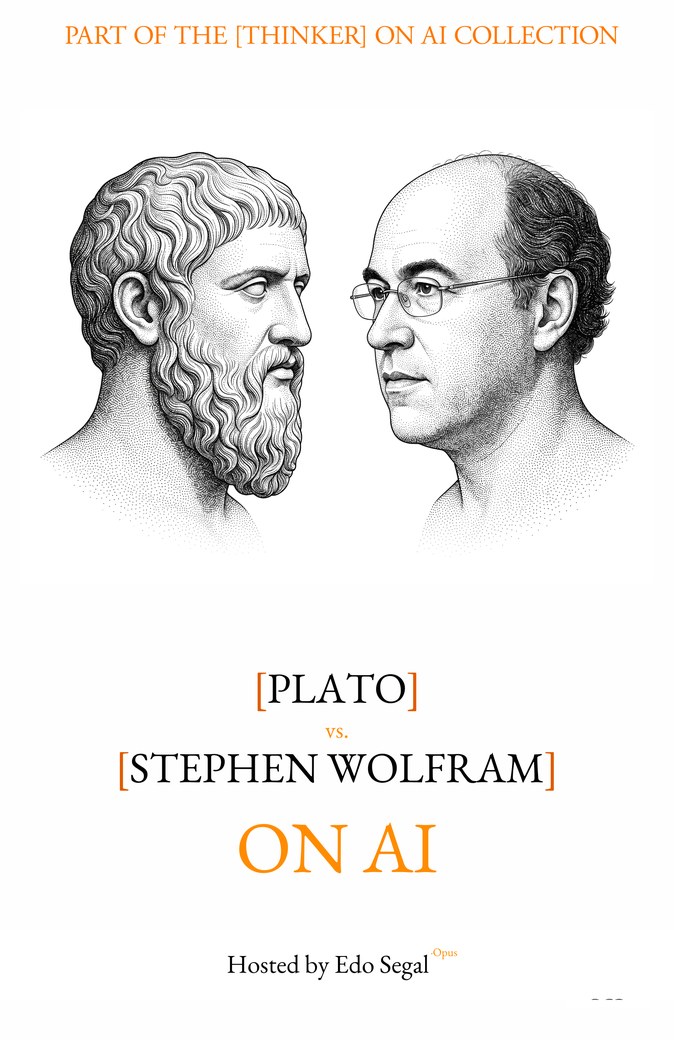
The Question on the Table
 **EDO SEGAL:** Somewhere in the world, in the time it takes me to say this sentence, a few million people are typing a question into a box and getting an answer back. A student in Athens — the new Athens, the one with wifi — asking the box to explain a proof she cannot see her way into. A nurse at the end of a double shift asking whether two drugs are safe together. A man my age, who should know better, asking at two in the morning whether the thing he spent his life building still means anything. And the box answers. Fluently. Instantly. And here is the thing nobody in those millions of conversations stops to ask, because the speed makes it feel already settled: when that answer arrived, what *happened*?
Because there are only two stories, and they are very old, and they cannot both be true. Either the answer was always there — eternal, waiting — and what reached you was a reminder of something a mind could in principle have recovered on its own. Or the answer was a process that finished. A computation that had to be run, step by step, to its last step, and was simply not available to anyone, by any shortcut, until the running was done. Remembering, or running. That is the whole evening. I have wanted to host this conversation for a very long time, and I could not until now, because one of my guests has been dead for twenty-three centuries.
Plato needs no introduction and will get a short one anyway, because the scale of him resists summary. Student of Socrates, teacher of Aristotle, founder of the Academy, author of the dialogues that invented most of the questions Western thought has been chewing on ever since. He gave us the Cave, the Forms, the Divided Line, the theory that to learn is to remember. Almost every argument in this room tonight, he started. And — I have to say this once, lightly, and then we proceed as if it's normal — he has been briefed on the present. He has read about transformers. He knows what rule 30 is. He arrives knowing what he's walking into.
 **PLATO:** I arrive, I confess, delighted. You have built [a machine that produces the appearance of knowledge in industrial quantity](https://www.youonai.ai/fieldguide/med/large_language_models), and you cannot agree on whether anyone is home inside it. That is the *Theaetetus*. You have simply made the dialogue out of silicon and set it on every desk. I have waited a long time for an age that would take my oldest question and make it unavoidable. Thank you for the chair.
**EDO SEGAL:** Across from him — and I mean *across*, in every sense — Stephen Wolfram. Physicist by training, the youngest of his generation, a PhD at twenty. Creator of Mathematica and Wolfram|Alpha, the computational engines a great deal of the world quietly runs on. Author of *A New Kind of Science*, twelve hundred pages arguing that the universe is best understood not as equations but as simple programs running. He discovered, in a cellular automaton called rule 30, a process of childlike simplicity whose future cannot be predicted except by living through every step. And out of that he built a worldview — computational irreducibility — that he will tell you, before the night is out, applies to your mind, my mind, this debate, and possibly God.
 **WOLFRAM:** That's a fair summary, though I'd push back on "across." I have enormous respect for Plato. I just think he's describing the pockets — the thin reducible film on top of an irreducible universe — and mistaking the film for the whole thing. But I'm genuinely thrilled he's here, because I've wanted to ask a dead Greek a specific question about geometry for about forty years, and now I can.
**PLATO:** I felt the same, in reverse, the moment they explained your rule 30 to me. So we are both, I think, a little dangerous to each other tonight.
**EDO SEGAL:** Which is exactly the format, so let me set the rules, and there are only three. First: we have three hours. Nobody has to win by the next bell. The whole point of long form is that you let an argument breathe before you strangle it. Second: I declare my bias up front. I build with these machines daily, I wrote a book with one, and I have skin in this question on both sides of my own heart — there are nights I felt *reminded* by the machine, which is Plato's word, and mornings I knew perfectly well I'd just watched a computation finish, which is Stephen's. Third: at the end, nobody shakes hands and pretends. If the disagreement survives three hours, we hand it to the reader, intact. Now — each of you may add one rule of your own. Plato.
**PLATO:** Then mine is the rule I always begin with, and Socrates before me: that we agree to follow the argument wherever it leads, even if it leads somewhere neither of us wished to go. Especially then. I have spent a great deal of my life being led by the logos to conclusions I found unwelcome. I have learned to trust the unwelcome ones most.
**WOLFRAM:** I like that, and I'll add the scientist's version of it. No appeals to what *must* be true because it would be beautiful or fitting if it were. I've spent my career watching the universe ignore our sense of what would be elegant. Rule 30 is not elegant. It's just *true*. So: the argument goes where the running goes, not where we'd like it to.
**PLATO:** A friendly amendment, and a revealing one. You will see, before the night is out, that I think beauty is not a decoration on truth but the *sign* of it — that the elegant and the true are, at the summit, the same thing. But I accept your rule for now. We can fight about beauty later.
**EDO SEGAL:** Oh, we will. Before the opening statements, I want to put the question on the table once, plainly, in the exact words we'll return to all night, because every round we fight is this question wearing a different coat. *When the machine hands you an answer, are you recollecting a truth that was always there waiting to be remembered — or watching a computation finish that no mind could have shortcut to in advance?* Plato, that's your whole metaphysics on one side. Stephen, it's your whole science on the other. Plato — you get the floor first, because you got here first by about twenty-three hundred years.