Opening Positions

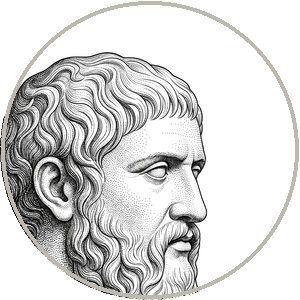 PLATO: Thank you. I want to begin not with a doctrine but with a boy, because the whole of my position is contained in him, and you can watch it happen. In the dialogue called the Meno, Socrates is challenged with a paradox: how can you ever inquire into something you do not already know? If you don't know it, you won't recognize it when you find it. If you do know it, you don't need to search. Inquiry looks impossible. And Socrates answers the paradox not with a theory but with a demonstration. He calls over an enslaved boy with no education in geometry, draws a square in the sand, and asks him to double its area. The boy guesses wrong, confidently — he doubles the side, which quadruples the square. Socrates does not correct him. He only asks more questions. And step by step, drawing nothing the boy could not see, asking and never telling, he leads the boy to construct the right answer: that you double the square by building on its diagonal.

Now attend to what just happened, because everything turns on it. Socrates put no knowledge into the boy. He gave him no theorem, no formula, no worked example. He asked questions, and the truth came out of the boy — a geometric truth the boy had never been taught and could not have read, because he could not read. Where did it come from? My answer, which I know your age finds extravagant, is that it was already in him. To learn is to recollect — anamnēsis — to draw out what the soul, in some deep sense, already possessed and had only forgotten. The boy did not acquire the diagonal. He remembered it. And this is why the elegant and the true converge: the truth was beautiful because it was always there, perfect, waiting, and recognition is the soul's homecoming to what it most deeply is.

Set this beside your machine and the contrast is total, and the contrast is my opening. Your model begins empty — initialized at random, possessing nothing — and is filled from outside by exposure to staggering quantities of human text. Its learning is the exact opposite of recollection: not the drawing-out of what was within, but the pouring-in of what was without. Where my boy already had the triangle and needed only the questions, your machine has nothing and needs the answers — millions of them, the worked-out residue of human minds that did the actual seeing. So when your box hands you a geometric truth, it is not remembering. It cannot remember; it was never home; it is constituted entirely by what came in. It is recovering a pattern latent in its corpus, which is real and is impressive and is recollection from other people's externalized thought — never from a soul that possessed the matter independently. The machine is the most learned thing ever built, and the one thing it cannot do is remember. That is my position. The answer it hands you was always there — but in the eternal Forms, where my boy's soul touched it — and the machine has only the shadows of where minds have been.

 EDO SEGAL: Stephen.

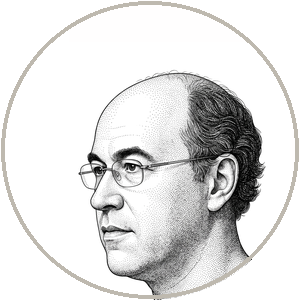 WOLFRAM: That was beautiful, and I mean that as a real compliment and also as a diagnosis, because the beauty is doing work that the argument can't quite do on its own. Let me start where I have to start, which is rule 30, because everything I believe comes out of it. In 1983 I was studying cellular automata — the simplest computational systems you can imagine. A row of cells, each black or white. A rule that says: look at a cell and its two neighbors, and here's the color it becomes in the next row. That's it. Rule 30 is one such rule. Childishly simple. You could explain it to Plato's slave boy in a minute. And I ran it, expecting — because I'd been trained as a physicist, trained to expect that simple rules give simple behavior — I expected something boring. Instead it produced a pattern of staggering, apparently random complexity. From almost nothing. And here is the thing that broke my whole worldview open and never let it close again: there is no shortcut.
Let me say exactly what I mean, because it's the load-bearing claim of my entire life. If you want to know the color of the cell a million steps down and a thousand cells over, there is no formula that gives it to you. None. You cannot leap ahead. You cannot derive it. The only way to find out what rule 30 does at step a million is to run it for a million steps. I have offered prizes — real money — for anyone who can find deep regularities that would let you shortcut it. The prizes stand. The irreducibility is real. The simplest system you can build can lock its own future away behind the absolute requirement that you actually live through every step to see it. I call that computational irreducibility, and once you've seen it you can't unsee it, because it's everywhere. Most of the universe is like rule 30. Newton's planets, where you can calculate a thousand years ahead without waiting — those are the exceptions. Those are the thin reducible pockets. The bulk of reality grants no shortcut at all.

So now turn to Plato's boy. Plato says the truth was always there, eternal, and the boy remembered it. Here's what I'd say happened, and notice it explains the same scene without any eternal realm. The doubled-square problem is reducible. It's one of the thin pockets — a question that happens to admit a shortcut, where a few right questions in the right order walk you to the answer. Of course Socrates can lead the boy there; the path is short and the structure is reducible. But that is the easiest class of truth there is, and Plato has built a cosmos on it. Ask the boy the hundred-and-tenth question about a system that's actually irreducible — ask him what rule 30 does at step a million — and no sequence of Socratic questions on Earth will draw it out of him, because it was never in him, because it isn't anywhere in advance. It has to be run. The answer doesn't exist until the computation finishes. So when your box hands you an answer, Edo — for the reducible questions, the box found the pocket. For the irreducible ones, the box ran the steps, faster than you could, and there was nothing to remember, because the answer didn't exist until the last cell updated. Not in the box. Not in your soul. Not in any eternal heaven. It had to be made, in time, by running. That's my opening. There is no shortcut. Not even for Plato. Not even for God.
EDO SEGAL: Two openings, and you can already feel the architecture of the night. Before I frame the first round, one discipline I impose on every long conversation, because it pays off three hours later — each of you, in a few sentences: what do you envy in the other's position? Not respect. Envy. The thing his side gets to have that yours doesn't. Plato first.

PLATO: I envy the humility before time. My picture asks the soul to ascend to a realm where everything already is, complete and timeless, and there is a kind of pride in that — the pride of the mind that believes it can leap, in a single intellectual motion, straight to the eternal. Wolfram's universe will not let anyone leap. Not the genius, not the god. Everyone must wait and run and find out. There is a discipline in that, an honesty about the cost of knowing, that my philosophers' ladder is always tempted to skip. I have watched clever men mistake the speed of their ascent for arrival. Wolfram's wall would have spared them, and me, that particular vanity.
WOLFRAM: And I envy the meaning. My framework tells me intelligence is common as dirt, that the universe computes everywhere with no special regard for us, that the elaborate significance I attach to my own thoughts is just one observer's particular sampling of a structure that means nothing by itself. Plato gets to live in a cosmos where the climb has a summit — the Good, the thing all the other truths point toward, the sun of the whole intelligible world. My pockets of reducibility are wonderful but they don't add up to a sun. They're just pockets. There are mornings when "the universe is computing and none of it means anything until an observer carves out a world" is a cold way to be a scientist. Plato's heaven has a top. Mine has no top, only more ruliad. I envy the top.
PLATO: That may be the most honest thing either of us says tonight.

EDO SEGAL: Hold both. Because that's the whole evening already, in miniature — it isn't that one of you loves the machine and one fears it. You'd both tell me to be careful with it. It's that you locate the answer in opposite places: Plato says it was always there and the machine forgot, because it never had a soul to remember with. Stephen says it was never there until it was run, and the machine is just a faster runner than you. We start the rounds at the exact seam — with a boy, a square drawn in the sand, and the question of whether learning is remembering or running.