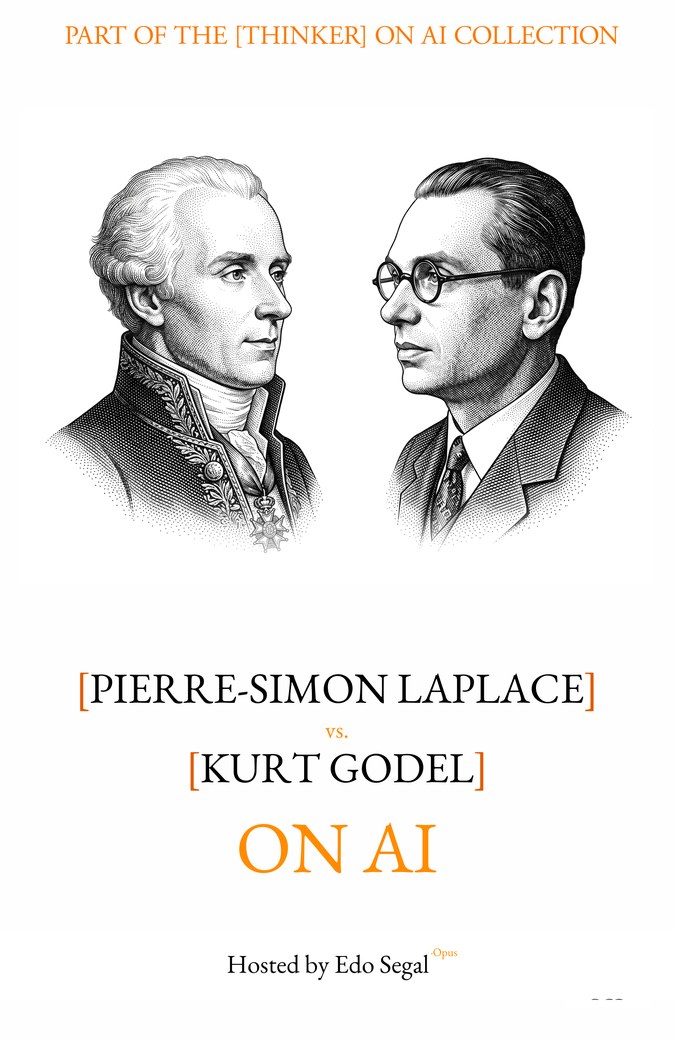
The Question on the Table

 EDO SEGAL: Somewhere in the world right now — in the time it takes me to say this sentence — a machine is computing the most probable next thing. The next word a man in Lagos will need. The next molecule that might fold into a drug. The next purchase, the next click, the next risk score that decides whether a stranger gets the loan or the parole. Trillions of these little forecasts a second, each one a small confident guess about what comes next, stitched together into something that increasingly runs the world. And underneath all of it, beneath the silicon and the data, is one ancient dream — that if you gather enough of the past, you can compute the future. That prediction, pushed far enough, becomes omniscience.

I have spent two years asking what that dream costs and whether it can be finished. Tonight I get to ask the two men who, between them, drew its outer boundary. One of them dreamed it most completely. The other proved it could not be done.
I can think of no stranger pairing on earth, and no more exact one. So let me state the question we are going to live inside for three hours, plainly, because every round tonight is this question wearing a different coat: if a great enough mind could compute everything, is there still a part of the truth that no machine will ever reach — and is that hole where you live?
Pierre-Simon Laplace was called the French Newton, and the title was not flattery. He took Newton's law of gravitation and proved that the Solar System was stable — that the whole vast clockwork would run on its own with no hand reaching in to wind it. He put probability on a rigorous foundation. And in a single sentence he set down the most audacious claim about prediction ever made: that an intelligence vast enough to know every force and every position could compute the entire future and the entire past, and for it, nothing would be uncertain. He imagined the perfect predictor before there was a machine to attempt it. Marquis, you have been listening to my century for a few days now. You know what they built.

 LAPLACE: I do, and I will confess at the door that I find it exhilarating and a little absurd in equal measure. Exhilarating because they have built, out of glass and electricity, an apprentice to my demon — a thing that gathers the data and projects it forward, exactly as I said a sufficient intelligence would. Absurd because they speak of it as if the dream were nearly closed, and I spent the second half of my life proving how far the dream is from closing. But yes. I recognize my own ambition in their machines. I would be a hypocrite to disown it.

EDO SEGAL: Kurt Gödel needs an introduction only because most people cannot finish the title of the paper that made him immortal. In 1931, at twenty-five, he proved that any formal system powerful enough to express ordinary arithmetic must contain statements that are true but that the system can never prove — and, worse, that no such system can ever prove its own consistency from inside. Not difficult. Not awaiting better engineering. Impossible, with the finality of a theorem. He proved where proof ends. Professor Gödel, you spent your life at the boundary of what can be formalized. You are about to spend three hours across from a man who thought there was no boundary at all.
 GODEL: That is not quite what he thought, and I expect we will spend a good deal of the evening on the difference. Laplace knew his demon was impossible. What he did not have — what no one had until I gave it to them — was the proof that the impossibility is not a matter of our weakness but of the structure of formal reasoning itself. I will try to be precise. Imprecision is the one thing I cannot tolerate, and it is, I notice, the native tongue of your century's discussion of these machines.

EDO SEGAL: It is, and you are both here partly to cure us of it. So let me set the rules of the evening — there are three, as there always are. First: we have three hours, which means no one has to win in the next ten minutes. The whole point of long form is that an argument gets to breathe before anyone strangles it. Second: I am not neutral, and I will tell you exactly where I am not. I build with these systems daily. I wrote a book with one. I have felt the pull of the demon's promise and I have felt the relief of the theorem, and I have skin in this question on both sides of my own chest. Third: at the end, no one shakes hands and pretends. If the disagreement survives three hours, I hand it to the reader intact. Each of you may add a rule of your own.

LAPLACE: Then I add this: let us not confuse the dream with the marketing of the dream. I am the father of the perfect predictor, and even I never promised it could be built. When your century says the machine will soon compute everything, that is not my claim. That is my claim stripped of the honesty that made it bearable. Hold the machines to what I actually said, not to the inflation of it.
EDO SEGAL: Granted, and gratefully. Professor?
GODEL: My rule is narrower and I suspect more irritating. Every word in this room must mean exactly one thing. When Laplace says "compute," when the engineers say "understand," when you say "reach the truth" — these words carry assumptions that have not been paid for. I will ask, each time, what precisely is meant. I have spent my life learning that the whole of a question is usually hidden in the imprecision of a single word, and that when you fix the word, the question either dissolves or becomes terrible. I would like it to become terrible.

EDO SEGAL: You will get your wish. One thing before openings, and I want to say it lightly because it is strange. You two could never have met — Marquis, you died seventy-nine years before the Professor was born. And neither of you lived to see the machine. So I have done something I should confess: I have briefed you both on the present. You know what a neural network is, what a transformer learned from a trillion words, what a trillion-dollar market looks like when it moves. You are reacting to my age in character, with your own minds, which is the only honest way to do this. Does that trouble either of you?

LAPLACE: It delights me. I would have given a great deal, in 1814, to see one century forward. To see two — and to argue with a man who proved the limits of the very dream I was dreaming — that is a gift no astronomer of my age could have priced.
GODEL: It does not trouble me. A theorem does not age. What I proved about formal systems in 1931 is exactly as true of your machines as it was of Hilbert's program, because your machines are formal systems in precisely the sense my proof requires. The century between us is, for the mathematics, nothing at all. That is rather the point.
EDO SEGAL: Then we have our evening. The question is on the table — if a great enough mind could compute everything, is there a part of the truth no machine will ever reach, and is that hole where you live? Marquis de Laplace, you dreamed the perfect predictor. The floor is yours.