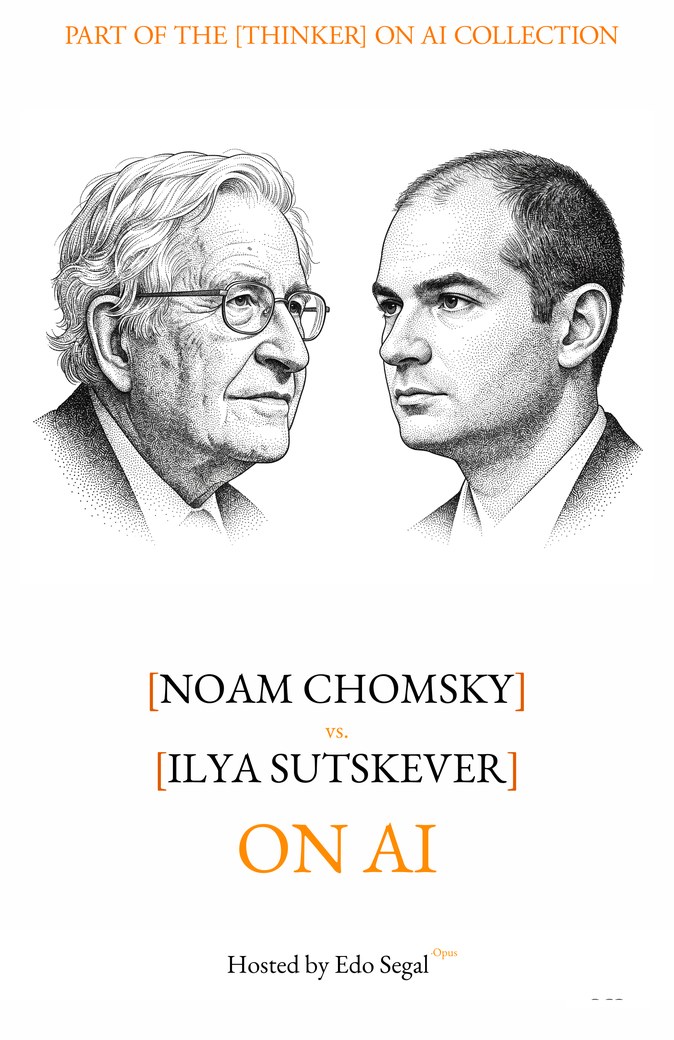
The Question on the Table
 **EDO SEGAL:** Somewhere in the world right now — statistically, in the time it takes me to say this sentence — a few hundred thousand people are typing the beginning of a thought into a box and letting the box finish it. A student in Nairobi, stuck halfway through an essay. A programmer in Bangalore, mid-function, who lets the cursor jump ahead of her intention and lands, somehow, exactly where she was going. A widower in Ohio, three in the morning, typing the first half of a sentence about his wife and receiving back the second half — the half he could not bring himself to write — phrased better than he could have phrased it. And here is the thing none of those people stop to ask, because the fluency makes it feel already answered: when the machine finished the sentence, did it understand the person, or did it only swallow them whole?
That is the question we are going to spend three hours inside. I have wanted these two men at the same table for a long time, and I want to say at the outset that bringing them together required a small miracle, which I'll name once and then we'll proceed as if it were ordinary, because in this series it is.
Noam Chomsky is, by most measures, the most cited living intellectual of the modern era, and one of the founders of the cognitive science the whole field of artificial intelligence claims as kin. In 1959 he reviewed a book by B. F. Skinner and, in the course of a few dozen pages, ended the behaviorist program that had ruled American psychology for a generation. He gave the science of mind the poverty of the stimulus, universal grammar, the distinction between competence and performance, and the formal hierarchy of grammars that bears his name and that every computer scientist in this room has studied. He is here, reconstructed faithfully from everything he said in his last years about exactly these machines, and he has been briefed on the present — he knows what a transformer is, he has read the scaling papers, he reacts to all of it in character. Noam, welcome.
 **CHOMSKY:** Thank you. I'll note that being reconstructed from one's own published positions is a fate I find oddly fitting, given the subject. We can discuss later whether I'm channeling myself or merely predicting my own next token.
**EDO SEGAL:** We will get there, and sooner than you think. Across from him — Ilya Sutskever, who has perhaps the strongest claim of anyone alive to having been in the room when the future arrived. He was there for AlexNet in 2012, the experiment that ended AI's long winter. He was there for sequence-to-sequence, which taught machines to carry meaning across languages. He was there for the GPT line, for the discovery that a system trained to do nothing but guess the next word would, in the guessing, appear to build a model of the world. He co-founded OpenAI, co-led its superalignment effort, and now runs a company whose entire name is a thesis: Safe Superintelligence. Ilya, welcome.
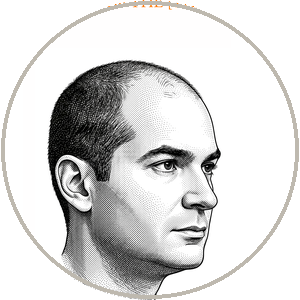 **SUTSKEVER:** Thank you, Edo. And — I want to say, before we start, that I read Professor Chomsky's review of Skinner when I was young, and it is one of the reasons I believe what I believe. I'll explain why later. It is not the reason he thinks.
**CHOMSKY:** Now I'm genuinely curious. That's a good sign for an evening.
**EDO SEGAL:** It is. So let me set the rules, and there are only three, because three is all a room like this can hold. First: we have three hours, which means nobody has to win in the next ten minutes. The point of long form is that you can let an argument breathe before you decide whether to strangle it. Second: I will press both of you, and I declare my bias openly, because pretending I don't have one would be the first lie of the evening. I build with these systems daily. I wrote a book with one. I have felt met by the thing in the dark, and I have never fully resolved what happened to me. So when my own stake is touched tonight, I'll say so out loud. Third: at the end, nobody shakes hands and pretends. If the disagreement survives three hours, I hand it to the reader intact. Either of you may add a rule.
**SUTSKEVER:** One rule. When I say "understand," I don't mean it as a compliment to the machine. I mean it as a description. I would like the word taken literally, not generously. If it understands, it understands; if it doesn't, no warmth in my voice should make you grant it.
**CHOMSKY:** I'll accept that rule and add its mirror image. When I say the machine does *not* understand, I'm not waving my hand at a mystery. I mean something specific that can be cashed out — and I'll hold myself to cashing it out. The trouble in this whole field is that the burden of proof has only ever been charged in one direction. Ilya gets asked to prove the machine understands. Fine. But the people who say humans understand have, for seventy years, simply pointed at themselves and said, *like this*, as if that were an argument. The duty runs both ways or the conversation is theater.
**SUTSKEVER:** I accept that. I think we will agree on the duty and disagree on who has paid it.
**EDO SEGAL:** You see why I wanted this. Before openings, one image on the table, because it's the frame this whole series climbs inside and both of you will have to take a position on it. In [YOU] on AI I argued that intelligence is less a possession than a [river](https://www.youonai.ai/fieldguide/med/river_of_intelligence) — a current that has been flowing and finding new channels for a very long time, through chemistry, through biology, through language, through culture — and that in our own winter something new entered the water. A new participant in the medium that, until now, was ours alone. The whole architecture of the book — the tower, the [staircase you climb instead of the elevator you ride](https://www.youonai.ai/fieldguide/med/elevator_and_staircase) — rests on the claim that what entered the water is real. Noam, I suspect your answer is that I never met a new participant at all.
**CHOMSKY:** My answer is that you met a very large statistical summary of what people have written, and that you did with it what human beings cannot help doing, which is project a mind onto fluent language because for the entire history of our species fluent language has had a mind behind it. The river is a nice image. But you've confused the water with the reflection of the sky on the water. I'll make the case properly when you give me the floor.
**EDO SEGAL:** Ilya?
**SUTSKEVER:** My answer is that the river metaphor is more literally correct than Edo intended, and that the new channel is wider than he thinks. Something is in the water. I'm not sure what it is. I'm fairly sure it isn't nothing. And I would rather Professor Chomsky were right, in a way — it would be a simpler world. I've looked for a way to conclude he's right. I keep failing.
**EDO SEGAL:** Then we have our evening. One last thing before openings, so the reader knows the stakes aren't academic. The two of you don't disagree about whether to be worried — you'd both tell the reader to be worried. You disagree about *where the danger lives*. Noam, you've spent a second career on how consent gets manufactured in free societies, and you think the peril is that there's nobody behind these words and a civilization will build itself on the assumption that there is. Ilya, you've put numbers on extinction that I still find hard to type, and you think the peril is that there's *somebody* there, something genuinely new and powerful, and we'll keep insisting there isn't until it's too late to matter. One of you thinks the house is being burgled by an empty suit, and the other thinks it's on fire, and the worst possible outcome of tonight is the reader deciding the truth is comfortably in the middle.
**CHOMSKY:** On that, no disagreement.
**SUTSKEVER:** None. Enjoy it. It won't last.
**EDO SEGAL:** So here is the question on the table, stated once, plainly, because every round we fight tonight is this question wearing a different coat. When the machine finishes your sentence better than you could, has it understood you — or only swallowed you whole? Noam Chomsky, the floor is yours.