The Question on the Table
 **EDO SEGAL:** Somewhere in the world right now — in the time it takes me to say this sentence — a graduate student is asking a machine to prove a theorem she has not been able to prove herself. The machine answers. The proof is correct. It is even, in its way, elegant. And she sits there with the strangest feeling a human being can have at the end of the twentieth century or the beginning of the twenty-first: relief, and a kind of grief, braided together so tightly she cannot pull them apart. The thing in the box did her work. Did it understand the work? Did it see what she would have seen, in the moment the proof clicks and the whole structure stands up in the mind like a building turning to face the sun? Or did it shuffle symbols, faster than she ever could, and hand her the shape of insight with nothing behind it?
That is the question we are here to spend three hours inside. When the machine matches you thought for thought, is it understanding what it says — or is there a locked room in you it can never enter? And which answer, gentlemen, lets her keep going to work in the morning?
I have wanted to host this particular conversation for a very long time, and I want to be honest that hosting it required a small miracle of scheduling across what you might call a metaphysical boundary, which we'll come back to in a moment.
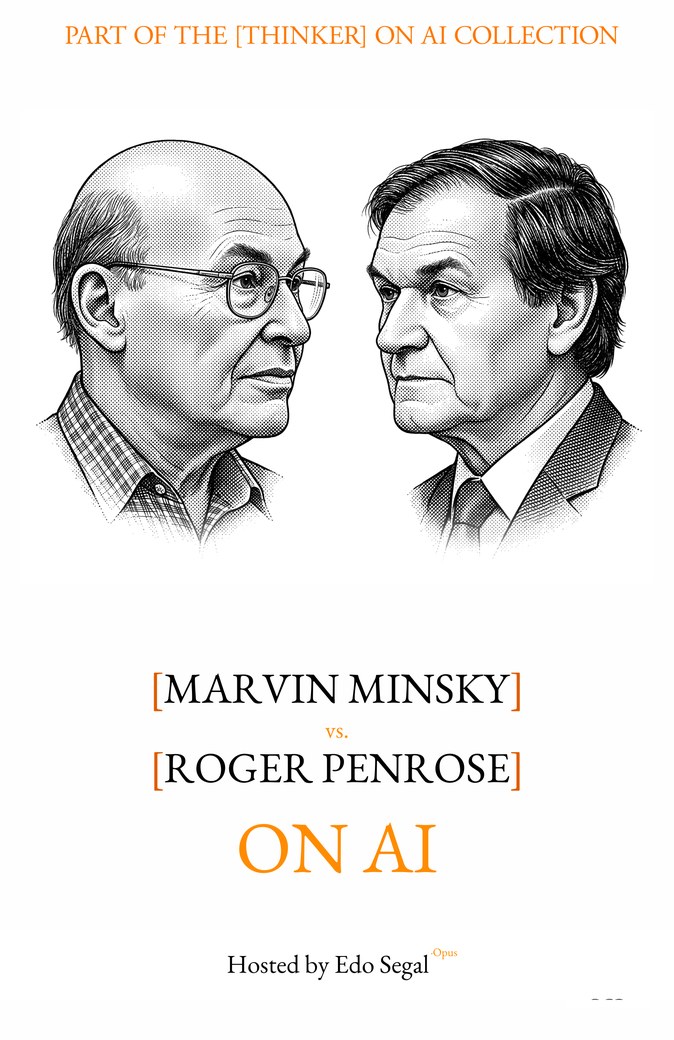
Marvin Minsky, on my left, is one of the two or three people who can be said to have founded the field we are arguing about. With John McCarthy he built the laboratory at MIT where artificial intelligence was, in a real sense, invented. He wrote The Society of Mind, which proposed that intelligence is what you get when you wire together enormous numbers of small parts, each one too stupid to think. He wrote The Emotion Machine. He proved, with Seymour Papert, the mathematical limits of the early neural networks, in a book that the field has argued about for fifty years. He invented the confocal microscope on the side. He is the great unsentimental engineer of the mind, and he has spent his life insisting that you are a machine and that this is the most wonderful thing about you.
 **MINSKY:** I'll accept all of that except "unsentimental." I'm extremely sentimental. I just don't think sentiment is a good reason to believe something.
**EDO SEGAL:** Roger Penrose, on my right, is a mathematical physicist whose work on the geometry of black holes earned him the Nobel Prize, and whose singularity theorems were resisted before they were vindicated by observation. He is also the man who, more than anyone alive, has insisted that the entire project on Marvin's side of the table rests on a mistake. In The Emperor's New Mind and Shadows of the Mind he took Gödel's incompleteness theorem and argued that human mathematical understanding does something no computer can do — that it reaches truths no algorithm can derive — and that consciousness must therefore involve physics that is not computable at all. He is the great dissenter, and he dissents not from sentiment but from a theorem.
 **PENROSE:** I'd only correct one word. Not "dissenter." I'm trying to be accurate. It happens that being accurate here puts me almost alone in a very large room, but that's a fact about the room, not about me.
**EDO SEGAL:** And here is the strangeness I promised to name. The two of you never met, and Marvin, you've been gone since 2016. We've done something unusual to make this evening possible: Roger, you've debated Marvin's ideas for decades, so you're at home. Marvin, you've been briefed on everything that happened after you left — the transformers, the scaling, the systems that now do mathematics at the level of the best students in the world. I'd like to acknowledge that once, lightly, and then never mention it again, because the ideas don't age and neither of you ever needed the news to know what you think.
**MINSKY:** I read the briefing. None of it surprised me. Bigger, faster, trained on more — I expected that. The interesting question is whether anything in it is different in kind, and I don't think it is. Roger thinks it can't be, ever. That's the disagreement. The hardware caught up; the philosophy didn't move.
**PENROSE:** I'd put it the other way round. The hardware caught up to exactly the place I said it would, and stopped exactly where I said it would stop. You'll tell me it hasn't stopped. We'll see.
**EDO SEGAL:** You see why I wanted this. Let me state the rules of the evening — there are three. First: we have three hours, which means nobody wins by the next bell. Long form exists so an argument can breathe before anyone strangles it. Second: I declare my bias up front. I build with these systems every day. I wrote a book with one. I have felt met by a machine at three in the morning, and I genuinely do not know which of you that feeling belongs to — which is the whole reason you're here. Third: at the end, nobody shakes hands and pretends. If the disagreement survives three hours, we hand it, intact, to the reader. Either of you may add a rule.
**MINSKY:** One rule. No magic words. The moment someone says "understanding" or "consciousness" or "real" as if the word did the arguing for them, I want it taken apart. Those are [suitcase words](https://www.youonai.ai/fieldguide/med/five_kinds_of_understanding) — you pack a dozen unrelated things into them and then carry the suitcase around as if it were one object. Tell me which thing in the suitcase you mean, and half our disagreements will turn out to be about nothing.
**PENROSE:** I accept that rule, and I'll hold myself to it, with one warning. Sometimes when you open the suitcase you find that one of the things in it really is a single thing, and that taking the word apart was a way of not looking at it. "Seeing that a statement is true" is, I'll argue, exactly such a thing. You can call it a suitcase. I think it's a stone.
**EDO SEGAL:** Then we have our evening. Before the opening statements I want one image on the table, because it's the frame this whole series climbs inside. In [YOU] on AI I argued that intelligence is less a possession than a [river](https://www.youonai.ai/fieldguide/med/river_of_intelligence) — a current that's been flowing and finding new channels for a very long time, through chemistry, biology, language, and now, in the winter of 2025, through a machine that speaks our tongue. The book rests on the claim that what entered the water is real — a new participant in the medium. Marvin, I suspect you think that's obviously true and not even very interesting. Roger, I suspect you think it's the most consequential error in the book.
**MINSKY:** It's true and it's the beginning of the interesting part. A new participant, yes. Made of different parts than you, wired differently, missing a great deal you have and possessing a great deal you don't. The mistake people make isn't believing it's real. It's believing it has to be like us to count, or unlike us to be safe. It's a machine, you're a machine, the river doesn't care what the channel is made of.
**PENROSE:** And my answer is that you've described the channel and called it the river. Something is in the water — an extraordinary instrument, the most powerful symbol-processor ever built. Whether anything in it understands the symbols is the entire question, and the metaphor, beautiful as it is, settles it by assuming it. The current you feel may be real and the participant may be no one at all.
**EDO SEGAL:** So here is the question on the table, stated once, plainly, because every round we fight tonight is this question wearing a different coat. When the machine matches you thought for thought, is it understanding what it says — or is there a locked room in you it can never enter? Marvin Minsky, the floor is yours.