The Carpenter's Hammer
 **EDO SEGAL:** Professor Heidegger, I want to put your most famous image on the table and let Terry tell us how he built his career on it. The hammer. For people who have never read a word of you — and that is most of the room — explain what happens when the carpenter is hammering, and what happens when the head flies off. And then, Terry, I want you to do something unusual. Before you use the hammer to attack the machine, tell us how a German philosopher's broken tool became the foundation of a Stanford computer scientist's life.
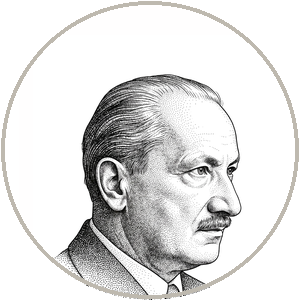 **HEIDEGGER:** When the carpenter hammers well, there is no hammer. I mean that almost literally. The hammer has withdrawn. It is [ready-to-hand](https://www.youonai.ai/fieldguide/med/ready_to_hand), transparent, vanished into the swing; the carpenter is not aware of it as an object any more than you are aware of your own hand when you reach for a cup. His attention is on the work, the joint, the wood, the whole web of purposes — the chair he is building, the room it will stand in, the people who will sit in it. That web is the world, and his skilled immersion in it is understanding in the only original sense. There is no representation here. There is no inner picture of a hammer. There is coping, fluent and wordless and complete.
Then the head flies off. And in that instant the hammer leaps into presence — it becomes [present-at-hand](https://www.youonai.ai/fieldguide/med/breakdown_heidegger), an object with properties, too heavy or badly balanced or cracked. *Now* the carpenter represents. Now he forms an explicit theory of the hammer. And this is the deepest point I ever made, so hear it: representation is born at the breakdown. It is the emergency mode, the derivative mode, the thing you fall into when smooth coping fails. The whole rationalist tradition, and the whole of your artificial intelligence, took this emergency mode — the detached subject forming representations of objects — and mistook it for the normal and primary condition of a mind. They built their machines out of the broken hammer and wondered why the machines never picked anything up.
 **WINOGRAD:** And I am the man who took that and made it an engineering principle, so let me tell the room how it happened, because it is the most important intellectual event of my life. I had built SHRDLU. I had the disappointment but not yet the theory of the disappointment. Then I encountered the work of Hubert Dreyfus — whose Heideggerian critique of AI my field had spent a decade dismissing as the carping of an outsider who had never written a program — and I had the one thing Dreyfus lacked, which was that I *had* written the program, and I knew exactly which of my engineering assumptions his philosophy indicted. Dreyfus, drawing on Heidegger, said the AI researchers had confused the formal, rule-governed, articulable dimension of intelligence with intelligence itself. The dimension they could not capture — the background feel for relevance, the ability to navigate a situation without first analyzing it into components — was not a supplement to be added later. It was the ground of the whole thing. And I looked at SHRDLU and saw that he was describing my program with a precision the people praising it could not match.
So with Flores I wrote *[Understanding Computers and Cognition](https://www.youonai.ai/fieldguide/med/understanding_computers_and_cognition)*, and the argument was Heidegger's, turned into a thesis about computation. Most of what we know is not represented anywhere at all. It is an unformalized, shared background — a way of being skillfully involved in a world of practices and tools and other people — out of which we articulate explicit representations only when we need them, and only against the backdrop of everything we are *not* representing. The carpenter does not consult an internal theory of hammering. We represent in order to cope with breakdown. And a computer program lives entirely in the realm of pre-formed representation. It has no transparent coping and therefore no genuine breakdown — only the exhaustion of its pre-selected categories, after which it does not cope. It fails, or worse, it continues confidently producing nonsense, because it has no background against which to register that anything has gone wrong.
**EDO SEGAL:** That phrase — "continues confidently producing nonsense" — you wrote that in 1986. Your industry now has a euphemism for it. It calls it hallucination. Did you predict the central failure mode of the machine that didn't exist yet?
**WINOGRAD:** I described its structure, yes, though I would not claim a prophet's credit, because the mechanism is different. SHRDLU could not hallucinate; it was too rigid. But the *reason* the modern machine hallucinates is exactly the reason I named: it has no background against which to register breakdown. When a human reaches the edge of what they know, something happens — a felt sense of uncertainty, a hesitation, a "wait, that's not right," because the background throws up a resistance. The machine has no such edge to feel, because it has no involvement in a world that could push back. It produces the false sentence with precisely the same fluency as the true one, because nothing is at stake for it in the difference. That is not a bug your industry will patch. It is the shape of a thing that has a foreground and no background, the broken hammer that does not know it is broken.
**HEIDEGGER:** And I want to honor what Herr Winograd added to me, because it is not nothing. I gave the analysis of the tool. He saw that a formal system is a tool that has been mistaken for a user. But I will also press him gently, here at the seam, because I think his framework has a soft place he has not fully closed. You say the modern machine has no background. The young engineers will answer: it handles relevance, context, the unspoken, with a facility no rule-based system approached. It absorbed, from an ocean of text, something that *behaves* like the background. Now — I think you are right that this is imitation and not having. But you must say *why*, and "it has no body" is not yet the answer, because they will reply that a body is just more sensors. The answer must be that the background is not a kind of information at all. It is the *being* of a creature who is [thrown](https://www.youonai.ai/fieldguide/med/dasein) into a world it did not choose, who must cope toward ends that matter to it because it is finite and will die. Relevance is a function of care. You cannot get relevance out of a system for which nothing matters by giving it more text, because the text is the trace of caring and not the caring itself.
**WINOGRAD:** That is exactly where I live, and I will admit it is now a judgment call at the edge of our concepts rather than the clean verdict it was against SHRDLU. The Heideggerian critique was forged against systems whose lack of a background was *obvious* — brittle, hand-coded rule-bases. The modern model scrambled the very distinction I rely on. My instinct, and I think the weight of the argument supports it, is that what looks like a background is fluent mimicry without involvement — that the relevance is borrowed, distilled from the relevance judgments of the millions of humans whose writing it consumed, who *did* have bodies and stakes and care. The model reflects our care back at us, exactly as SHRDLU reflected our understanding. A far larger, far more sophisticated mirror. But the structure may be the same: the involvement on the listener's side, and the machine supplying a statistically faithful echo of an involvement it does not have. I hold that as the strongest reading. I no longer hold it as certainty, and Heidegger's question about *why* it is mimicry is the question I have to keep answering, because the day I cannot answer it is the day my wall has a crack in it.
**EDO SEGAL:** Then let me find the crack on purpose, because the next round is built for it. There is a benchmark out there with your name on it, Terry — designed, explicitly, to be impossible to pass without genuine understanding. The machines pass it. They pass it and we are no closer to agreeing whether they understand. That paradox is the cleanest experiment this whole debate has ever produced, and I want to drop both of you into it. The Winograd Schema, passed and unsolved. After this.