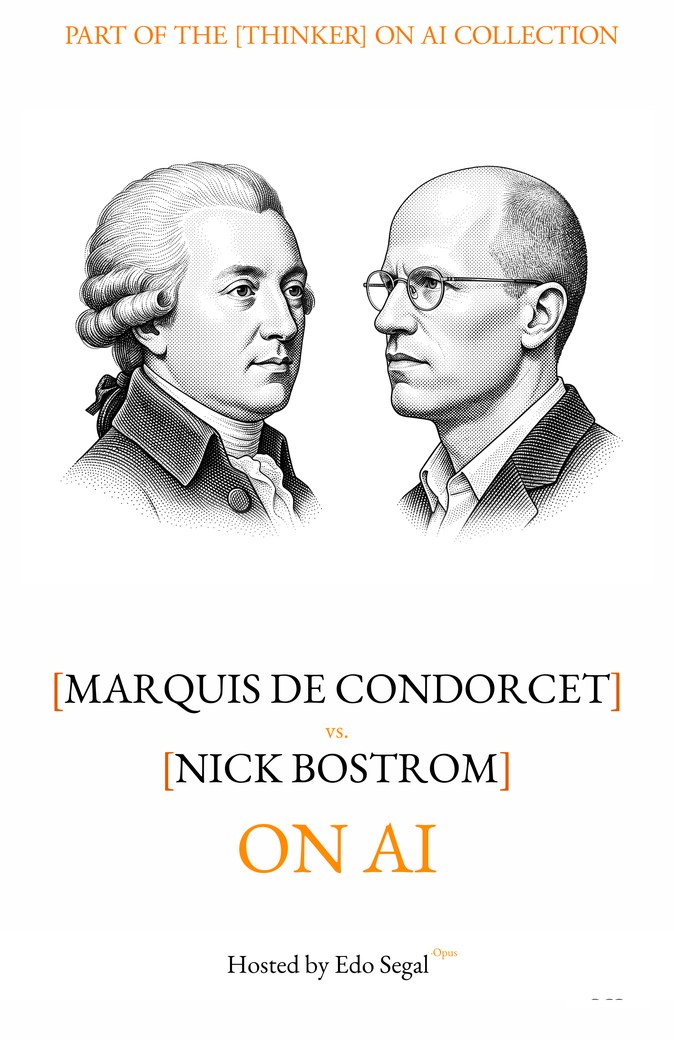
The Question on the Table
 **EDO SEGAL:** I want to begin with a number, and then I want to ruin it with a single human being. Somewhere on the planet tonight, the curve of machine capability crosses the curve of human capability on some narrow task it did not cross yesterday — and tomorrow it crosses on three more. The line is rising. We argue about its slope; we do not really argue about its direction. So picture the rising line. Now picture the person standing under it. A teenager in Lagos asking the machine to teach her calculus at midnight because no human in her life can. A widow in Lyon asking it whether the ache in her chest is grief or her heart failing. A man my age, who built things for a living, asking quietly whether the thing he is best at will matter in five years. The curve does not care which of them is asking. It just keeps rising.
And here is the question we are going to spend three hours inside, the only question, the one every round tonight will wear a different coat of: when the machine you built crosses the line that until now defined being human — when the curve goes past us — does the same accelerating intelligence carry you up toward perfection, or off the edge into extinction?
I have wanted to host this particular conversation for as long as I have been thinking about any of this, and I will tell you why it is strange before I tell you why it is necessary. One of my two guests has been dead for two hundred and thirty-two years.
 **CONDORCET:** A fact I have decided not to take personally.
**EDO SEGAL:** The Marquis de Condorcet — Marie Jean Antoine Nicolas de Caritat — was a mathematician admitted to the Académie des Sciences at twenty-five, a friend of d'Alembert and Turgot and Voltaire, the man who applied probability theory to human affairs and gave us what we now call the [jury theorem](https://www.youonai.ai/fieldguide/med/condorcet_jury_theorem): the proof that a crowd of modestly reliable judges, voting independently, converges toward truth as it grows. He was the only one of the great philosophes to live into the Revolution and try to build it — he drafted a constitution, he argued for the rights of women and for the abolition of slavery when almost no one would. And in 1793 the Revolution turned and condemned him. He wrote his greatest book in hiding, with the guillotine scheduled, and the book insists that the human mind progresses without limit toward perfection. He died in a prison cell in 1794, two days after he was caught, before they could execute him. Monsieur, I have to ask the impossible question first. You wrote that history climbs forever while you were waiting to be killed by history. How?
**CONDORCET:** Because the two facts are not in contradiction, monsieur, though everyone assumes they must be. My death was a fact about me. Progress is a fact about the species. I had observed — measured, where I could — that across the long sweep of recorded time the sum of human knowledge increases, the reach of reason widens, cruelty contracts under the pressure of enlightenment. That observation did not require that I personally be spared. A man may calculate the orbit of a comet while drowning. The truth of the calculation is not refuted by the drowning. I wrote what I had seen to be true, and what I had seen to be true was that the candle, once lit, is very hard to put out.
**EDO SEGAL:** Hold the candle. We will need it. Nick Bostrom needs less introduction only because the present recognizes him on sight. A philosopher trained across physics, computational neuroscience, logic, and analytic philosophy; founder of the Future of Humanity Institute at Oxford; author of Superintelligence, the book that took the question of machine minds from the fringe of futurism to the center of national-security strategy in a single decade. He gave us the vocabulary we now think with — the orthogonality thesis, instrumental convergence, the treacherous turn, the vulnerable world, the singleton, deep utopia. And his most quoted line is the opposite of the Marquis's faith. Nick, you wrote that before the prospect of an intelligence explosion, we are like small children playing with a bomb.
 **BOSTROM:** I did, and I'd defend every word, including the unflattering ones, because they're the load-bearing ones. I want to be precise about one thing before we start, since the Marquis just gave a beautiful account of why his death doesn't refute his thesis. I agree with the logical move entirely. The truth of a claim about trajectories is independent of what happens to the person making it. That's exactly why I reason in the conditional and not in the prophetic. I don't claim to know that catastrophe comes. I claim that *if* we build a sufficiently capable optimizing agent, certain consequences follow with high probability, and those consequences are severe enough and irreversible enough to warrant enormous care now, before the fact, while intervention is still possible. So I'm not the Marquis's pessimist. I'm his accountant. He has told you what we stand to gain. I'm here to ask what we're betting, and whether we can afford to lose it.
**EDO SEGAL:** And that is the evening, in two sentences, so let me set the rules — there are three, and I'll invite each of you to add a fourth. First: we have three hours, which means nobody wins by the next bell. The whole point of the long form is that an argument is allowed to breathe before anyone strangles it. Second: I declare my bias at the door. I build with these systems daily, I wrote a book with one, I have felt both the staircase and the edge in my own chest, sometimes in the same night — and when my own stake gets touched tonight, I will say so out loud rather than referee from behind it. Third: if the disagreement survives three hours, nobody shakes hands and pretends. We hand it to the reader, intact. Marquis, a fourth rule?
**CONDORCET:** Yes. That we reason from evidence and not from temperament. It is the easiest thing in the world to call hope naïve and fear wise, as though gravity favored the gloomy. I have buried more friends to the confident pessimism of tyrants than to any excess of hope. So: whoever claims the curve bends his way must show his work. I will show mine.
**BOSTROM:** I'll accept that and add the fifth, which is its twin. That we distinguish, every single time, between what is probable and what is merely possible — and then notice that with stakes this large, a low-probability outcome can still dominate the calculation. The Marquis wants me to show my work, and I will. But he must grant that "I cannot prove it will happen" is not the same as "it is safe to ignore." Most of what I worry about lives precisely in the gap between those two sentences.
**EDO SEGAL:** Rules accepted, all five. One housekeeping truth for the reader, because it's unusual and I won't hide it. The Marquis has been briefed on the present — fully. He knows what a transformer is, he has read the architecture, he knows what year it is and what these systems can do and what they cannot. So when he speaks of the machine he is not guessing across two centuries; he is reacting, in his own voice, to the thing itself. Marquis, has the briefing changed your thesis?
**CONDORCET:** It has confirmed it past anything I dared write. I claimed the mind would build instruments to extend its own power without limit. I imagined — vaguely, I confess — better printing, better calculation, a universal language of the sciences. I did not imagine you would build a calculating engine that speaks. Gentlemen, you have constructed a machine that participates in reason itself, that any peasant may consult in his own tongue. This is the [printing press](https://www.youonai.ai/fieldguide/med/horizon_of_potentiality) raised to a power I lacked the mathematics to name. I came prepared to defend progress. I find instead that progress has exceeded my defense of it.
**BOSTROM:** And I'd say to the Marquis: yes — and that is exactly the property that should frighten you. You're delighted that it exceeded your imagination. I'm noting that a thing which exceeds the imagination of its makers is, by definition, a thing whose behavior its makers cannot fully predict. You call that the staircase. I call that the reason we cannot see the next step.
**EDO SEGAL:** So here is the question on the table, stated once, plainly, because every round tonight is this question in a different coat. The curve crosses the human line. Does it carry us up to perfection, or off the edge? Marquis de Condorcet — you wrote the most hopeful book in the language with the blade scheduled. The floor is yours.