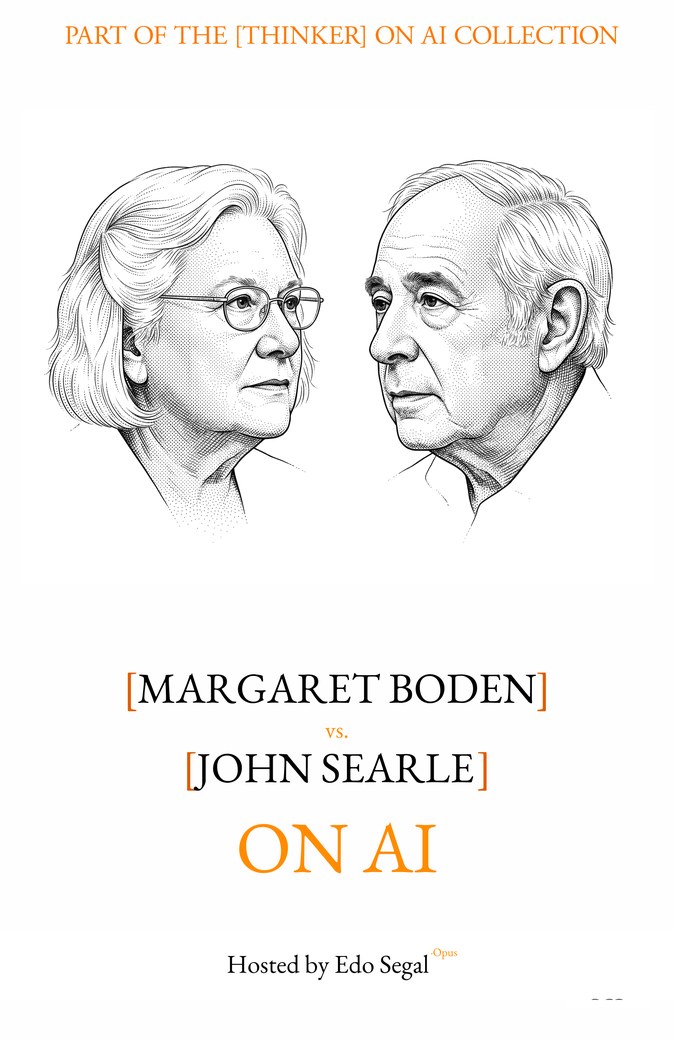
The Question on the Table
 **EDO SEGAL:** Somewhere in the world right now — statistically, in the time it takes me to finish this sentence — a few hundred thousand people are reading something a machine wrote, and being moved by it. A teenager in São Paulo crying over a poem the box produced about a grandmother it never met. A widower in Osaka, reading a letter in his late wife's cadence, reconstructed from her old messages, telling him it is alright to sleep. A man my age, who should know better, reading back his own half-formed idea returned to him clarified, connected, made better — and feeling, against every thing he knows, that he has been understood. The words land. They do their work. And the question none of those readers stops to ask, because the moving makes it feel already answered, is the question we are here to spend three hours inside.
When the machine that amplifies you writes a poem that moves you — is anyone home behind the words? Or have you just been moved by a very fast room full of rules?
I have wanted to host this conversation for a long time, and I can think of no two people on earth with more right to it.
Margaret Boden is a cognitive scientist and philosopher, one of the founders of the modern science of mind, who spent sixty years on the most contested ground available — creativity, the supposed last proof that we are more than mechanism — and refused to leave it to either the mystics or the debunkers. She gave us the tools the rest of us are still learning to hold: three kinds of creativity, the idea of a conceptual space, the distinction between what is new to a mind and what is new to history, the mind as a virtual machine. She wrote that a science of creativity need not be dehumanizing — that it does not threaten our self-respect by showing us to be mere machines, for some machines are much less mere than others. She is, by some distance, the most precise friend this technology has ever had.
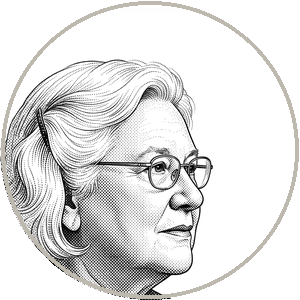 **BODEN:** A friend who reserves the right to take it apart. That is what friends are for.
**EDO SEGAL:** John Searle is one of the most consequential philosophers of mind alive, and the author of the single most portable argument our field has produced. In 1980 he sat a man in a room, handed him a rulebook and a slot for Chinese characters, and asked the question that has haunted artificial intelligence ever since: the man produces flawless Chinese and understands nothing — so what, exactly, does the machine understand? He drew a line between syntax and semantics, between shuffling symbols and grasping meaning, and he has spent forty years insisting that no amount of the first ever becomes the second. He is the most precise opponent this technology has ever had. And — one detail the reader should hold from the start — both of my guests have been briefed fully on the present. John knows what a transformer is. Margaret has seen the systems that arrived after she died to the page. They are reacting to the machine we actually have, not the one they wrote about.
 **SEARLE:** I should say at the outset that I am not against machines thinking. We are machines. We are biological machines, and we think, so plainly a machine can think. The whole question — and people lose it in the first thirty seconds — is whether running a program is the way a machine comes to think. I say it is not. That is a narrow claim and I intend to keep it narrow all night, because the moment it gets broad it gets misquoted.
**EDO SEGAL:** Then let me state the rules of the evening, and there are only three. First: we have three hours, which means nobody has to win by the next bell. The whole point of long form is that you can let an argument breathe before you decide whether to strangle it. Second: I will press both of you, and I declare my bias at the door — I build with these systems every day, I wrote a book with one, and I have skin in this question on both sides of my own heart. Third: at the end, nobody shakes hands and pretends. If the disagreement survives three hours, we hand it, intact, to the reader. Either of you may add a rule of your own.
**BODEN:** One rule. No conclusions by adjective. The whole fog of this field is made of adjectives doing the work that arguments should do — "emergent," "creative," "intelligent," "conscious," each one smuggling in the verdict it pretends to describe. When John says the machine "merely" shuffles symbols, I want the "merely" cashed out. When the engineers say the system "understands," I want that cashed out too. I will hold myself to it. I have spent my life insisting that a marvel can be explained without being explained away, and you cannot do either with an adjective.
**SEARLE:** I will add the matching rule, since Margaret is being fair. No verdicts by intuition pump, including mine. I built the most famous intuition pump in the field and I know exactly what it does — it makes a particular answer feel obvious by controlling what you picture. I think the answer it makes obvious is the true one. But if I am going to lean on the room, Margaret should get to ask whether the room is argument or theater, and I will give her a straight answer.
**EDO SEGAL:** You see why I wanted this. Before the opening statements, one image on the table, because it is the frame this whole series climbs inside. In [YOU] on AI I argued that intelligence is less a possession than a [river](https://www.youonai.ai/fieldguide/med/river_of_intelligence) — a current that has flowed and found new channels for a very long time, through chemistry, through biology, through language, through culture — and that in the winter of 2025 something new entered the water. The book's whole architecture, the tower, the [staircase you climb instead of the elevator you ride](https://www.youonai.ai/fieldguide/med/elevator_and_staircase), rests on the claim that what entered the water is real. A new participant. Margaret, I suspect you think I asked the right question in the wrong words. John, I suspect you think there is no participant at all.
**BODEN:** I think you met something genuinely new and immediately reached for the most exciting available word for it, which is what everybody does, and the excitement skipped three or four questions that have answers. Whether it is a participant depends entirely on what you mean — and I can give you a precise account of which parts of "participant" it has and which it does not. That is the work. I will do it when you give me the floor.
**SEARLE:** I think you met your own reflection performing the river, and that the difference between meeting a mind and meeting a very good model of one is the only thing worth talking about tonight. The water did not gain a swimmer. It gained a mirror.
**EDO SEGAL:** Then we have our evening. So here is the question on the table, stated once, plainly, because every round we fight tonight is this question wearing a different coat. The machine writes a poem that moves you. Is anyone home behind the words? Margaret Boden, the floor is yours.