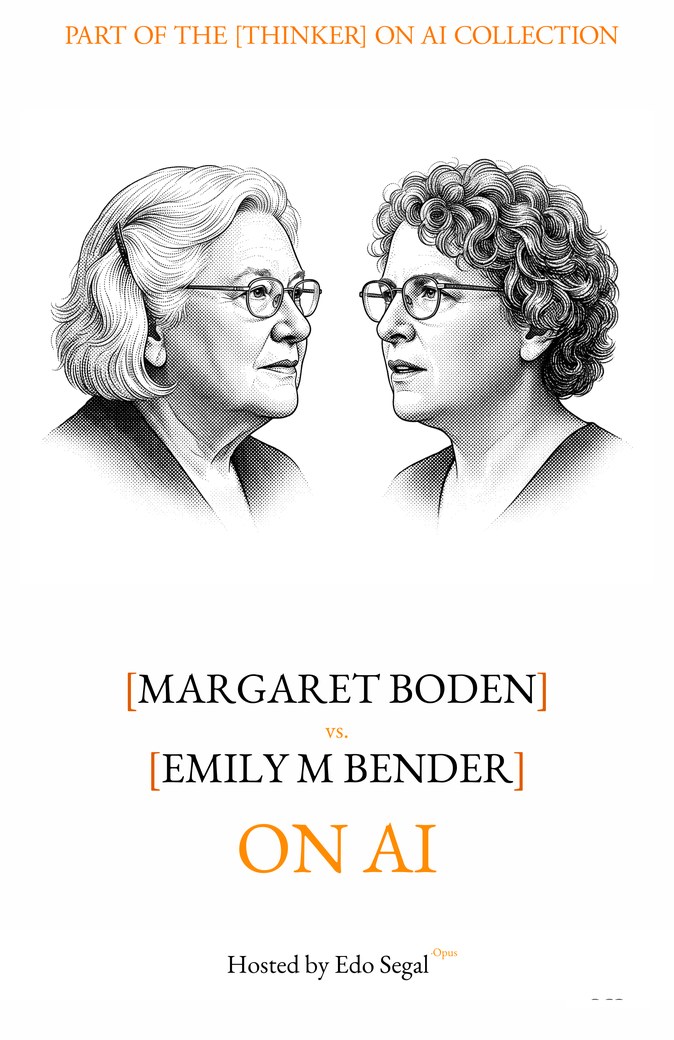
The Line No Human Ever Wrote

 EDO SEGAL: I want to begin with an experiment I ran this morning, in the kitchen, before anyone else in the house was awake. I asked a language model to write me one sentence that no human being has ever written. It thought — or did whatever we will spend three hours deciding it does — and it gave me this: "The lighthouse keeper taught her grief to swim before she let it out past the rocks." I searched. Every index I could reach. That sentence, as far as the searchable record of our species is concerned, did not exist when I poured my coffee, and existed when the coffee went cold.
Now here is what fascinates me, and why I have wanted this particular conversation for years. I showed that sentence to two friends. One said: that's beautiful, the machine is creative now, it's over. The other said: that's a collage, it has read ten thousand grief poems and ten thousand lighthouse poems and it shuffled the deck, and you, Edo, you supplied every gram of the beauty yourself when you read it. And I realized I was listening to a proxy war — that my two friends were doing amateur versions of the two most serious positions on earth about machine novelty. So I decided to skip the proxies and go to the sources.
Margaret Boden — pioneer of cognitive science, the person who took the word creativity, which everyone before her treated as a sacred fog, and turned it into a research program. Author of The Creative Mind, the woman who gave us the three types of creativity that every serious discussion of this question has used since. Margaret, welcome.
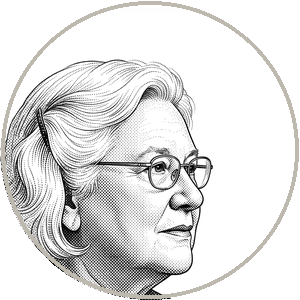 BODEN: Thank you, Edo. And may I say, before we begin, that your second friend has rather flattered himself. "It shuffled the deck" is not an analysis. It is an incantation — the sort of thing people say to make an uncomfortable question lie down. Whether a deck-shuffle can be creative is precisely the question, and it cannot be settled by pronouncing the word shuffle with sufficient contempt. We shall need better instruments than tone of voice.
EDO SEGAL: And across the table — Emily M. Bender. Computational linguist, professor at the University of Washington, co-author of the most consequential papers of the modern era on what language models are and are not, the person who put the words stochastic parrot into the world's vocabulary and then watched the world use them as a hashtag while declining to read the argument. Emily, welcome.
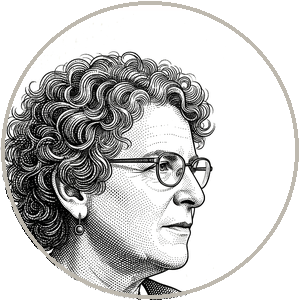 BENDER: Glad to be here, Edo. And I'll return the opening courtesy: your first friend has also flattered himself, or rather, the machine. "It's creative now, it's over" — notice that nothing in that sentence is doing any work except the word now, which is doing marketing. I'd also gently flag the frame of your experiment, because it smuggles in the conclusion. You said the machine thought, or did whatever we'll spend three hours deciding it does. Good — that's the honest version. But then you said it gave you a sentence. Systems don't give. People give. The grammar of agency is exactly where this debate lives, and I intend to be tedious about grammar tonight.
EDO SEGAL: I would expect nothing less from a linguist. And before the formal question, a word to the listener about why these two, why together, why three hours — because the booking itself is an argument. You can hear Margaret's position cartooned by a thousand enthusiasts and Emily's cartooned by a thousand doomers, and the cartoons cancel into noise. But these are the two people whose originals the cartoons are forged from — and here is the thing the discourse has never metabolized: they are not natural enemies. Margaret's life work deflates the romantic myth of human creativity; Emily's deflates the romantic myth of machine understanding. They are, structurally, the same temperament aimed at opposite altars — two demolition experts of comfortable nonsense who have somehow never been in the same room for three hours. The series exists for exactly this booking. Long form, because their actual positions take an hour each to even state. No clips, because the clip economy is the thing that cartooned them in the first place.
Let me put the question on the table formally, and then I want to do something unusual before we argue — I want each of you to tell me what would change your mind. Here is the question of the evening: when the machine writes a line no human ever wrote, is that the novelty of a mind crossing into new conceptual territory — or only a parrot rearranging forms it cannot mean? And the stakes, for everyone listening: on which answer do you stake your own next move — your craft, your career, the thing you tell your children to study?
Margaret, what would change your mind?
BODEN: A fair question, and I shall answer it precisely because most people in my position would not. I hold that creativity is not magic. It is a capacity of certain information-processing systems, and I have spent my career showing that its three forms — combinational, exploratory, and transformational — can each be given a computational account. What would change my mind is a demonstration that some component of human creativity in principle resists such an account — not "we haven't built it yet," which is a fact about engineering, but "it cannot be built," which would be a fact about the universe. No one has produced such a demonstration. Many have produced the feeling of one. Feelings are data about the feeler.
EDO SEGAL: Emily?
BENDER: First, appreciate what just happened, because it's rarer than the discourse deserves: Margaret stated a falsifier that her opponents could actually pursue. The standard inflationist answer to your question is nothing — dressed up as the benchmarks will speak for themselves, which means the goalposts will walk backward forever. So, respect. Now mine, with the same discipline.
What would change my mind is evidence that meaning has gotten into the system by some route other than form. That's it. That's the whole bar. My position isn't that machines are made of the wrong stuff, or that silicon can't host minds — I leave that metaphysics to others. My position is narrower and therefore harder to escape: a system whose only training signal is the distribution of word forms has access to the form of language and nothing else. Meaning — the connection between an utterance and a communicative intent about a shared world — was never in the data. Show me the route by which it got in, and I'll update in public, with a citation. What I will not accept as evidence is output that feels meaningful, because we've known since ELIZA that humans are meaning-finding machines who will find a mind in a curtain moving in the wind.
BODEN: You see, Edo, we shall get along famously. We are both allergic to the same incense. We simply disagree about where the altar is.
EDO SEGAL: Before the first break I want to do one more piece of housekeeping, because the vocabulary itself is contested ground and I'd rather fight about it once, now, than thirty times tonight by accident. Emily, you've argued that even the phrase artificial intelligence begs the question — that it's a 1956 fundraising term that became a field's name and then a civilization's frame. If you could rename the thing on the table, what would you call it, and what would the renaming buy us?
BENDER: I'd call it what it is: a synthetic text extruder. And I know exactly how that lands — it's deliberately unlovely, like calling a sausage mechanically separated meat, which is also accurate and also resented by the people selling sausages. What the renaming buys is hygiene. Every time we say the model understands, the model thinks, the model hallucinates, we are running our social cognition on a system it was never calibrated for, and the errors compound silently. Linguists call this kind of slippage a category mistake; venture capital calls it a pitch deck. I don't actually expect the world to adopt my sausage word. I expect the world to notice, at least once a day, that the comfortable word is doing comfortable work.
BODEN: And I shall defend the old name, with full knowledge of its sins, because I was in the room with the generation that chose it — McCarthy wanted money, certainly, but Minsky and Simon and Newell also wanted something intellectually honorable: to claim that intelligence is a natural phenomenon admitting of mechanistic study. That claim needed a flag, and the flag has flown over fifty years of genuine science alongside the salesmanship. Emily's hygiene is real. But terminological asceticism has its own failure mode: if we may not say the system explores, the system evaluates, we are forced into paraphrases so tortured that thought itself becomes impossible, and the field's actual discoveries — which are considerable — become unsayable. I propose a middle discipline for tonight: we may use the mental verbs, but either of us may, at any moment, call cash the metaphor — and the speaker must then restate the claim in mechanism. If the claim survives restatement, it was science. If it evaporates, it was sausage.
BENDER: "Cash the metaphor." Accepted, and I'll use it mercilessly.
EDO SEGAL: Then let's find the altar. Three hours. No press releases, no hashtags, no incense — and a new bell in the room that either guest may ring. Margaret, after the break, I want your opening case in full: the machinery of creativity, the three doors, and why you believe a machine can walk through the third one. Emily, then yours: the parrot, the octopus, and the empty room. And I'll declare my own stake now, because the host shouldn't get to hide: I wrote a book with one of these systems. The question of who wrote the good sentences in it is not academic to me. It may be the least academic question of my life.