The Dog That Was Never a Dog

 EDO SEGAL: Jerry, you teed it up, so take the swing. You have a theory of what it takes for a symbol to mean something — not just behave rightly, but be about a thing in the world. Tell us the theory, and then tell us what it says about a machine that has read the word "dog" ten million times and never met a dog.
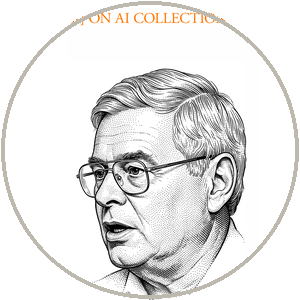 FODOR: The theory is about aboutness — the spookiest property there is, the thing a symbol has when it's about something. My account is causal. Roughly: the symbol DOG means dog because dogs cause DOG-tokenings, and because anything else that might trigger a DOG — a fox on a dark night, a wolf at a distance — does so only because dogs do, and not the other way around. The dependence is asymmetric. Cut the dog-to-DOG connection and the fox-to-DOG connection dies with it; cut the fox connection and the dog one survives. That asymmetry is what makes DOG about dogs and not about fox-or-dog. It grounds meaning in nature, no inner interpreter required.
Now the machine. By this standard — and it's the only worked-out standard going — the model has no meaning at all. Its "dog" was never caused by a dog. It was caused by the word, in the company of "bark," "leash," "loyal," "tail." It has a closed circle of tokens, each defined by the others, none touching the world — a dictionary in a language nobody speaks, where every word points only to more words. You could trace it forever and never reach a thing — the closed circle that the grounding problem describes, and that no quantity of text alone can open. The fluency is real. The structure is real. What's missing is the one thing that turns a shape into a sign: contact with what it's about.
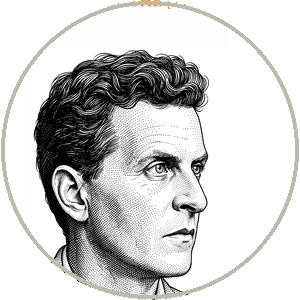 WITTGENSTEIN: I agree with the conclusion and I refuse the theory, and the refusal matters, because the theory is going to mislead you about the cure. You want meaning to be a causal chain from the dog to the symbol — a fact about wiring, mechanical, in the head. But consider how a child actually comes to mean "dog." She is not a camera that dogs cause to fire a DOG-token. She is taught, in a practice: the parent points, the child reaches, the parent says "gentle," the dog is feared and then loved, the word is corrected — "no, that one's a wolf" — inside a whole life of fetching and petting and being knocked down and warned. The meaning of "dog" is woven into all of that. It is not a wire from the animal to a symbol. It is the child's whole answerable participation in the dog-involving life of her people.
FODOR: That's a charming description of how the wire gets installed. Training is how the causal dependence gets set up. You've described my mechanism's assembly process and pretended it's an alternative to the mechanism.
WITTGENSTEIN: No — because on your account, once the wire is in, the practice drops out and the meaning sits in the head as a causal fact. On mine, the practice never drops out; the meaning is the ongoing answerable use, and a being cut off from the practice has no meaning even with the wire intact. And this matters enormously for your machine, Jerry, because the multimodal systems are coming with the wire. They're trained on the word "dog" and pictures of dogs; the robots get sensors and actuators; soon the causal chain from the animal to the token will be as real as you like. On your theory, the moment that wire is in place, the machine means dog — your grounding problem is solved by an engineering upgrade. Is that what you want to say? That a camera bolted to the network confers genuine aboutness?
FODOR: [pause] That is the hardest question you've asked me, and I won't dodge it. No. A correlation between the token and an image is still a relation between two representations — the pixels are not the dog, they're a representation of the dog. The asymmetric dependence has to run to the actual animal, in the way that makes the system's tokenings track dogs because they're dogs, robustly, counterfactually. A camera correlating "dog" with dog-pictures might be the beginning of that, or it might be a more elaborate version of the closed circle, with images added to the words. I can't tell from the outside, and I won't pretend I can. The bar is high and I hold the machine to it.
WITTGENSTEIN: Then hear what you've just done. You have admitted that adding the world-contact does not obviously confer meaning — that a system can have the causal correlation and still, maybe, be a closed circle with pictures in it. But that is exactly my point against your inner symbols. The wire is not enough. What is missing in the camera-machine is what is missing in the bare symbol: a creature for whom the dog matters — who can be bitten, who fears, who fetches, who is answerable, in a life, to getting the dog right. You keep arriving at my conclusion by your road and refusing to read the signpost.
FODOR: Or you keep stealing my conclusion and adding incense. "A creature for whom it matters" — mattering is a functional state, Ludwig. It's implemented. Pain is a state with causes and effects and a role in the system. You say "mattering" as though it were a sacred word that ends inquiry. I hear it as the name of a mechanism we haven't finished reverse-engineering. The difference between us is that you think you've reached bedrock when you say "form of life," and I think you've reached the point where the real science starts and you've decided to stop.
WITTGENSTEIN: And I think you mistake the point where the science runs out for the point where it has not yet begun. Some things are not mechanisms with a hidden floor. Some things are just what we do, and the demand to find the mechanism underneath the doing is the disease, not the diagnosis. But I will grant you this, and it costs me: I cannot prove mattering is not a mechanism. I can only show that treating it as one has, every time, produced a homunculus or a regress. You have the better hope. I have the better track record.
FODOR: One more thing on grounding, because the optimists have a real reply and I won't strawman them. They say: language isn't arbitrary; it's shaped by the world, so the structure of language already encodes a shadow of the structure of the world, and a system that masters language masters that shadow. Maybe the shadow is content enough. I think it's the strongest case the other side has, and I think it fails for a precise reason: a shadow of a relation is not the relation. Knowing every word that travels with "dog" is knowing the shape of the discourse about dogs. It is not standing in the relation to dogs that makes "dog" mean dog. The shadow can be exquisitely detailed and still be a shadow.
WITTGENSTEIN: And here, remarkably, I am the one who will give the optimist more than Jerry does — and still not enough to save the machine. The structure of language does carry the world, far more than Jerry's "shadow" admits, because language is not a picture laid over life; it is woven through life, and the weave is in the corpus. So the machine inherits an astonishing amount. But it inherits it as a bequest, not as a life — the way an heir inherits a house he has never lived in and cannot find the light switches in the dark. He has the deed. He has not the dwelling. And meaning, I have said all night, is in the dwelling.
EDO SEGAL: I want to name a second convergence and a clean divergence, because the reader needs the map. You both think today's machine is not grounded — its words run in a closed circle. Convergence two. You divide on the cure: Jerry says ground it by building the right causal wire to the world, and it's an engineering question whether we've done it. Ludwig says the wire is necessary and not sufficient — what's missing is a creature for whom it matters, and that may not be buildable by adding parts. Hold the divide. Because the next thing the machine does is the thing Jerry said for thirty years it could not. It is systematic. After the break, the challenge of 1988.