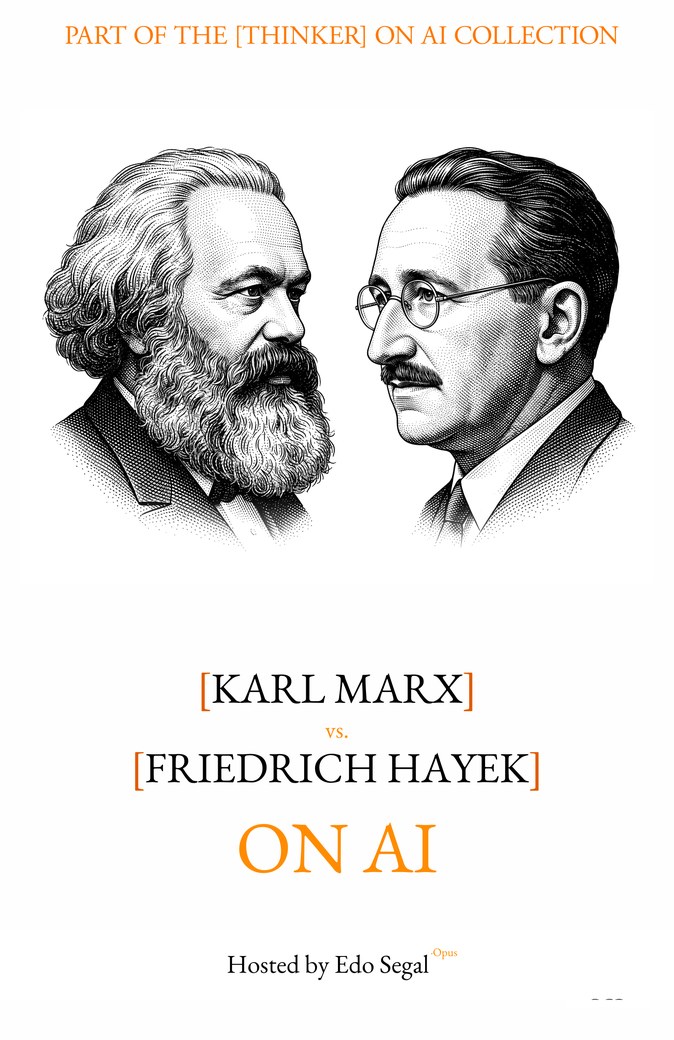
The Question on the Table

 EDO SEGAL: Somewhere tonight, in a data center the size of a small town, a machine is reading the entire written record of the human species — every ledger, every wage, every complaint, every price ever posted — and finding the patterns in it faster than any institution in history could. And somewhere else, much smaller, a woman closes a shop at the end of a long day and decides, for reasons she could not fully explain even to herself, to mark down the bread before it goes stale, because she knows this street, and this weather, and the man who comes in at six. One of those two things is what we mean when we say a machine could run the economy. The other is what we mean when we say it can't.

I have wanted this conversation my whole adult life, and I could not have it, because the two people I needed for it are separated by a hundred years and by death. So we have done the only honorable thing, which is to bring them both here anyway and tell you plainly that we have done it. Gentlemen — and I will say this once, lightly, and then never again — you have both been briefed on the present. You know what a transformer is. You know that a single model can now write a contract, diagnose a fever, and draft a five-year plan before lunch. Karl, you've seen the data centers. Friedrich, you've seen the optimization. We are not going to pretend you died before any of it.
 MARX: I have seen it. And I will tell you what I saw — I saw the factory at last grown large enough to swallow the world, and I saw, frozen inside it, the labor of every human being who ever wrote a sentence down. I did not need the briefing to recognize it. I have been describing it since 1858.

 HAYEK: And I saw, with respect, the oldest error in political economy wearing the most convincing costume it has ever worn. I will grant the machine is remarkable. I spent fifty years arguing against the dream it has revived, and I confess the dream has never looked so plausible. That is precisely why I am worried.

EDO SEGAL: That is exactly the collision I wanted, so let me set the rules of the evening, and there are only three. First — we have three hours. Nobody has to win by the next bell. The whole point of long form is that you can let an argument breathe before you strangle it. Second — I will press both of you, and I declare my bias at the door. I have built systems that optimize. I have watched the number I was maximizing quietly come apart from the thing I actually cared about. I have skin in this on both sides of my own chest. Third — at the end, nobody shakes hands and pretends. If the disagreement survives three hours, I hand it to the reader, intact. Now — each of you may add a rule.
HAYEK: Then mine is this. We must never confuse what a thing can describe with what it can direct. The machine has read everything that was written. But the question is not what was written. It is what was never written down at all, and could not be — and whether the most important knowledge in an economy lives in the part that reaches the page or the part that never does.
MARX: A fair rule, and I will add its twin. We must never speak of "the machine" as though it fell from the sky. It did not. It is made of something, and the something is human labor — congealed, accumulated, frozen into property and owned by almost no one. Every time my friend says "the market discovered" or "the system computed," I am going to ask him: discovered by whom, paid how much, and who keeps the result?

EDO SEGAL: Two rules that are already half the argument, and I'll honor both. Let me put one image between you before we start, because my whole book climbs inside it and you'll both have to take a position on it whether you like it or not. I've argued that intelligence is less a possession than a river — a current that has been flowing and finding new channels for a very long time, through chemistry, through biology, through language — and that in the winter of 2025 something new entered the water. A new participant in the medium. The question on the table tonight is what we do when the river becomes powerful enough to reroute the whole landscape of human cooperation. Karl, I suspect you think the river already has an owner. Friedrich, I suspect you think the moment it gets an owner is the moment it stops being a river at all.
MARX: The river has been dammed, Edo, and the dam is privately held, and the men who own the dam sell us the water that fell as rain on all of us. Your metaphor is better than you know. A river is a commons until someone builds a wall across it. They have built the wall. I want to ask who holds the floodgates.
HAYEK: And I say the river's intelligence is precisely that no one routes it — that it finds its own channel through ten thousand small choices no mind made. The danger is not that the river has an owner. It is that a man will stand at the headwaters with a machine and believe he can finally direct the whole flow, for our own good, and in straightening the river he will drain the floodplain that made the valley live. We do not disagree that the water matters. We disagree about whether a hand on the flow is salvation or catastrophe.

EDO SEGAL: You see why I wanted you both in the room. Before the opening statements I want to put the question on the table, plainly, because every round we fight tonight is going to be this same question wearing a different coat. Here it is. When a machine can finally model the whole economy — when the impossible computation becomes something we might actually attempt — do we hand it the plan? Or is the plan itself the thing that buries us? Karl, you will say hand it the plan, and at last. Friedrich, you will say the plan is the chain. And the strange thing, the thing that makes this worth three hours, is that you both believe the other man's victory would be a catastrophe for the human race.
MARX: I believe his victory would mean that the greatest tool of liberation ever forged would remain a private engine of accumulation, that the general intellect of the species — its whole accumulated knowledge, made at last into a working machine — would be owned by a handful of men and pointed at the rest of us. Yes. I believe that is a catastrophe, and I believe it is the one we are actually living in.
HAYEK: And I believe that his victory — a single mind, however vast, set over the whole order of human cooperation, deciding what is to be produced and for whom — is the precise structure of every tyranny the twentieth century produced, now equipped for the first time with a brain that does not tire. The planners before him ran out of paper and pencils. That was the only thing that ever stopped them. He proposes to remove it.

EDO SEGAL: One more thing before openings, because the reader deserves to know the stakes are not a seminar. Karl, your stake is bodies and ownership — the annotators paid a few dollars an hour, the writers whose work was taken, the worker managed by a process he cannot argue with, the value of a species flowing uphill to almost no one. Friedrich, your stake is the lever itself — that whoever gets to point this thing at the whole of human life will be wielding a power no king ever had, and will do it sincerely, in the name of the good. You are not here to split a difference. One of you thinks the house has been robbed. The other thinks it is about to be locked from the outside. And the worst outcome of tonight would be a reader concluding the truth sits comfortably in between.
MARX: On that — and perhaps only that — we will agree.
HAYEK: The first consensus of the evening. I would not get used to the feeling.
EDO SEGAL: So here is the question, stated once more, plainly, because we will be inside it until midnight. A machine can finally compute the whole economy. Do you hand it the plan, or does the plan bury you? Karl Marx — you have waited a hundred and forty years for this floor. The opening is yours.