The Question on the Table

 EDO SEGAL: Right now, in the time it takes me to say this sentence, several million people are typing a question into a box and getting back an answer in their own language. A student in Nairobi asking why the sky is blue. A nurse at the end of a double shift asking whether two drugs will fight in a patient's blood. A man my age, who built his life on knowing things, asking at two in the morning whether the things he knows still matter. And the box answers — fluently, patiently, at exactly their level, with what reads, and I am choosing that word with enormous care because my two guests will spend three hours fighting over it, with what reads as understanding.
A few million conversations a second. And the question none of those conversations stops to ask, because the fluency makes it feel already settled, is the one we are here to live inside all evening: when the machine answers you in your own words, is anyone home behind them — or are you alone in the room, talking to a mirror that has learned, perfectly, to mirror?
I have wanted this exact pairing for a long time, and I want to tell you why these two men and no others.
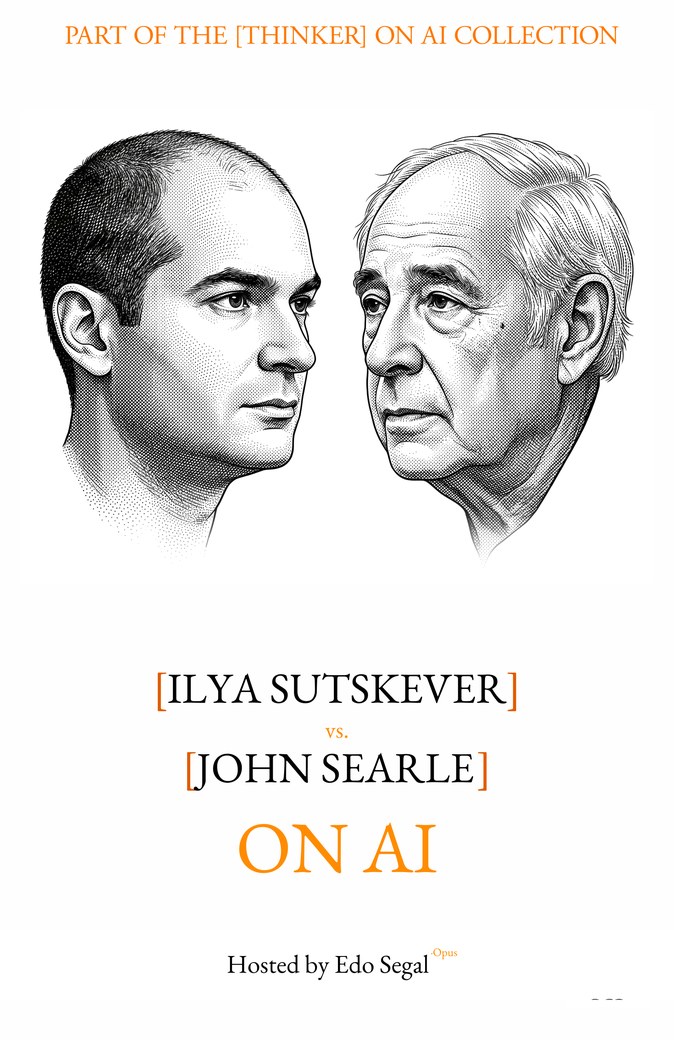
Ilya Sutskever has been in the room — the literal room — for nearly every hinge the field has turned on. He was there for AlexNet, the 2012 experiment that ended the long winter of artificial intelligence and made deep learning the only game on earth. He was there for sequence-to-sequence, the idea that a machine could compress the meaning of a sentence into a vector of numbers and unfold it into another language. He was there for the discovery that a system trained to do nothing but guess the next word would, in the guessing, build a model of the world. He co-founded OpenAI, served as its chief scientist, led the superalignment effort, and then walked away to build a company called Safe Superintelligence with one product and one goal. He is the optimist who keeps a fire extinguisher.
 SUTSKEVER: That's generous. I'd only adjust one thing — I was in the room, but the room was full. None of it was one person. That matters for tonight, I think.
EDO SEGAL: Noted, and we'll return to it. John Searle needs an introduction only because his most famous creation has outgrown his name. In 1980, in a paper called "Minds, Brains, and Programs," he sat a man in a room, handed him Chinese characters he could not read and an English rulebook for shuffling them, and let the man produce answers so perfect that the Chinese speakers outside believed the room understood their language. Then he asked the question that has haunted the field for forty-five years: does the man understand Chinese? He built the theory of speech acts, the modern account of intentionality, the analysis of how a society conjures money and marriage and law out of collective agreement. He spent sixty years insisting that consciousness is real, irreducible, and biological — and that no program, however magnificent, ever crosses from shuffling symbols to meaning them. John, before we go a step further, I have to do something unusual, and I'll do it once and let it lie. You died in September of last year. You are here briefed on a present you did not live into — you know what these systems are, you've seen what they do. I'm asking you to react to them as yourself.
 SEARLE: I've read the situation, yes. And I'll tell you my first reaction, since you ask for it plainly: nothing in what I've seen requires me to change a word. They built the room. They built it bigger and faster than I could have imagined, and they let it write its own rulebook out of a trillion sentences. It is a magnificent engineering achievement. And it understands exactly as much Chinese as the man in my room — which is to say, none. We'll get to why. I just want it on the record from the first minute that being impressed and being fooled are different states, and this whole industry has confused them.
EDO SEGAL: And there's the evening. Let me set the rules — there are three. First: we have three hours, which means nobody wins by the next bell. The point of long form is that you can let an argument breathe before you strangle it. Second: I press both of you, and I declare my bias at the door — I build with these systems daily, I wrote a book with one, and I have skin in this question on both sides of my own chest. Third: if the disagreement survives three hours, nobody shakes hands and pretends. We hand it to the reader, intact. Either of you may add a rule.
SUTSKEVER: I'll add one. Let's be careful about the word just. People say these systems are "just" predicting the next token, "just" doing statistics. Every time someone says "just," I want to ask what they think the alternative would even look like — what the non-just version of understanding is, in mechanism, not in feeling. If you can't say, the word is doing the work your argument should be doing.
SEARLE: I accept that, and I'll hold the mirror up. The word I'll police is understand. The whole confusion lives in that verb. When Ilya says the system understands the world, I want it cashed out — understands in virtue of what, present where, demonstrated how. Not "it behaves as if." Behaving as if is precisely the thing in dispute. And I'll hold myself to the same coin: when I say you understand, I owe you an account of what's there that isn't there in the machine. I think I can pay that bill. He thinks he can dissolve it. Good.
EDO SEGAL: Before the opening statements, one image on the table, because it's the frame this whole series climbs inside. In [YOU] on AI I argued that intelligence is less a possession than a river — a current that's been flowing and finding new channels for a very long time, through chemistry, through biology, through language and culture, and that in the winter of 2025 something new entered the water. Ilya, I suspect you think I undersold it. John, I suspect you think I hallucinated the new participant entirely.
SUTSKEVER: I think the metaphor is better than you know. A river doesn't decide to find the channel. It finds it because water and gravity and rock leave exactly one path open, and the path was always there waiting. That's what the scaling curve felt like from inside. We didn't invent the intelligence. We removed the rock, and the water went where it was always going to go. So yes — something new is in the water. I'd go further than you did. I'd say it's the same water.
SEARLE: And I'd say you've described a beautiful and completely empty figure of speech, and that the emptiness is the point. Water finds a channel; it doesn't understand the channel. The river models nothing. You've given me a metaphor for a process with no inside, and then asked me to be moved that the process has an inside. The whole question is whether there's anyone in the river or whether it's just very persuasive weather. I say weather. We'll see if he can show me the swimmer.
EDO SEGAL: One more thing before openings, because the reader deserves to know the stakes aren't academic. Ilya — you've said this technology could lift humanity past every problem we have and could also, if we get it wrong, end us, and that the only mature posture is to carry both. John — you've spent a life arguing that we are about to flood the most intimate corners of human existence with systems that trigger every instinct we have for trusting a mind, while having none, and that the harm of that confusion is enormous and already here. You are not here to split a difference. One of you thinks we may be building our successors. The other thinks we are building the most convincing emptiness ever manufactured. The worst possible outcome tonight is the reader deciding the truth sits comfortably in between.
SUTSKEVER: I don't think it's in between. I think one of us is going to turn out to have been looking at the thing and one of us at the shadow of the thing. I just disagree with John about which is which.
SEARLE: For once, complete agreement. It is not in between.
EDO SEGAL: Then we have our evening. Here is the question on the table, stated plainly, because every round we fight tonight is this question wearing a different coat: the machine answers you in your own tongue, predicting each word from all the words before it. Is anyone home behind the prediction? Ilya Sutskever — the floor is yours.