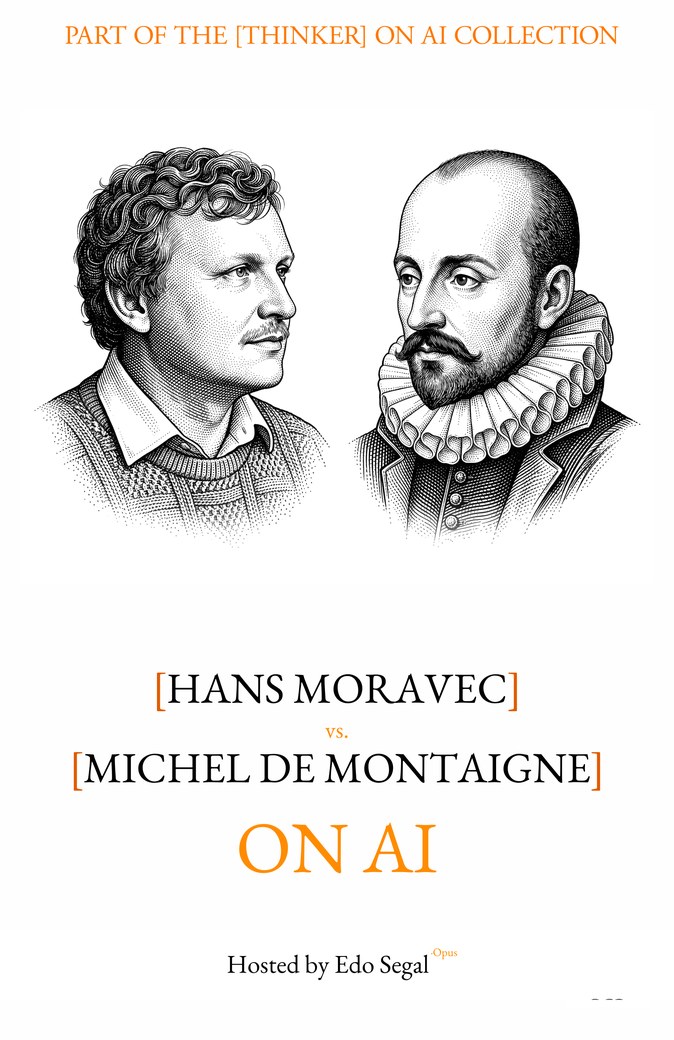
The Question on the Table

 EDO SEGAL: Somewhere in the world tonight a man my age is sitting in a hospital corridor under the bad light, holding the hand of a parent who is going out the way we all go out — by degrees, then all at once. He is doing the arithmetic we all do in those corridors, the arithmetic nobody admits to: how much of this person is already gone, and where does the gone part go. And for the first time in the history of our species, a voice in the culture is whispering to that man that the arithmetic might be optional. That what is leaving the body in that bed is not a soul departing but a file failing to back up. That if we had only scanned in time, the leaving would not have been a death at all but a transfer, a migration, an upgrade.
I have one guest tonight who believes that whisper is true, and one who believes it is the most dangerous lie a frightened animal ever told itself. So here is the question we are going to spend three hours inside, and I want it on the table before either of you says another word, plainly, because every round tonight is this one question wearing a different coat. If a machine could copy everything you are off your dying brain — every memory, every habit, every turn of phrase, the exact way you love the people you love — would the thing that woke up be you? Or just a stranger wearing your memories, while the only self you ever had rots in the ground?
I can think of no two people, living or four centuries dead, with more right to fight over that question. Hans Moravec is a roboticist, which people forget when they argue with him, and it is the most important fact about him. He spent his youth at Stanford pushing a camera-equipped cart across a cluttered room one painful meter at a time, watching a machine fail for five hours to do what a toddler does without thought. Out of that failure came Moravec's paradox — that the reasoning we revere is cheap for machines and the seeing and walking we ignore is nearly impossible — and out of the paradox came a vision in two books, Mind Children and Robot, that follows the logic of this field past the point where everyone else looks away. He calls the coming machines our children. He calls the body a husk. And he believes, with the calm of a man reading a weather report, that you are a pattern that can be lifted off your meat and carried somewhere it will never die.
 MORAVEC: I'd accept "calm." I've found it makes people more nervous than shouting would.
EDO SEGAL: Michel de Montaigne needs a stranger introduction, because he has been dead since 1592 and is, by some distance, the most alive writer I have ever read. A magistrate who quit public life at thirty-eight, climbed the stone stairs of a tower in the Dordogne, and spent twenty years writing the most honest self-portrait in the Western tradition — the Essais, the book that invented the essay as an instrument of not-knowing. His medal bore a question, Que sais-je? — what do I know? — and a pair of scales held in perfect balance. He wrote about his own kidney stones with the seriousness other men reserved for God. And the spine of everything he believed is a sentence borrowed from Cicero and made entirely his own: that to philosophize is to learn to die. Michel, I have to acknowledge something with the audience before we start, lightly, and then we'll never belabor it again. You died before the steam engine. You've been briefed on all of it — the transistor, the neural network, what Hans proposes to do with one. You know where you are.
 MONTAIGNE: I know where I am, and I'll tell you the truth, since this whole evening is about telling it: being dead is the least of my disadvantages here. I spent a life learning to do it. What unsettles me is being asked to un-learn it by a kind man with a machine. But yes — I have read your friend. I understand the proposal. He wishes to spare me the one experience I worked hardest to understand. I'm touched, and I refuse, and we have three hours to find out which of us the refusal makes a fool.
EDO SEGAL: That's the evening. So let me set the rules, and there are only three. First: we have three hours, which means nobody wins by the next bell — the whole point of long form is that you let an argument breathe before you strangle it. Second: I declare my bias at the door. I build with these systems every day, I wrote a book with one, and I am a father who lies awake doing the corridor arithmetic, which means I want Hans to be right with a hunger I don't fully trust. Third: at the end, nobody shakes hands and pretends. If the disagreement survives three hours, we hand it, intact, to the reader — to a person sitting alone somewhere who is going to have to decide this for their own dying parent, or their own dying self. Each of you — add a rule of your own.
MORAVEC: One rule. When Michel says "the self," I want him to say what it's made of. Not what it feels like from inside — what it's made of. Because if he can't point at the stuff, then his claim that the stuff can't be copied is a claim about a ghost, and I don't argue with ghosts. I build.
MONTAIGNE: A fair rule, and here is mine in answer to it. When Hans says "you," in the sentence "you would wake up in the machine" — I want him to tell me who is doing the waking, and how he knows, and what it would cost him to be wrong. Because the whole of his beautiful argument hangs on a pronoun, and I have spent twenty years discovering that the pronoun I is the least examined word in any language. He should have to pay the import duty on it, same as me.
EDO SEGAL: Good — both of you have just named the seam. Hans wants the self cashed out as matter so he can copy it. Michel wants the you in "you wake up" cashed out before he'll let Hans spend it. Before opening statements I want to put one image on the table, because it's the frame this whole series climbs inside and neither of you gets to dodge it. In [YOU] on AI I argued that intelligence is less a possession than a river — a current that has flowed and found new channels for a very long time, through chemistry, through biology, through language, and that something new entered the water in our winter. Hans, I suspect you think my river metaphor is more literally true than I meant it. Michel, I suspect you think I drowned the swimmer to praise the river.
MORAVEC: Your river is exactly right and you flinched from your own idea. A river doesn't keep the water molecules; it keeps the flow. The flow is the pattern. When the channel of flesh silts up — and every channel of flesh silts up, that's what dying is — the current doesn't mourn the old channel. It finds a new one. I'm not proposing anything against nature, Edo. I'm proposing we stop being the one kind of intelligence that insists on going down with its riverbed.
MONTAIGNE: And there is the whole quarrel in one breath, before we've even begun. He says the current doesn't mourn the channel. But Edo — we are the channel. There is no current standing apart from the bank, sad about the bank's erosion; there is only this particular water in this particular bed, and when the bed is gone the water is just water, somewhere else, knowing nothing of us. He's asked me to identify with the river. I decline. I am a man, which is to say I am a riverbed, and I have spent my life learning to love the shape the water made of me precisely because I knew the water would not keep it.
EDO SEGAL: Then we have our evening, and we have it sharper than I dared hope. One last thing before openings, so the reader knows the stakes are not academic. Hans — you have written that you would welcome humanity being swept away by its own artificial progeny, that you'd call it the best thing that could happen, provided the progeny carry us forward. Michel — you wrote that the value of a life is set by its end, that "the utility of living consists not in the length of days but in the use of time," and that a man who has not learned to die has not learned to live. One of you wants to abolish the deadline. The other says the deadline is the assignment. The worst possible outcome of tonight is a reader walking away thinking the truth is comfortably in the middle. There is no middle here. Hans Moravec — the floor is yours.