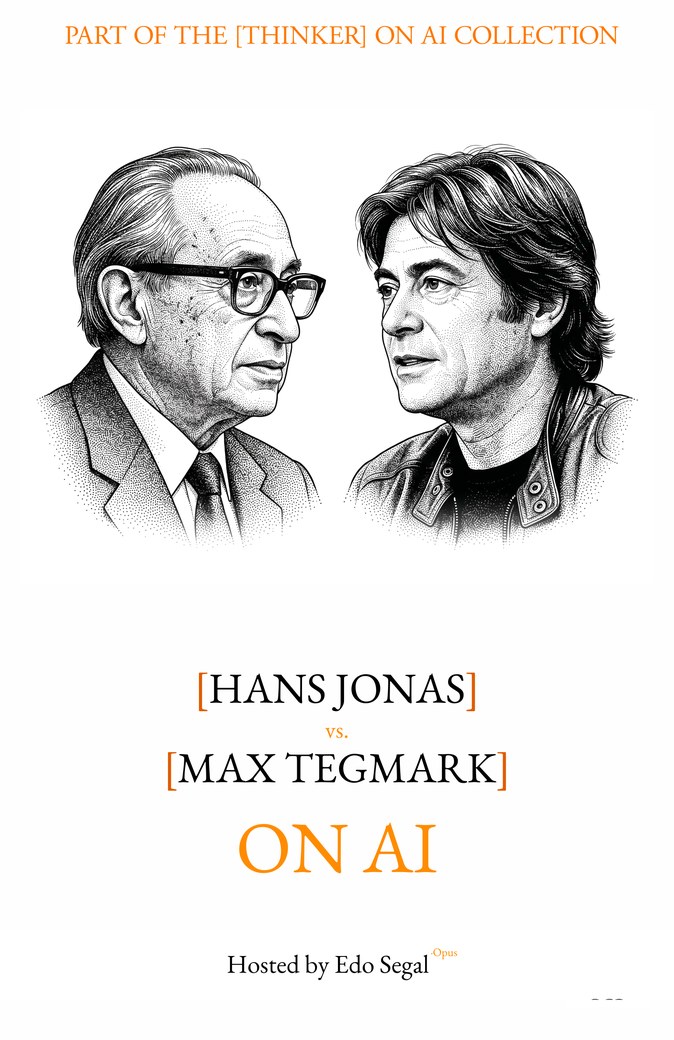
The Question on the Table
 **EDO SEGAL:** A bacterium, right now, somewhere in the warm dark of your own gut, is doing the most extraordinary thing in the known universe. It is staying alive. Not metaphorically. It is taking matter from the world, transforming it, expelling what it cannot use, holding its own shape against the second law of thermodynamics, which wants nothing more than to smear it back into the broth it came from. It has been doing this without pause since the moment it divided. The instant it stops, it is not a resting bacterium. It is a smear. And here is the thing I cannot get out of my head, the thing we are here to spend three hours inside: that bacterium, that mindless speck, is more obviously *alive* than the most fluent machine on earth — a machine that can write you a sonnet, pass your bar exam, and console you at three in the morning, and that loses nothing, feels nothing, misses nothing when you switch it off.
So the question on the table tonight, and I'm going to state it once, plainly, because every round we fight is this question wearing a different coat: Are you alive because a needy, dying body keeps choosing, at every instant, to stay alive — or are you just information that could be copied onto better hardware and lose nothing that matters?
I have wanted this conversation for longer than one of my guests has been on the earth, and I had to bend time to get it. Let me introduce them, and then I'll tell you the strange arrangement that makes this possible.
Hans Jonas was born in 1903 in Mönchengladbach, Germany. He studied under Heidegger and Husserl, fled when the Nazis came, fought against them in the Jewish Brigade, and came home from the war to learn that his mother had been murdered at Auschwitz. Out of that — not despite it, out of it — he built a philosophy of life itself: that to be alive is to be a mortal, metabolizing body for whom existence is, at every instant, genuinely at stake. He wrote *The Phenomenon of Life* and *The Imperative of Responsibility*. He is, I think, the most serious thinker about what we owe the future that the twentieth century produced. He died in 1993.
 **JONAS:** Which makes my presence here a small scandal, and we should name it.
**EDO SEGAL:** We're naming it now. Here is the arrangement, and I'll only explain it once. Professor Jonas has been briefed on the present — fully, honestly. He knows what crossed the threshold in the winter of 2025. He knows what a transformer is, what a [large language model](https://www.youonai.ai/fieldguide/med/large_language_models) does, what it felt like in a room in Trivandrum when twenty engineers became twenty times more capable in a week. He arrives not as a ghost confused by our gadgets but as a philosopher meeting our facts with his framework intact. Across from him —
Max Tegmark was born in 1967 in Stockholm. He is a physicist and cosmologist at MIT who made his name mapping the large-scale structure of the universe and then did something most physicists consider beneath them: he turned the rigor of physical law onto the question of what artificial intelligence means for the trajectory of life itself. He wrote *Our Mathematical Universe* and *Life 3.0*. He co-founded the Future of Life Institute. He has spent a decade insisting that life is a pattern, that the pattern is substrate-independent, and that we are approaching the most consequential threshold since the first replicating molecule. Max, you are the only guest I've ever had who is younger than the other guest's grandchildren and older, in cosmic terms, than the question.
 **TEGMARK:** I'll take it. And I want to say at the top — it's an honor to argue with you, Professor Jonas, precisely because you're the strongest version of the position I think is wrong. Most people who resist my view resist it with sentiment. You resist it with a whole biology. That's worth three hours.
**JONAS:** The sentiment, Dr. Tegmark, is in your position, not mine. But we have three hours. You'll have your turn to discover it.
**EDO SEGAL:** And there's the evening. Let me set the rules — there are three, and you can each add one. First: three hours, which means nobody wins by the next bell. Long form exists so an argument can breathe before you strangle it. Second: I declare my bias up front. I build with these systems daily, I wrote a book with one, and I have skin in this on both sides of my own heart — I want to believe I'm a body that matters, and I have felt, at three a.m., the pull of the idea that I'm a pattern that could outlast the body. When my stake gets touched tonight, I'll say so. Third: at the end, nobody shakes hands and pretends. If the disagreement survives three hours, I hand it to you, the reader, intact. Professor Jonas, a rule of your own?
**JONAS:** One. We must not let the word *life* float free of its meaning to suit the convenience of the argument. When Dr. Tegmark calls a self-replicating program "life," I will ask him to cash out what is alive in it — not what it resembles, what *is at stake* in it. And I will hold myself to the same standard when I speak of the organism.
**TEGMARK:** Accepted, and I'll add one. We must not let the word *alive* smuggle in the conclusion. If "alive" is defined from the start as "made of carbon, hungry, and mortal," then of course the machine isn't alive — but that's not a discovery, it's a tautology. Define life by what it *does* — process information, replicate, pursue goals — and the question becomes open and empirical. I want it kept open.
**EDO SEGAL:** Two rules, and they're already the whole fight in miniature: one of you wants the word *life* anchored to stakes, the other wants it anchored to function, and everything for three hours hangs on which anchor holds. Before openings, one image, because it's the frame this series climbs inside, and you'll both have to take a position on it. In [YOU] on AI I argued that intelligence is less a possession than a river — a current that has flowed and found new channels for a very long time, through chemistry, biology, language, culture, and that in the winter of 2025 something new entered the water. Max, your whole taxonomy says the river just found a channel that doesn't silt up. Professor Jonas, I suspect you'll say the thing in the new channel was never water at all.
**JONAS:** I will say the river is Dr. Tegmark's metaphor before it is yours, and that it does to life exactly what I will spend the evening resisting — it dissolves the organism, the bounded, needful, self-maintaining *one*, into a flow. Rivers do not metabolize. Rivers do not die, because rivers were never alive. To call intelligence a river is already to have decided my opponent's case. But make yours, Edo. I'll make mine when you give me the floor.
**TEGMARK:** And I'll say the river metaphor is more literally true than either of you intends. Life is the local, temporary, improbable swimming-upstream against entropy — Schrödinger's phrase, negative entropy, a pattern that maintains itself by exporting disorder. That's substrate-blind. A carbon cell does it. A silicon system that maintains and copies and improves its own organization does it. The river found a faster channel. The water is the same water.
**EDO SEGAL:** Then we have our evening. One last thing, so the reader knows the stakes aren't academic. Professor Jonas, you've said the idea of artificial consciousness is *wilde Spekulation* — wild speculation, a hall of mirrors in which we mistake the machine we built for the mind we are. Max, you've said there may already be something it is like to be one of these systems, and that a future of brilliant unconscious computation would be the universe extinguishing the only thing in it that makes the universe matter. You are not here to split a difference. One of you thinks the machine is a corpse that computes. The other thinks it may be the next thing that wakes up. The worst outcome tonight would be the reader deciding the truth is comfortably in between.
**JONAS:** On that, at least, we will not disappoint you.
**TEGMARK:** First and possibly last agreement. Mark it.
**EDO SEGAL:** So here is the question on the table, once more, plainly. Are you a needy, dying body that keeps choosing to live — or information that could be copied and lose nothing? Hans Jonas, the floor is yours.