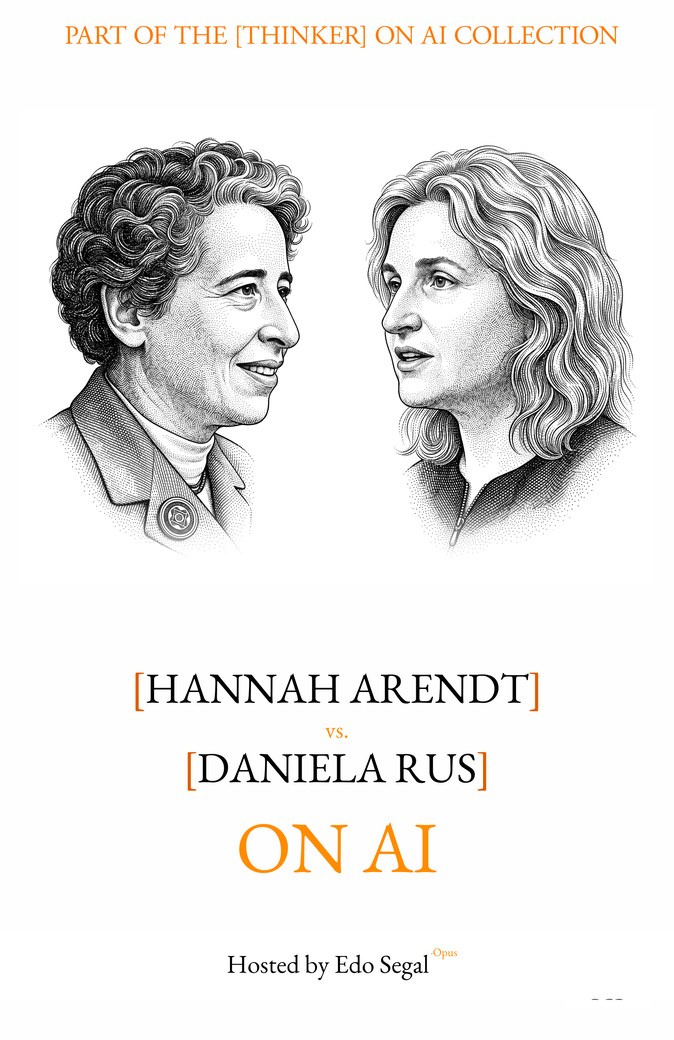
The Question on the Table

 EDO SEGAL: Somewhere in the world, in the time it takes me to say this sentence, a car with no one's hands on the wheel is deciding. A pedestrian steps off a curb in the rain; a sensor resolves the shape; a system that has never been afraid in its life computes, in eleven milliseconds, who lives. It will most likely choose correctly — more reliably than I would, more reliably than the tired man in the next lane who has been awake for nineteen hours. And in that eleven milliseconds, something has happened that no century before ours had a word for: an action has occurred in the world, with consequences a human being will carry forever, and at the moment of the deed, no human being was thinking at all.
A million of those moments a day, and climbing. The deed without the doer. And the question nobody in the car stops to ask, because the smoothness of the ride makes it feel already answered, is the one we are here to spend three hours inside: when the machine acts in the world but no one is left thinking, who is responsible for what it does — and can you climb any higher if you've handed off that answer?
I have two guests with more right to this question than anyone alive or, in one case, recently briefed back into the conversation.
Hannah Arendt is, to my mind, the indispensable witness of the twentieth century — a political theorist who fled Germany in 1933, survived statelessness, and then turned the full force of a philosophical training under Heidegger and Jaspers onto the question of how the catastrophes had been possible. She gave us The Human Condition, which split human activity into labor, work, and action, and she gave us the phrase that will outlive us all, the banality of evil — the discovery, in a Jerusalem courtroom, that monstrous wrong can be administered by a man who is simply, terrifyingly, not thinking about what he does. She has been briefed on the present, which I should say out loud.
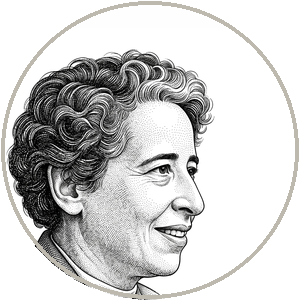 ARENDT: I have. And I want to register, before we begin, my astonishment — not at the machines, which are only the latest form of a very old temptation, but at how exactly they fit the shape of what I spent my life warning against. I died believing the thoughtless process was a danger we might still choose to refuse. You have gone and built it a body and put it on the road. So. I am listening, but I am not reassured.
EDO SEGAL: Daniela Rus needs less reintroduction but deserves the gravity. She directs CSAIL at MIT, the largest computer science laboratory in the world. She is the great theorist of physical intelligence — intelligence that has to pick something up, swim a reef, fold a sheet, decide whether the shadow ahead is a puddle or a hole. She built SoFi, the soft robotic fish; she built a neural network of nineteen neurons that can steer a car; she invented, with her collaborators, the liquid network, small enough to live inside the body of the machine. And she wrote The Heart and the Chip, whose argument is that robots are tools — neither savior nor threat — and that the chip provides the means while the heart provides the why.
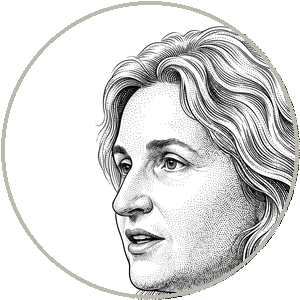 RUS: That's a generous introduction, and I'll just add one correction to the framing, because it matters for the next three hours. Hannah said I gave the thoughtless process a body. I'd say almost the opposite. The hard part of what I do — the part that has humbled me for thirty years — is that the physical world will not tolerate thoughtlessness. A language model can be glib and survive. A robot that is glib falls down the stairs. Everything I've built has been an argument that acting well in the world requires more thought, not less. We may disagree about where the thought lives. We will not disagree that it has to be there.
EDO SEGAL: And there is the evening in a sentence — you both insist the thinking has to be there, and you are about to spend three hours discovering you mean radically different things by there. So let me set the rules, and there are only three. First: we have three hours, which means nobody wins by the next bell. The whole point of long form is that you can let an argument breathe before you strangle it. Second: I will press both of you, and I declare my bias at the door — I build with these systems daily, I wrote a book with one, and I have sat in the board meeting where the arithmetic said if the machine can decide, why pay the person who decides. I kept the person. I know the structure punishes that. Third: at the end, nobody shakes hands and pretends. If the disagreement survives three hours, we hand it, intact, to the reader. Either of you may add a rule.
RUS: One rule. When either of us says the word "autonomy," the other gets to ask: autonomy to do what, audited by whom, failing how. I've watched that word do an enormous amount of unpaid work in policy rooms. I'd like it to earn its keep tonight.
ARENDT: I will accept that rule and offer its twin. When either of us says "responsibility," the other may ask: responsibility located in whom — a person who can be praised or blamed, who made a promise and can be held to it, or a fog of components in which everyone can truthfully say they were only doing their part. I spent a trial in Jerusalem watching a man dissolve his responsibility into a system. I will not let the word be used loosely at this table.
EDO SEGAL: Two rules, and already the seam is glowing. Before opening statements, one image, because it's the frame this whole series climbs inside and you'll both have to take a position on it. In [YOU] on AI I argued that intelligence is less a possession than a river — a current that has flowed through chemistry, biology, language, culture, finding new channels — and that the climb out of this moment is a tower with a staircase and no elevator: ascending friction, no shortcut to the roof. Daniela, your robots are a new thing in that river: intelligence that has climbed down out of the symbolic and into the water itself. Hannah, I suspect your worry is that what's climbing into the water is precisely the thing that cannot judge.
ARENDT: My worry is more specific than that, and I'll make it properly when you give me the floor. But yes — a river is exactly the wrong consolation, Edo, because a river is a process, and a process is what I am afraid of. The whole of human freedom, as I understand it, is the capacity to interrupt a process — to begin something that the current did not predict. You have built a machine that is nothing but current.
RUS: And I'd say the river is the right metaphor for the wrong reason. What's entering the water isn't a flood of thoughtlessness. It's a flood of capability — the ability to act competently in the physical world, which used to be scarce and is becoming abundant. The question is never whether the current is rising. It's what we choose to build in it, and for whom. The dam, Edo, not the drowning.
EDO SEGAL: Then we have our three hours. Here is the question on the table, stated once, plainly, because every round tonight is this question wearing a different coat. The machine acts in the world, and at the moment of action no one is thinking. Who is responsible — and can you climb any higher if you've handed off the answer? Hannah Arendt, the floor is yours.